Introduction
The technology industry is evolving rapidly, and businesses increasingly need professionals who can contribute across multiple areas of software and website development. In this environment, full-stack development skills can provide aspiring developers with a valuable competitive edge.
A full-stack developer understands both the front end, which users interact with, and the back end, which powers applications behind the scenes. This broader understanding enables developers to work on complete digital products rather than focusing on only one layer of development.
For students, fresh graduates, and professionals looking to build a career in technology, learning full-stack development can open the door to diverse opportunities and help them become more versatile, job-ready professionals.
What Is Full-Stack Development?
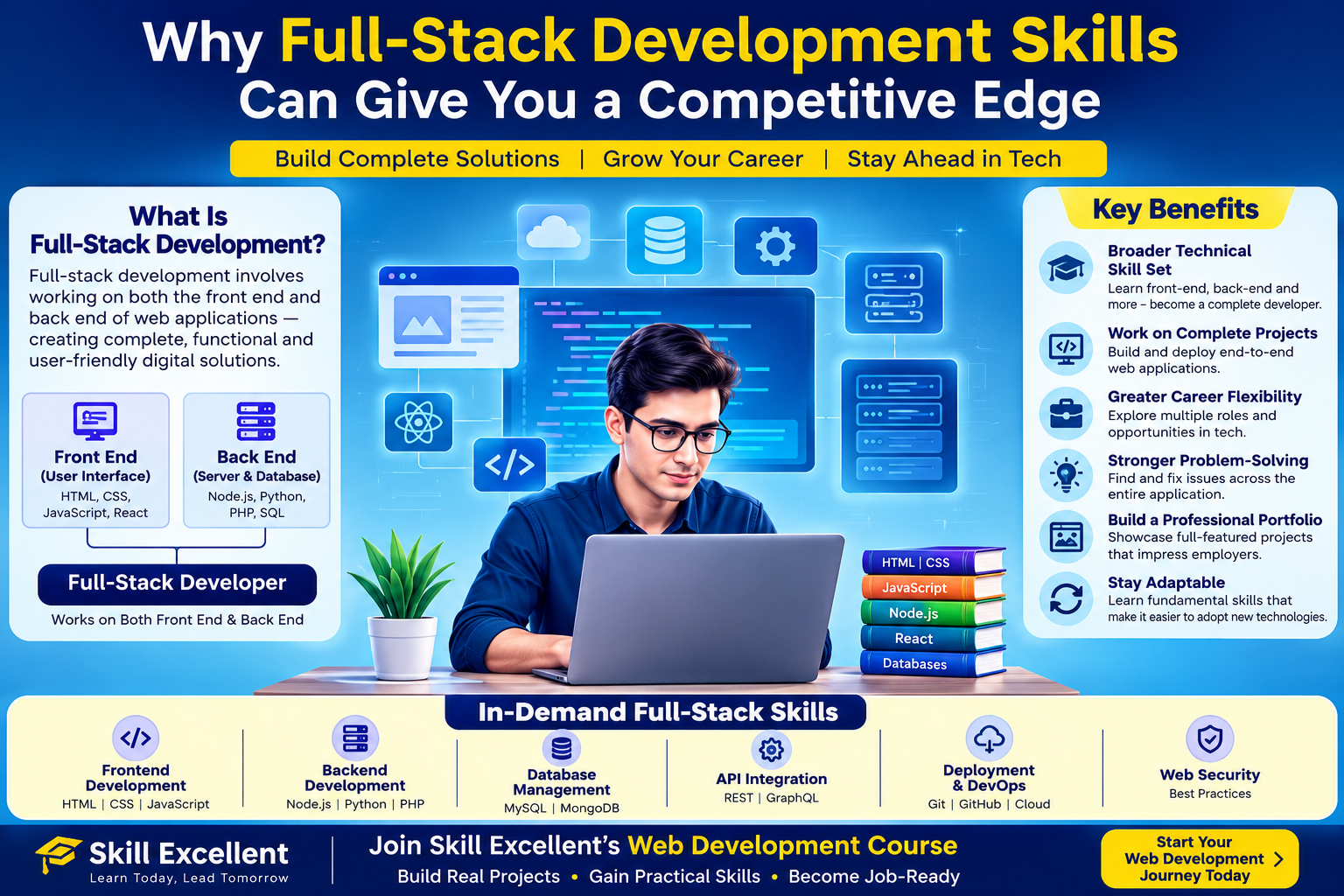
Full-stack development involves working across the different layers required to build a modern website or web application.
The front end includes technologies such as HTML, CSS, JavaScript, and modern frameworks that determine how an application looks and behaves. The back end handles application logic, servers, databases, APIs, authentication, and other functions that operate behind the interface. A full-stack developer connects these components to create functional, scalable, and user-friendly digital experiences.
Instead of understanding only one part of the development process, full-stack professionals develop a broader perspective of how different technologies work together.
1. Develop a Broader Technical Skill Set
One of the biggest advantages of full-stack development is the opportunity to build a diverse technical skill set.
A well-rounded learning path can introduce students to:
1.HTML and CSS
2.JavaScript
3.Front-end frameworks
4.Back-end programming
5.Databases
6.APIs
7.Version control
8.Server-side technologies
9.Deployment concepts
10.Web security fundamentals
This combination allows developers to understand the complete development lifecycle and communicate more effectively with different technical teams.
2. Work on Complete Projects
Full-stack skills allow developers to participate in projects from concept to deployment.
For example, when building an e-commerce website, a developer may need to create the product interface, develop user authentication, connect databases, integrate payment-related APIs, and manage server-side functionality.
Understanding these different components makes it easier to see how individual features contribute to the overall product.
For learners, working on complete projects can also provide practical experience that goes beyond theoretical coding exercises.
3. Increase Career Flexibility
The technology sector includes a wide range of development roles. Developers may specialize in front-end development, back-end development, mobile applications, cloud technologies, or other areas.
Full-stack knowledge provides a strong foundation for exploring these career paths.
A developer who understands multiple layers of application development can potentially pursue roles such as Full-Stack Developer, Web Developer, Software Developer, Front-End Developer, or Back-End Developer, depending on their additional skills and experience.
This flexibility can be particularly useful for beginners who are still discovering which area of technology interests them most.
4. Improve Problem-Solving Abilities
Web applications are interconnected systems. A problem that appears on the front end may sometimes originate from a database, API, server, or back-end process.
Full-stack knowledge helps developers investigate problems from multiple perspectives.
For instance, if information is not appearing correctly on a webpage, a developer with both front-end and back-end knowledge can examine the user interface, API request, server logic, and database connection.
This broader technical perspective can support faster troubleshooting and more effective problem-solving.
5. Understand the Bigger Picture
Specialization is valuable, but understanding how different technologies connect can provide an additional advantage.
Full-stack development teaches learners to think beyond individual programming languages or frameworks. They begin to understand how user requirements are transformed into interfaces, how information moves through applications, how databases store data, and how different systems communicate.
This bigger-picture perspective can help developers make more informed technical decisions.
6. Build Stronger Portfolio Projects
A strong portfolio can make a difference when applying for entry-level technology positions. Full-stack skills allow learners to create more comprehensive projects rather than simple static webpages.
Examples include:
1.E-commerce platforms
2.Job portals
3.Learning management systems
4.Appointment booking applications
5.Business dashboards
6.Content management systems
7.Social networking applications
Such projects can demonstrate multiple skills simultaneously and give candidates meaningful examples to discuss during interviews.
7. Collaborate More Effectively With Teams
Modern software development is rarely an individual activity. Developers often work alongside designers, project managers, testers, database specialists, and other engineers.
A full-stack developer's understanding of different development layers can make technical communication easier.
For example, understanding both front-end requirements and back-end limitations can help developers discuss project feasibility and dependencies more effectively with team members. This ability to collaborate across technical areas can become an important professional advantage.
8. Stay Adaptable as Technology Changes
Technology changes constantly. New frameworks, development tools, libraries, and platforms continue to emerge.
Rather than focusing entirely on one tool, full-stack learning encourages developers to understand fundamental concepts such as programming logic, APIs, databases, application architecture, and responsive design.
Strong fundamentals make it easier to learn new technologies when industry requirements evolve.
The goal is not to master every technology available. Instead, developers should build a solid foundation and continuously expand their skills according to career goals and market requirements.
9. Combine Technical Skills With Practical Experience
Learning full-stack development becomes more valuable when technical concepts are combined with practical application.
Students should ideally work on real-world projects, practice writing clean and maintainable code, use version-control platforms, troubleshoot errors, and understand how applications are deployed.
Practical learning can transform theoretical knowledge into usable development skills. Training programs that emphasize hands-on projects, structured learning, and industry-relevant technologies can help learners move closer to becoming job-ready developers.
Conclusion
Full-stack development is more than learning multiple programming languages. It is about understanding how different parts of a digital product work together.
By developing front-end, back-end, database, API, and problem-solving skills, aspiring developers can become more versatile and adaptable. These capabilities can help them build stronger portfolios, explore diverse career opportunities, collaborate effectively, and respond to changing technology requirements.
For students and professionals planning a career in technology, developing full-stack expertise can be a strategic step toward becoming a more capable, flexible, and industry-ready developer. With consistent practice, real-world projects, and continuous learning, full-stack development skills can provide a strong foundation for long-term growth in the digital world.