Introduction
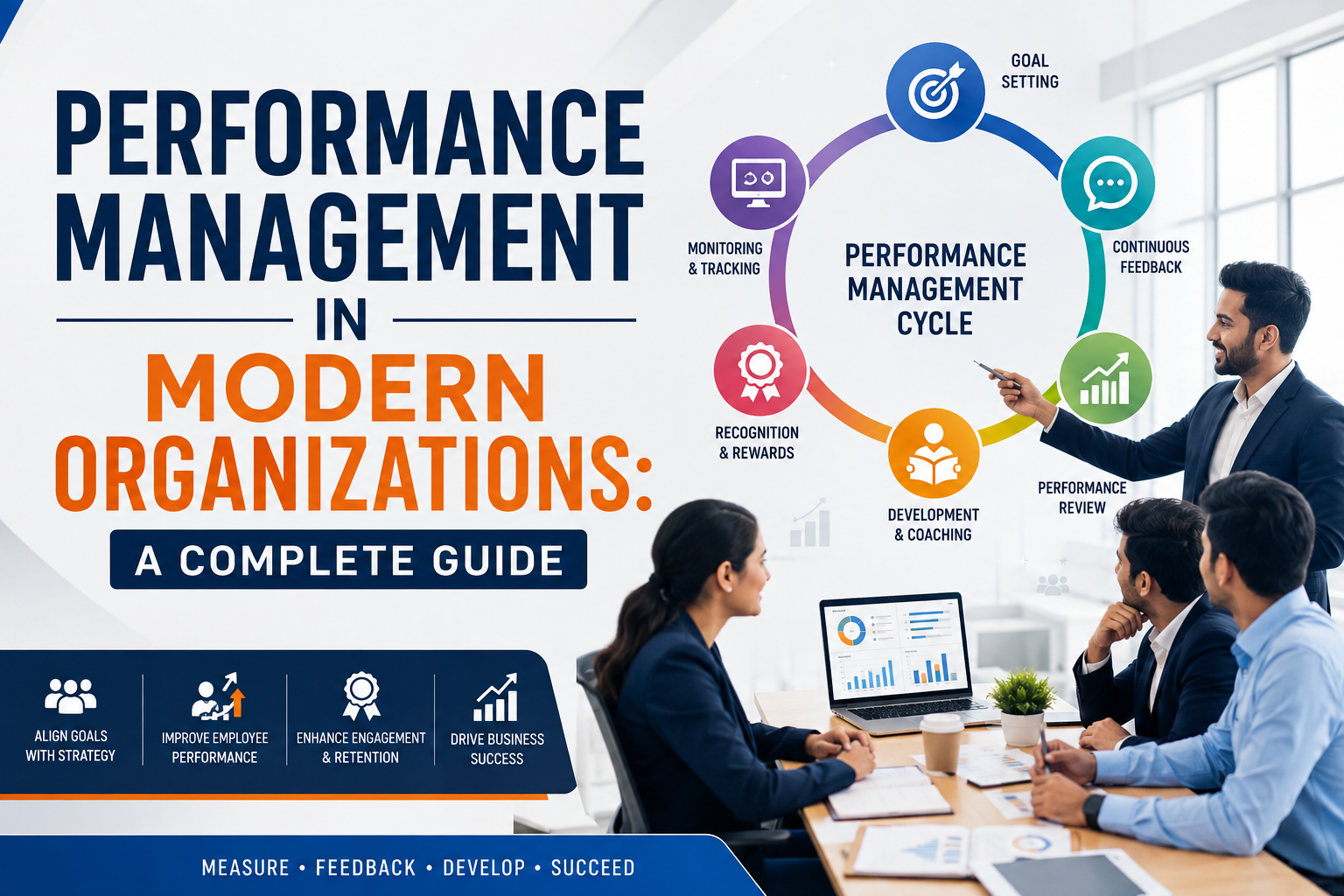
In today’s competitive business environment, organizations can no longer depend only on annual performance reviews to evaluate employees. Businesses are becoming more dynamic, workplaces are increasingly technology-driven, and employees expect continuous communication, meaningful feedback, professional growth, and recognition. This has made performance management in modern organizations an essential part of effective human resource management.
Performance management is not simply about measuring whether an employee has achieved a target. It is a continuous process that connects individual performance with organizational objectives. It helps employees understand what is expected from them, identifies areas for improvement, encourages professional development, and enables organizations to build a productive and engaged workforce.
For HR professionals, managers, and business leaders, understanding modern performance management is particularly important. Organizations that develop a structured and employee-focused performance management system can improve productivity, strengthen employee engagement, identify talent, and achieve their strategic goals more effectively.
This complete guide explains the meaning of performance management, its importance, process, benefits, challenges, modern strategies, technology, and best practices.
What Is Performance Management?
Performance management is a continuous process through which an organization plans, monitors, evaluates, and improves employee performance to achieve business objectives.
It involves setting clear expectations, establishing measurable goals, providing regular feedback, reviewing performance, identifying development needs, recognizing achievements, and supporting employees in improving their capabilities.
Unlike traditional performance appraisal, which often focuses on an employee’s performance at the end of a year, modern performance management emphasizes continuous performance conversations and development.
A modern performance management system typically includes:
- Goal setting
- Performance planning
- Regular feedback
- Performance monitoring
- Coaching and mentoring
- Performance reviews
- Employee development
- Recognition and rewards
- Performance improvement plans
- Career development
The ultimate objective is to create a situation where employees succeed while the organization achieves its strategic goals.
Why Is Performance Management Important in Modern Organizations?
The workplace has changed significantly. Employees today may work from offices, homes, or hybrid environments. Teams can be distributed across different cities and countries. Technology is also changing job responsibilities and required skills.
Because of these changes, organizations need a performance management approach that is flexible, transparent, measurable, and continuous.
1. Aligns Employees With Organizational Goals
One of the most important purposes of performance management is connecting individual responsibilities with organizational objectives.
For example, if a company wants to improve customer satisfaction, customer service employees may receive goals related to response time, customer feedback, and issue resolution.
When employees understand how their work contributes to larger business objectives, they are more likely to work with purpose and direction.
2. Improves Employee Productivity
Clear goals help employees understand what they need to accomplish.
A well-designed performance management system can help managers identify:
- Productivity gaps
- Skill deficiencies
- Process problems
- Resource requirements
- Training needs
- Performance barriers
When these issues are addressed, employees can perform more efficiently.
3. Encourages Continuous Feedback
Traditional annual reviews can make performance discussions stressful because employees may receive feedback about issues that occurred many months earlier.
Modern performance management encourages regular conversations between managers and employees.
Frequent feedback allows employees to:
- Understand their strengths
- Correct mistakes quickly
- Ask questions
- Improve performance
- Receive recognition
- Discuss career goals
4. Supports Employee Development
Employees increasingly value learning and career growth. Performance management helps organizations identify the skills employees need to develop.
For example, an HR employee may need training in:
- HR analytics
- Recruitment technology
- Payroll systems
- Employment regulations
- Data interpretation
- Communication
- Leadership
Performance discussions can therefore become a foundation for creating personalized development plans.
5. Improves Employee Engagement
Employees are more likely to remain engaged when they understand expectations and feel that their contributions are recognized.
Performance management provides opportunities for managers to appreciate good work, discuss challenges, and support employee growth.
6. Helps Identify High-Potential Employees
Organizations need to identify employees who can take on greater responsibilities.
Performance data, manager feedback, leadership assessments, and employee development progress can help organizations identify high-potential talent.
These employees can then be considered for:
- Leadership programs
- Promotions
- Special projects
- Mentoring opportunities
- Management responsibilities
Performance Management vs Performance Appraisal
These terms are often used interchangeably, but they are different.
Performance appraisal generally refers to the formal evaluation of an employee’s performance during a specific period.
Performance management is broader and includes the complete continuous process of planning, monitoring, coaching, evaluating, and improving performance.
| Performance Management | Performance Appraisal |
|---|---|
| Continuous process | Periodic evaluation |
| Focuses on development | Focuses on assessment |
| Includes regular feedback | Usually involves formal feedback |
| Future-oriented | Often reviews past performance |
| Includes goal setting | Measures achievement |
| Encourages coaching | Evaluates performance |
Therefore, modern organizations should not treat performance management as simply an annual appraisal exercise.
Key Components of a Modern Performance Management System
An effective performance management system includes several interconnected components.
1. Goal Setting
Goals provide employees with direction.
Organizations can use the SMART framework to create effective goals:
- Specific
- Measurable
- Achievable
- Relevant
- Time-bound
For example, instead of saying:
“Improve recruitment.”
A more measurable goal would be:
“Reduce average recruitment turnaround time by 15% during the next six months while maintaining hiring quality.”
Clear goals make performance easier to measure.
2. Performance Planning
Performance planning establishes what an employee is expected to accomplish.
Managers and employees should discuss:
- Key responsibilities
- Performance expectations
- Targets
- Key performance indicators
- Required skills
- Available resources
- Development objectives
Employees should understand how their responsibilities connect to team and organizational goals.
3. Continuous Performance Monitoring
Performance should not be evaluated only once a year.
Managers can monitor progress through:
- One-on-one meetings
- Project reviews
- Key performance indicators
- Team meetings
- Employee self-assessments
- Customer feedback
- Project outcomes
Continuous monitoring helps managers identify problems before they become serious.
4. Regular Feedback
Feedback is one of the most important elements of performance management.
Effective feedback should be:
- Specific
- Timely
- Constructive
- Balanced
- Action-oriented
Instead of saying:
“Your communication needs improvement.”
A manager could explain:
“Your project updates contain useful information, but organizing them into clear sections would make them easier for the team to understand.”
This type of feedback provides an employee with a clear direction for improvement.
5. Coaching and Mentoring
Managers should not only evaluate employees; they should also help them improve.
Coaching may involve:
- Identifying performance barriers
- Developing new skills
- Improving communication
- Solving work-related problems
- Preparing employees for new responsibilities
Mentoring can provide longer-term career guidance.
6. Performance Reviews
Formal performance reviews remain important, but their role is changing.
Instead of being the only performance conversation, a formal review should summarize ongoing discussions and progress.
A performance review can cover:
- Achievements
- Challenges
- Goal completion
- Strengths
- Development areas
- Future objectives
- Career aspirations
7. Recognition and Rewards
Recognizing employees for good performance can improve motivation and engagement.
Recognition can take different forms, including:
- Verbal appreciation
- Written recognition
- Awards
- Bonuses
- Promotions
- Additional responsibilities
- Professional development opportunities
Recognition should be meaningful and connected to genuine contributions.
The Modern Performance Management Process
A structured performance management process can generally be divided into several stages.
Step 1: Set Organizational Goals
The organization first establishes its strategic priorities.
Step 2: Set Team Goals
Departmental goals are created based on organizational objectives.
Step 3: Set Individual Goals
Managers and employees establish individual performance objectives.
Step 4: Monitor Progress
Managers track progress through regular communication and measurable indicators.
Step 5: Provide Feedback
Employees receive continuous feedback about their performance.
Step 6: Provide Coaching and Development
Training, mentoring, and resources are provided where required.
Step 7: Conduct Performance Review
Performance is formally evaluated against agreed expectations.
Step 8: Create Future Goals
The cycle continues with new goals and development plans.
This makes performance management a continuous cycle rather than a one-time event.
Role of HR in Performance Management
Human Resource professionals play a central role in designing and maintaining performance management systems.
HR professionals are responsible for:
- Developing performance policies
- Creating appraisal frameworks
- Designing performance management processes
- Training managers
- Establishing evaluation criteria
- Monitoring fairness and consistency
- Managing performance data
- Supporting employee development
- Identifying organizational skill gaps
HR should also ensure that performance management does not become overly bureaucratic.
The goal should be to create a system that is useful to both employees and managers.
Role of Managers in Performance Management
Managers directly influence how employees experience performance management.
An effective manager should:
- Set clear expectations
- Communicate regularly
- Give constructive feedback
- Recognize achievements
- Provide coaching
- Remove performance barriers
- Encourage learning
- Discuss career aspirations
Managers should avoid waiting until the formal appraisal to discuss performance issues.
Regular conversations create a more transparent and supportive workplace.
Performance Management in Hybrid and Remote Workplaces
Hybrid and remote work have changed how organizations measure employee performance.
Managers cannot always evaluate employees based on physical presence or working hours.
Instead, organizations should focus on:
- Results
- Deliverables
- Quality
- Deadlines
- Collaboration
- Communication
- Customer outcomes
For remote employees, managers should establish clear expectations and maintain regular communication without excessive monitoring.
A result-oriented approach is generally more appropriate than measuring performance based simply on online availability.
Role of Technology in Performance Management
Technology has significantly transformed modern HR practices.
Performance management software can help organizations manage:
- Goal setting
- Employee reviews
- Feedback
- Performance dashboards
- Employee development
- Recognition
- HR analytics
Technology can reduce administrative work and make performance information easier to access.
Organizations can also use data to identify performance trends and workforce development needs.
However, technology should support human decision-making rather than completely replace it.
AI and Performance Management
Artificial intelligence is becoming increasingly relevant to HR and performance management.
AI-powered tools may help organizations analyze large amounts of workforce data, identify patterns, generate reports, and support personalized learning recommendations.
For example, AI can potentially help identify:
- Common skill gaps
- Training requirements
- Workforce trends
- Performance patterns
- Employee development opportunities
However, organizations must use AI responsibly.
Performance decisions should not be based blindly on automated recommendations. HR professionals need to consider context, fairness, privacy, and potential bias.
Human judgment remains essential.
Key Performance Indicators in Performance Management
Key Performance Indicators (KPIs) are measurable values used to assess performance.
Different departments require different KPIs.
HR KPIs
- Time to hire
- Cost per hire
- Employee turnover
- Employee retention
- Absenteeism
- Training completion
- Employee engagement
Sales KPIs
- Revenue
- Conversion rate
- Number of sales
- Customer acquisition
- Sales growth
Customer Service KPIs
- Customer satisfaction
- Response time
- Resolution time
- Customer retention
- Complaint resolution
KPIs should be relevant to the employee's actual responsibilities.
Common Challenges in Performance Management
Despite its importance, performance management can face several challenges.
1. Unclear Goals
If employees do not understand what is expected, performance evaluation becomes difficult.
2. Managerial Bias
Personal preferences can influence evaluations.
Organizations should use objective criteria and manager training to reduce bias.
3. Lack of Regular Feedback
If feedback is provided only once a year, employees may not know how they are performing throughout the year.
4. Overemphasis on Ratings
Excessive focus on numerical ratings can make performance management feel like a compliance exercise.
5. Poor Communication
Employees may resist performance management if managers fail to explain its purpose.
6. Unrealistic Targets
Goals should challenge employees without being unreasonable.
7. Lack of Employee Participation
Employees should have an opportunity to contribute to goal setting and development discussions.
Best Practices for Effective Performance Management
Organizations can improve their performance management systems by following several best practices.
Make Performance Management Continuous
Do not limit performance conversations to annual reviews.
Set Clear Expectations
Employees should know exactly what success looks like.
Focus on Development
Performance management should help employees improve rather than simply identify mistakes.
Train Managers
Managers need training in feedback, coaching, goal setting, and unbiased evaluation.
Use Multiple Sources of Feedback
Depending on the role, organizations may use manager feedback, peer feedback, customer feedback, and self-assessment.
Recognize Good Performance
Recognition can reinforce positive behaviors and contributions.
Keep the Process Simple
Complicated forms and excessive paperwork can reduce participation.
Use Technology Wisely
Digital tools should make performance management easier, not more complicated.
Review the System Regularly
Organizations should periodically evaluate whether their performance management process is actually improving employee and business outcomes.
How Performance Management Supports Employee Career Growth
Performance management can become an important career development tool.
During performance discussions, employees can discuss:
- Future career goals
- Skills they want to develop
- Training opportunities
- Leadership interests
- Potential career paths
- New responsibilities
For example, an HR executive who wants to become an HR manager may need to develop leadership, employee relations, HR analytics, recruitment strategy, and decision-making skills.
A performance management system can help create a roadmap for developing these capabilities.
Performance Improvement Plans
When an employee consistently fails to meet reasonable performance expectations, an organization may use a Performance Improvement Plan (PIP).
A PIP should clearly explain:
- Performance concerns
- Expected standards
- Improvement objectives
- Support available
- Review timeline
- Evaluation criteria
A PIP should not simply be treated as a disciplinary document. When implemented appropriately, it can provide employees with clarity and an opportunity to improve.
How Performance Management Improves Business Performance
Effective performance management can contribute to organizational success in several ways.
It can help organizations:
- Improve productivity
- Strengthen employee engagement
- Reduce avoidable performance gaps
- Improve talent retention
- Develop future leaders
- Align employees with business strategy
- Identify training requirements
- Improve accountability
When employee goals and organizational goals move in the same direction, businesses are better positioned to achieve sustainable growth.
Future of Performance Management
The future of performance management is likely to become increasingly continuous, personalized, data-informed, and employee-focused.
Organizations are moving away from rigid annual appraisal systems toward approaches that emphasize:
- Continuous feedback
- Real-time recognition
- Employee development
- Skills-based management
- Data-driven decision-making
- AI-assisted HR processes
- Flexible goal setting
- Career development
- Employee experience
The future HR professional will therefore need more than traditional HR knowledge. They will also need skills in communication, technology, analytics, leadership, and employee development.
Why HR Professionals Should Learn Performance Management
Performance management is an important skill for HR professionals because it connects several HR functions.
Professionals working in HR may need to understand:
- Goal setting
- Performance appraisal
- Employee engagement
- Feedback systems
- Talent management
- Training and development
- HR analytics
- Employee relations
- Compensation and rewards
Practical HR training can help learners understand how these concepts are applied in real organizational environments.
For students and professionals looking to build a career in HR, learning performance management can therefore provide valuable industry-oriented knowledge.
Conclusion
Performance management in modern organizations is much more than an annual employee appraisal. It is a continuous process of setting expectations, tracking progress, providing feedback, developing skills, recognizing achievements, and aligning employee performance with organizational objectives.
As workplaces become increasingly digital, flexible, and employee-centric, organizations need performance management systems that are transparent, measurable, adaptable, and focused on development.
HR professionals have an important role to play in creating these systems. They need to understand both traditional HR principles and emerging areas such as HR analytics, digital HR, AI, employee experience, and skills-based talent management.
For organizations, effective performance management can contribute to productivity, engagement, talent development, and long-term business growth. For employees, it can provide clarity, recognition, continuous learning, and opportunities for career advancement.
Ultimately, the most successful performance management systems are those that answer one fundamental question:
How can we help employees perform better while enabling the organization to achieve its goals?
When organizations approach performance management as a continuous partnership between employees, managers, and HR, it becomes a powerful tool for building a motivated workforce and a stronger, future-ready organization.
Frequently Asked Questions About Performance Management
What is performance management?
Performance management is a continuous HR process involving goal setting, performance monitoring, feedback, evaluation, employee development, and improvement.
Why is performance management important?
It helps organizations align employees with business goals, improve productivity, identify skill gaps, support employee development, and strengthen engagement.
What is the difference between performance management and performance appraisal?
Performance appraisal is generally a formal evaluation of employee performance, while performance management is a continuous process covering planning, monitoring, feedback, development, and evaluation.
What are the main components of performance management?
The major components include goal setting, performance planning, continuous feedback, monitoring, coaching, performance reviews, recognition, and employee development.
How does technology help performance management?
Technology can simplify goal tracking, feedback, performance reviews, reporting, employee development, and HR analytics.
What skills do HR professionals need for performance management?
Important skills include communication, goal setting, feedback, coaching, HR analytics, employee relations, leadership, and knowledge of HR technology.
Is performance management useful for small businesses?
Yes. Small businesses can also benefit from clear goals, regular feedback, employee development, and structured performance discussions. The process can be simpler than that of a large organization while still providing significant value.