Introduction
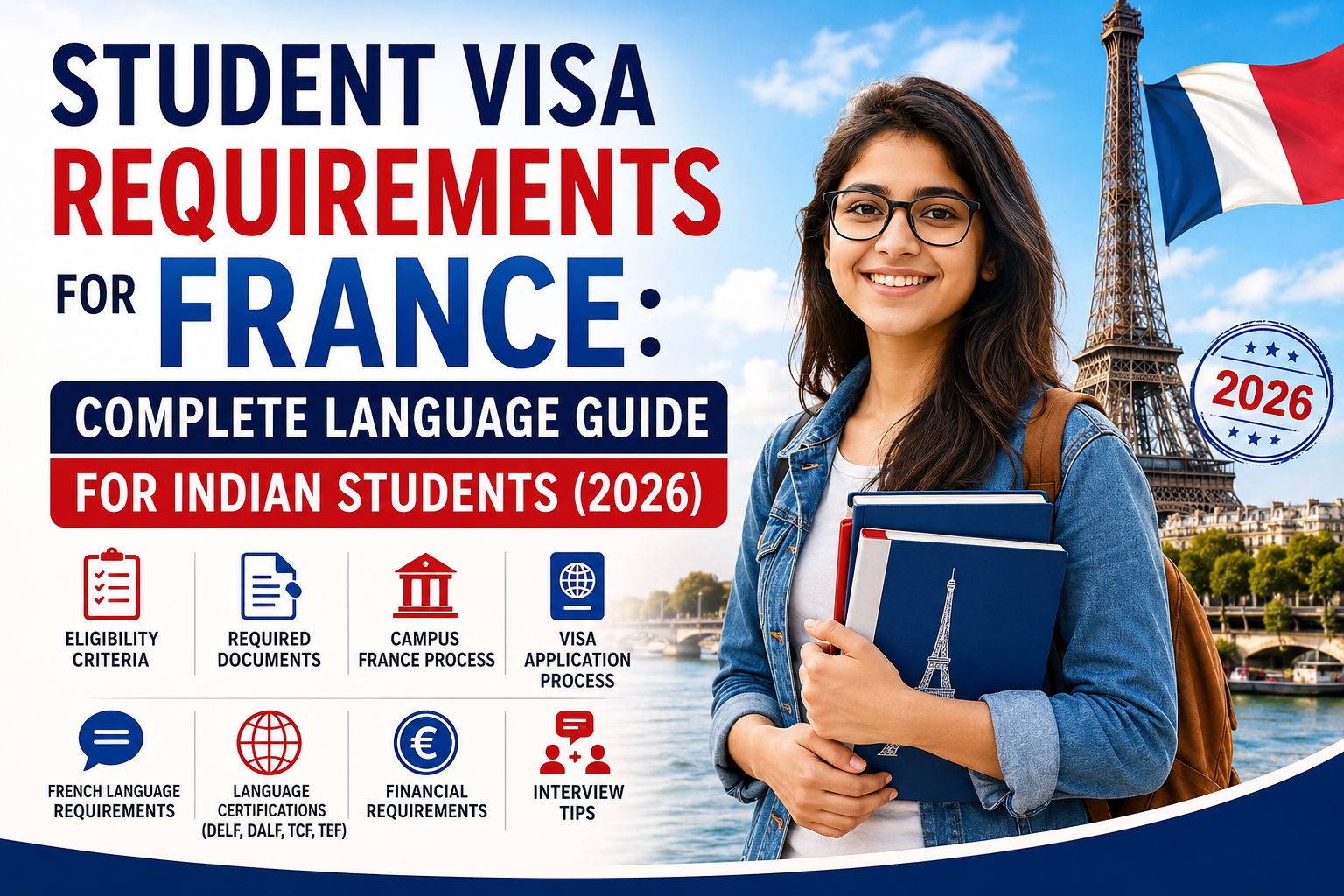
France has become one of the most sought-after study destinations for international students, especially those from India. Known for its world-class universities, affordable tuition fees, rich cultural heritage, and excellent career opportunities, France attracts over 400,000 international students every year. Whether you're planning to pursue a Bachelor's, Master's, MBA, Engineering, Fashion Design, Culinary Arts, or Research program, understanding the France student visa requirements—particularly the language requirements—is essential for a successful application.
One of the most common questions among aspiring students is:
"Do I need to know French to get a France student visa?"
The answer depends on several factors, including the language of instruction, your chosen university, and the type of program you wish to pursue.
In this comprehensive guide, we'll explain everything about the French language requirements for a France student visa, the certifications you may need, and how language proficiency can improve both your visa approval chances and future career prospects.
Why Study in France?
France consistently ranks among the world's top destinations for higher education. Apart from its iconic landmarks like the Eiffel Tower and the Louvre Museum, France offers internationally recognized degrees, innovative research opportunities, and a multicultural learning environment.
Here are some of the top reasons why students choose France:
1. Globally Recognized Universities
France is home to prestigious institutions such as:
Sorbonne University
PSL University
École Polytechnique
Sciences Po
HEC Paris
Grenoble Alpes University
Degrees from these institutions are recognized worldwide and are highly valued by employers.
2. Affordable Tuition Fees
Compared to countries like the USA, UK, or Australia, France offers relatively affordable tuition fees at public universities.
Approximate annual tuition:
Bachelor's Degree: €170–€3,000
Master's Degree: €243–€4,000
Private Institutions: €7,000–€20,000
Many scholarships are also available for international students.
3. Excellent Career Opportunities
France is home to multinational companies such as:
Airbus
L'Oréal
Renault
Capgemini
BNP Paribas
Dassault Systèmes
Learning French significantly increases employment opportunities in these organizations.
4. Work While Studying
International students can work part-time while pursuing their education, helping them gain professional experience and manage living expenses.
5. Gateway to Europe
A French student visa allows students to travel within many countries in the Schengen Area, making France an attractive base for exploring Europe during their studies.
Do You Need to Know French to Get a France Student Visa?
This is one of the biggest misconceptions among international students.
The Short Answer:
Not always.
The language requirement depends on the program you choose.
Generally, there are two categories:
Option 1: English-Taught Programs
Many French universities now offer programs entirely in English, especially:
MBA
Engineering
Data Science
Artificial Intelligence
Business Management
Computer Science
International Relations
If your program is taught entirely in English, you may not need French language certification.
Instead, universities may require:
IELTS
TOEFL
PTE Academic
Cambridge English qualifications
Option 2: French-Taught Programs
If your course is taught in French, you'll usually need to demonstrate proficiency in the language.
Commonly accepted certifications include:
DELF
DALF
TCF
TEF
Without sufficient French language skills, universities may not issue an admission letter, making it impossible to proceed with the student visa application.
Is French Language Mandatory for a France Student Visa?
The visa itself generally does not impose a universal requirement to speak French.
Instead, the visa authorities verify whether you meet the admission requirements of your educational institution.
That means:
If the university accepts you into an English-medium course, French language certification is usually not mandatory.
If the university requires French proficiency, you'll need to submit an approved language certificate.
However, even if you're enrolled in an English-taught program, learning basic French is highly recommended because it helps with:
Daily communication
Renting accommodation
Shopping
Public transportation
Networking
Part-time jobs
Internship opportunities
Long-term employment
Understanding French Language Levels
French language proficiency is measured according to the Common European Framework of Reference for Languages (CEFR).
A1 – Beginner
Students can:
Introduce themselves
Understand basic greetings
Ask simple questions
Handle everyday conversations
Suitable for complete beginners.
A2 – Elementary
Students can:
Discuss routine activities
Communicate in familiar situations
Understand frequently used expressions
B1 – Intermediate
Students can:
Participate in conversations
Write simple essays
Understand lectures
Handle travel situations confidently
Many undergraduate programs accept B1 proficiency.
B2 – Upper Intermediate
Students can:
Communicate fluently
Understand academic lectures
Write reports
Participate in university discussions
Many French universities require B2 for admission.
C1 – Advanced
Students can:
Understand complex texts
Participate in professional discussions
Write academic papers
Deliver presentations confidently
Ideal for postgraduate studies and research.
C2 – Proficient
This level indicates near-native fluency and is typically expected only for specialized academic or professional contexts.
French Language Certifications Accepted in France
To prove your French proficiency, universities commonly accept standardized certifications.
1. DELF (Diplôme d'Études en Langue Française)
DELF is one of the most recognized French language certifications worldwide.
Levels available:
DELF A1
DELF A2
DELF B1
DELF B2
Best for:
Undergraduate applicants
General French learners
Students planning long-term education in France
Validity: Lifetime
2. DALF (Diplôme Approfondi de Langue Française)
DALF is designed for advanced learners.
Levels:
DALF C1
DALF C2
Suitable for:
Master's students
Researchers
Professionals
Like DELF, DALF certificates do not expire.
3. TCF (Test de Connaissance du Français)
TCF is a standardized French language assessment accepted by many universities and institutions.
It evaluates:
Reading
Listening
Speaking
Writing
Grammar
Unlike DELF and DALF, TCF scores are valid for a limited period, so applicants should check the validity before applying.
4. TEF (Test d'Évaluation de Français)
TEF measures practical French language skills and is accepted by various educational institutions and, in some cases, for immigration-related purposes.
It assesses:
Listening
Reading
Speaking
Writing
Vocabulary and grammar
As with TCF, TEF results are valid for a limited time.
Which French Certification Should You Choose?
The right certification depends on your academic goals.
| Study Goal | Recommended Certification |
|---|---|
| Beginner Learning | DELF A1 |
| Undergraduate Programs | DELF B1 or B2 (depending on university requirements) |
| Master's Programs | DELF B2 or DALF C1 (if required by the institution) |
| Research & PhD | DALF C1 or C2 (where applicable) |
| University-Specific Requirement | TCF or TEF, if accepted or requested |
Always verify the exact language requirement with your chosen university before registering for an exam.
Can Learning French Improve Your Visa Approval Chances?
While French language proficiency is not a standalone visa requirement for every applicant, it can strengthen your overall study profile.
Benefits include:
Demonstrates commitment to studying in France.
Helps you adapt more easily to life in a French-speaking environment.
Supports your academic success, especially in French-medium programs.
Increases opportunities for internships and part-time work.
Enhances employability after graduation.
For students enrolling in French-taught programs, having the required language certification is often essential for receiving an admission offer, which is a key part of the visa process.
Who Needs a France Student Visa?
If you are an Indian student (or another non-EU/EEA citizen) planning to study in France for more than 90 days, you generally need to apply for a Long-Stay Student Visa (VLS-TS). Students must first receive admission from a recognized French institution before applying for the visa.
France Student Visa Eligibility Criteria
To qualify for a France student visa, you should generally meet the following conditions:
1. Admission Letter from a Recognized Institution
You must receive an official admission or enrollment letter from a recognized French university, business school, engineering institute, or other higher education institution.
The admission letter is one of the most important documents in your visa application.
2. Valid Passport
Your passport should:
Be valid for the required duration of your stay
Have sufficient blank pages for visa stamping
Be in good condition
3. Financial Capability
You must prove that you have enough funds to cover your:
Tuition fees
Living expenses
Accommodation
Daily costs
Financial proof can include:
Personal bank statements
Sponsor's bank statements
Education loan sanction letter
Scholarship letter
Financial guarantee
Visa officers need to be satisfied that you can support yourself throughout your studies.
4. Genuine Study Purpose
Applicants should clearly demonstrate that they intend to study in France and meet the academic requirements of their chosen course.
Your Statement of Purpose (SOP) or motivation letter should explain:
Why you chose France
Why you selected the university
Your career goals
How the course aligns with your future plans
5. Language Requirements
Depending on the language of instruction:
For English-medium programs:
IELTS
TOEFL
PTE
Other accepted English proficiency tests (if required by the institution)
For French-medium programs:
DELF
DALF
TCF
TEF
Always follow your university's admission requirements.
Complete Documents Required for a France Student Visa
Preparing your documents carefully is one of the most important steps.
Identity Documents
Valid passport
Passport-size photographs
Completed visa application form
Academic Documents
Keep both originals and photocopies of:
Class 10 Marksheet
Class 12 Marksheet
Bachelor's Degree
Master's Degree (if applicable)
Semester mark sheets
Degree certificates
Academic transcripts
University Documents
Include:
Admission Letter
Enrollment Confirmation
Tuition Fee Receipt (if applicable)
Offer Letter
Language Proficiency Documents
Depending on your course:
English:
IELTS
TOEFL
PTE
French:
DELF
DALF
TCF
TEF
Financial Documents
Usually include:
Recent bank statements
Sponsor affidavit (if sponsored)
Sponsor's income proof
Income Tax Returns (where applicable)
Salary slips
Education loan approval letter
Scholarship documents
Accommodation Proof
Examples include:
University residence confirmation
Hostel booking
Rental agreement
Invitation letter from host (if staying with family or friends)
Additional Supporting Documents
You may also need:
Passport copies
Curriculum Vitae (CV)
Statement of Purpose (SOP)
Travel itinerary (if requested)
Health insurance (where applicable)
Campus France documents (for applicants using the Études en France process)
Document requirements may vary depending on your country and individual circumstances, so always verify the latest checklist before applying.
What Is Campus France?
Many students believe Campus France is the organization that grants visas.
This is incorrect.
Campus France is France's official agency that assists international students with the higher education application process. For applicants from countries participating in the Études en France procedure (including India), completing the Campus France process is generally required before applying for a student visa.
Campus France helps students:
Choose universities
Submit applications
Verify academic documents
Complete the pre-consular process
Prepare for visa application
Step-by-Step France Student Visa Process
Step 1: Choose Your Course
Research programs based on:
Career goals
Tuition fees
Language of instruction
University rankings
Location
Step 2: Apply to Universities
Submit:
Academic transcripts
SOP
Recommendation letters (if required)
Resume
Language test scores
Wait for the admission decision.
Step 3: Complete the Campus France Process
Applicants covered under the Études en France procedure should:
Create an account
Upload required documents
Submit academic information
Complete any required verification or interview process
Receive the necessary confirmation before proceeding with the visa application
Step 4: Apply Through the France Visas Portal
Once eligible, complete the online visa application through the official France Visas portal.
You'll receive:
Visa application form
Required document checklist
Appointment instructions
The required supporting documents are determined through the official visa process.
Step 5: Schedule Biometrics
Book your appointment and visit the designated visa application center.
Carry:
Passport
Original documents
Photographs
Printed application
Supporting documents
Your fingerprints and photograph will be collected.
Step 6: Wait for Visa Processing
After submitting your application:
Your documents are reviewed.
Additional documents may be requested.
You can usually track your application status online if the service is available.
France Student Visa Fees
Visa fees can vary depending on:
Visa category
Nationality
Local service charges
Visa application center fees
Applicants should always check the latest official fee schedule before making payment, as charges may change over time.
Financial Requirements
Visa officers want assurance that students can support themselves during their stay.
You should be prepared to show evidence of funds covering:
Tuition fees
Accommodation
Food
Transportation
Daily living expenses
Health-related costs
Recent French regulations specify a minimum monthly resource requirement for student residence purposes, although applicants should verify the latest amount applicable to their case.
Visa Processing Time
Processing times vary based on:
Country of application
Time of year
Application volume
Completeness of documents
Students are strongly advised to apply well before their course begins to avoid delays.
Common Reasons for France Student Visa Rejection
Many refusals can be avoided with proper preparation.
1. Incomplete Documentation
Missing or inconsistent documents are among the most common reasons for delays or refusals.
2. Weak Financial Proof
Insufficient evidence that you can finance your education and stay may negatively affect your application.
3. Poor Statement of Purpose
A generic or unclear SOP that doesn't explain your study plans and career objectives can weaken your application.
4. Incorrect Information
Any mismatch between your application, passport, academic documents, or financial records can raise concerns.
5. Unclear Academic Plan
Applicants should be able to explain:
Why they selected the course
Why they chose France
How the program fits their long-term career goals
6. Ignoring Language Requirements
If your university requires proof of English or French proficiency, failing to provide the appropriate certificate may affect both admission and your visa process.
France Student Visa Interview Tips
Although not every applicant is interviewed, some students may be asked questions during the Campus France process or by visa authorities. The purpose is to confirm that you are a genuine student with a clear academic plan.
Common Interview Questions
1. Why do you want to study in France?
A good answer should include:
High-quality education
Internationally recognized degrees
Research opportunities
Affordable tuition compared to other study destinations
Career opportunities in Europe
Avoid saying:
"I only want to move to Europe."
2. Why did you choose this university?
Mention:
University ranking
Course curriculum
Faculty expertise
Research opportunities
Industry collaborations
Internship opportunities
3. Why this particular course?
Explain:
Your educational background
Career goals
Skills you want to develop
How the course fits your long-term plans
4. Who will sponsor your education?
Be prepared to explain your source of funds.
Possible answers include:
Parents
Education loan
Scholarship
Self-funded
Carry supporting financial documents to match your explanation.
5. What are your plans after graduation?
A strong response focuses on:
Gaining international experience
Building professional skills
Pursuing career opportunities relevant to your qualification
Avoid giving inconsistent or unclear answers.
Tips to Increase Your Visa Approval Chances
Many applicants worry about visa rejection, but careful preparation can significantly strengthen your application.
✔ Apply Early
Start your application several months before your course begins.
Early applications reduce stress and allow time for any additional document requests.
✔ Keep Documents Organized
Arrange all documents in order:
Passport
Admission Letter
Academic Records
Financial Proof
Accommodation Details
Language Certificates
A well-organized file creates a positive impression.
✔ Write a Strong Statement of Purpose (SOP)
Your SOP should clearly explain:
Why France?
Why this university?
Why this course?
Your career goals
Your future plans
Avoid copying sample SOPs from the internet.
✔ Demonstrate Financial Stability
Provide genuine and complete financial evidence.
Avoid sudden, unexplained large deposits in bank statements unless they are properly documented.
✔ Improve Your French Skills
Even if your program is taught in English, learning basic French can:
Help with daily communication
Improve internship opportunities
Increase employability
Make settling into French society easier
Can International Students Work While Studying in France?
Yes.
International students holding a valid long-stay student visa are generally allowed to work up to 964 hours per year, which is approximately 60% of full-time working hours in France.
Common part-time jobs include:
Restaurant staff
Retail assistant
Customer service
Tutor
University assistant
Library assistant
Delivery services
Administrative support
Working part-time can help students gain practical experience and contribute toward living expenses.
Popular Part-Time Jobs for Indian Students
Some of the most common student jobs are:
English Tutor
French-English Translator
Café Staff
Receptionist
Research Assistant
IT Support
Software Developer (Intern)
Sales Assistant
Warehouse Associate
Freelance Content Writer
Students with French language skills often have access to a broader range of customer-facing and administrative roles.
Career Opportunities After Learning French
French is one of the world's most widely spoken languages and can open doors across multiple industries.
1. Information Technology
Many multinational IT companies seek bilingual professionals for international projects.
Popular roles:
Software Developer
Technical Support Engineer
Business Analyst
Project Coordinator
2. International Business
French-speaking professionals are valued in:
International Sales
Global Marketing
Business Development
Export Management
3. Tourism & Hospitality
Career options include:
Hotel Management
Travel Consultant
Tour Guide
Airline Customer Service
4. Translation & Interpretation
Professionals can work as:
Translator
Interpreter
Localization Specialist
Content Reviewer
5. Education
Qualified French speakers may become:
French Language Trainer
School Teacher
University Lecturer
Online Tutor
6. International Organizations
French language skills are an asset when working with:
NGOs
International agencies
Diplomatic organizations
Global corporations
Post-Study Work Opportunities in France
Many students choose France because it offers pathways to gain professional experience after graduation.
Depending on your qualification and circumstances, graduates may be eligible to apply for permits that allow them to search for employment or start a business, subject to French immigration rules. For example, eligible graduates with a qualifying Master's-level degree can apply under the "Job Search / Business Creation" route if they meet the applicable conditions.
France has also announced initiatives to make the country more attractive for Indian students, including simplified procedures and a goal of welcoming 30,000 Indian students by 2030.
Cost of Living in France
Your monthly expenses depend on the city and your lifestyle.
Typical costs include:
Accommodation
Food
Transportation
Health insurance
Mobile and internet
Study materials
Personal expenses
Major cities such as Paris are generally more expensive than cities like Lille, Nantes, Toulouse, or Montpellier.
Creating a monthly budget before arrival is strongly recommended.
Mistakes to Avoid During the Visa Process
Avoid these common mistakes:
Applying at the last minute
Submitting incomplete documents
Ignoring university instructions
Providing incorrect financial information
Writing a weak SOP
Choosing a course unrelated to your academic background without explanation
Not preparing for interview questions
Missing deadlines for Campus France or visa appointments
Frequently Asked Questions (FAQs)
Is French mandatory for a France student visa?
Not always. If your course is taught in English, French language certification may not be required. However, French is generally required for French-medium programs.
Can I study in France without IELTS?
Some universities may accept alternatives or waive English language tests under specific conditions, but requirements vary by institution. Always check your university's admission policy.
How long does the visa process take?
Processing times vary depending on your country of application, the time of year, and whether your application is complete. Applying early is recommended.
Can I bring my spouse?
This depends on your visa category and French immigration rules. Separate applications and eligibility requirements may apply.
Can I stay in France after graduation?
Yes. Depending on your qualifications and eligibility, you may be able to apply for a residence status that allows you to seek employment or start a business after completing your studies.
Do I need health insurance?
Students may need appropriate health coverage depending on their circumstances and the applicable French regulations. Check the latest requirements before departure.
Conclusion
France continues to be one of the most attractive destinations for international students, offering high-quality education, globally recognized degrees, affordable public universities, vibrant cultural experiences, and excellent career prospects.
Understanding the France student visa requirements, preparing the correct documents, meeting your university's language requirements, and following the Campus France and visa application process carefully can greatly improve your chances of success.
Even if your course is taught in English, investing time in learning French is a valuable decision. It can help you integrate into everyday life, expand internship and job opportunities, and strengthen your long-term career prospects in France and beyond.
With careful planning, strong academic preparation, and a complete application, your dream of studying in France can become a reality.