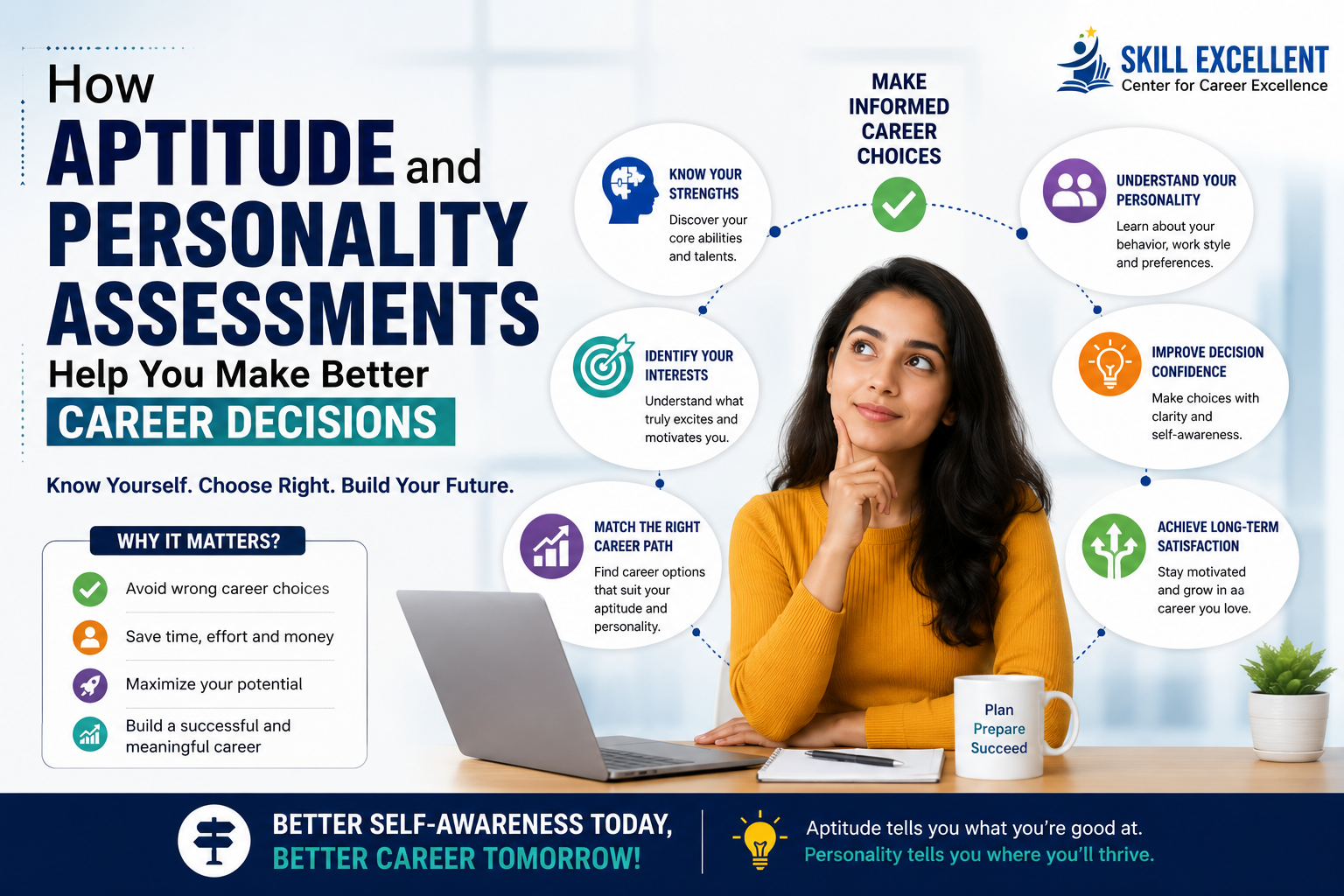
Choosing a career is one of the most important decisions in a person's life. The right career not only provides financial stability but also contributes to personal satisfaction, confidence, and long-term growth. However, with hundreds of career options available today—from engineering and medicine to digital marketing, artificial intelligence, foreign languages, entrepreneurship, and creative professions—making the right choice has become more challenging than ever.
Many students and even working professionals struggle with questions like:
Which career is best for me?
What are my strengths?
Which profession matches my personality?
Should I follow my passion or choose a career with better opportunities?
Am I making the right career decision?
Without proper guidance, these questions often lead to confusion, stress, and poor career choices. Many students select careers based on parental expectations, peer influence, social trends, or salary prospects without considering whether those careers align with their natural abilities and interests. As a result, they may lose motivation, perform below their potential, or even decide to switch careers later.
This is where aptitude and personality assessments play a transformative role. These scientifically designed tools help individuals understand themselves better by evaluating their abilities, interests, behavioral traits, learning styles, and work preferences. Instead of relying on assumptions, students receive objective insights that support informed career decisions.
When combined with professional career counselling, aptitude and personality assessments become even more powerful. Career counsellors interpret the results, explain suitable career paths, and guide students toward education and career options that match their unique profiles.
At Skill Excellent, we believe that every student possesses unique strengths and untapped potential. Through personalized career counselling, aptitude assessments, and personality evaluations, we help students discover careers where they can truly excel and build successful futures.
In this comprehensive guide, we'll explore what aptitude and personality assessments are, how they work, why they matter, and how they can help you make smarter career decisions with greater confidence.
Why Career Decisions Matter More Than Ever
The world of work has changed dramatically over the past decade. Traditional career paths are evolving, and new industries are emerging at an unprecedented pace. Technologies like Artificial Intelligence (AI), automation, data science, cybersecurity, cloud computing, and digital transformation have created exciting opportunities while also changing the skills employers expect.
At the same time, globalization has expanded career options beyond geographical boundaries. Students today can pursue international education, remote work opportunities, multinational careers, freelancing, or entrepreneurship. While this variety offers incredible possibilities, it also makes career decision-making far more complex.
Making a career choice without understanding your strengths can result in:
Lack of interest in studies
Low academic performance
Job dissatisfaction
Frequent career changes
Poor work-life balance
Reduced confidence
Financial setbacks due to changing courses or professions
On the other hand, choosing a career aligned with your natural abilities and personality increases the likelihood of long-term success, motivation, and happiness.
This is why career planning should begin with self-awareness rather than guesswork.
What Is an Aptitude Assessment?
An aptitude assessment is a structured evaluation designed to measure an individual's natural abilities and potential to perform specific tasks or develop particular skills. Unlike school examinations that test acquired knowledge, aptitude assessments focus on your capacity to learn, solve problems, think critically, and adapt to different situations.
These assessments help identify areas where you naturally perform well, making it easier to select educational paths and careers that align with your strengths.
What Does an Aptitude Assessment Measure?
A comprehensive aptitude assessment may evaluate several abilities, including:
1. Numerical Ability
This measures your ability to work with numbers, perform calculations, understand mathematical concepts, and analyze quantitative information.
Students with strong numerical aptitude often succeed in careers such as:
Engineering
Finance
Accounting
Data Analytics
Economics
Statistics
Banking
2. Verbal Ability
Verbal aptitude evaluates your understanding of language, vocabulary, grammar, reading comprehension, and communication skills.
Strong verbal skills are valuable for careers in:
Journalism
Law
Content Writing
Teaching
Public Relations
Marketing
Civil Services
3. Logical Reasoning
Logical reasoning measures your ability to analyze patterns, solve problems, and make decisions using logical thinking.
This aptitude is highly valued in fields like:
Software Development
Artificial Intelligence
Cybersecurity
Research
Business Analysis
Consulting
4. Abstract Reasoning
Abstract reasoning evaluates how well you identify relationships, recognize patterns, and think conceptually without relying on language or numbers.
It is particularly useful in careers involving innovation and strategic thinking.
5. Spatial Ability
Spatial aptitude measures how effectively you visualize objects, understand dimensions, and interpret diagrams.
Careers benefiting from strong spatial skills include:
Architecture
Interior Design
Civil Engineering
Mechanical Engineering
Graphic Design
Animation
6. Mechanical Reasoning
Mechanical aptitude assesses your understanding of physical principles, machinery, tools, and mechanical systems.
It is relevant for careers in:
Mechanical Engineering
Automotive Engineering
Aviation
Manufacturing
Industrial Design
7. Problem-Solving Skills
Employers across industries highly value individuals who can analyze situations, identify challenges, and develop practical solutions.
Aptitude assessments often include problem-solving exercises to evaluate this essential skill.
What Is a Personality Assessment?
While aptitude assessments measure what you can do, personality assessments help understand how you naturally behave, communicate, make decisions, and interact with others.
A personality assessment identifies your behavioral preferences, emotional tendencies, motivation, leadership style, communication patterns, and work environment preferences.
Rather than labeling someone as "good" or "bad," these assessments recognize that every personality type has unique strengths suited to different careers.
Key Areas Measured in Personality Assessments
Communication Style
Some people naturally enjoy speaking, networking, and presenting ideas, while others prefer thoughtful written communication or independent work.
Understanding your communication style helps identify careers where you'll thrive.
Leadership Potential
Leadership assessments evaluate your ability to:
Take initiative
Make decisions
Inspire others
Manage responsibilities
Handle challenges
Students with strong leadership qualities may excel in management, entrepreneurship, project management, administration, or public service.
Teamwork and Collaboration
Many careers require professionals to work effectively in teams.
Personality assessments evaluate your collaboration style, adaptability, and interpersonal skills, helping determine whether you are better suited for highly collaborative roles or more independent work environments.
Emotional Stability
Emotional resilience is increasingly important in today's fast-paced workplaces.
Assessments may evaluate how individuals respond to:
Stress
Pressure
Deadlines
Uncertainty
Workplace conflicts
Understanding emotional tendencies helps students prepare for careers with different levels of responsibility and pressure.
Creativity
Creative thinking is valuable far beyond artistic professions.
Creativity assessments identify individuals who enjoy innovation, idea generation, and unconventional problem-solving.
Creative personalities often flourish in careers such as:
Advertising
Graphic Design
UI/UX Design
Digital Marketing
Product Design
Film and Media
Entrepreneurship
Attention to Detail
Some professions demand exceptional accuracy and precision.
Students with high attention to detail often succeed in:
Accounting
Quality Assurance
Laboratory Sciences
Research
Auditing
Compliance
Healthcare
Why Self-Awareness Is the First Step Toward Career Success
Many students spend years preparing for competitive exams without fully understanding whether the chosen career aligns with their natural abilities or personality. While dedication and hard work are essential, self-awareness plays an equally important role in long-term success.
Self-awareness means understanding your strengths, limitations, interests, values, and preferred ways of learning and working. When you know yourself better, you can make career choices based on evidence rather than assumptions.
Aptitude and personality assessments provide this clarity by offering a structured, objective understanding of who you are. Instead of following trends or comparing yourself with others, you gain insights into the environments, roles, and responsibilities where you are most likely to perform well and stay motivated.
At Skill Excellent, these assessments are used as the foundation for personalized career counselling. Our experienced counsellors help students interpret their assessment results, connect them with suitable career paths, and create a practical roadmap for academic and professional success.
How Do Aptitude and Personality Assessments Work?
Many students assume that career assessments are just another type of exam. In reality, aptitude and personality assessments are designed to understand your natural abilities, preferences, and behavioral patterns—not to determine whether you "pass" or "fail."
These assessments are usually conducted online or offline under the guidance of certified career counsellors. They use scientifically validated psychometric techniques to provide reliable insights into your strengths, interests, and potential career paths.
Although the format may vary depending on the assessment provider, the process generally includes the following stages:
Step 1: Understanding the Individual
Before taking the assessment, career counsellors often gather basic information about the student, including:
Educational background
Academic performance
Career interests
Hobbies and extracurricular activities
Personal goals
Challenges faced in career planning
This helps counsellors understand the student's current situation and provide more personalized guidance.
Step 2: Taking the Assessment
The assessment consists of carefully designed questions that evaluate different aspects of an individual's abilities and personality.
These may include:
Logical reasoning questions
Numerical ability problems
Language comprehension exercises
Pattern recognition tasks
Situational judgment questions
Personality-based statements
Interest inventories
Unlike school exams, these assessments focus on understanding how you naturally think, solve problems, and respond to different situations.
Step 3: Report Generation
Once the assessment is completed, a detailed report is generated.
A typical report may include:
Natural strengths
Areas for improvement
Learning style
Personality profile
Career interests
Suitable academic streams
Recommended career options
Workplace preferences
Leadership potential
Communication style
These reports provide a comprehensive picture of the individual's potential rather than focusing on marks alone.
Step 4: Career Counselling Session
The assessment report is only one part of the process. The real value comes from discussing the results with an experienced career counsellor.
During the counselling session, the counsellor helps students:
Understand their assessment results
Explore career options that match their profile
Compare different educational pathways
Set realistic career goals
Develop a step-by-step action plan
This personalized guidance ensures that students make informed decisions based on both assessment results and their aspirations.
Benefits of Aptitude and Personality Assessments
Career assessments offer far more than career suggestions. They provide clarity, confidence, and direction at every stage of a student's educational journey.
Let's explore their key benefits.
1. Helps You Discover Your True Strengths
Many students underestimate their abilities simply because they compare themselves with others.
For example:
A student who struggles in mathematics may have exceptional communication skills.
Someone who isn't interested in science may possess outstanding creative abilities.
A quiet student may excel in analytical thinking and research.
Aptitude assessments highlight these strengths, helping students recognize their unique potential instead of focusing only on academic scores.
2. Removes Career Confusion
One of the biggest challenges students face today is information overload.
The internet offers thousands of career options, making it difficult to decide where to begin.
Career assessments simplify this process by narrowing down options based on your abilities and personality.
Instead of considering hundreds of careers, students receive a focused list of professions that align with their natural strengths and interests.
3. Improves Career Confidence
Career uncertainty often leads to stress and self-doubt.
Students may constantly question whether they are making the right decision.
Assessment-based career counselling replaces uncertainty with confidence by providing objective insights supported by scientific evaluation.
Knowing that your career choice aligns with your abilities allows you to move forward with greater motivation.
4. Prevents Wrong Career Choices
Many professionals eventually realize they entered careers that don't match their interests or personality.
Changing careers later can involve:
Additional education
Financial costs
Loss of time
Emotional stress
Career assessments reduce this risk by helping students make informed decisions from the beginning.
5. Identifies Hidden Talents
Some abilities remain unnoticed during regular schooling.
For instance, a student with average grades may possess excellent:
Leadership qualities
Strategic thinking
Creativity
Entrepreneurial mindset
Emotional intelligence
Career assessments uncover these hidden strengths, opening doors to opportunities students may never have considered.
6. Supports Better Academic Planning
Career decisions influence subject selection, higher education, certifications, internships, and skill development.
Assessment results help students choose:
Appropriate school streams
Suitable undergraduate programs
Professional certifications
Skill development courses
Internship opportunities
This structured approach prevents unnecessary course changes in the future.
7. Encourages Long-Term Career Satisfaction
Success isn't measured only by salary.
True career success also includes:
Job satisfaction
Work-life balance
Personal growth
Motivation
Career stability
When your career matches your personality and abilities, you're more likely to enjoy your work and stay committed to your professional goals.
Common Myths About Aptitude and Personality Assessments
Despite their growing popularity, several misconceptions still prevent students from taking career assessments.
Let's address some of the most common myths.
Myth 1: These Tests Decide My Future
Reality:
Career assessments don't make decisions for you.
Instead, they provide valuable insights that help you make better-informed choices.
The final decision always remains yours.
Myth 2: Only Weak Students Need Career Counselling
Reality:
Career counselling benefits students of all academic levels.
Even high-performing students may be confused between multiple career options.
Assessments help everyone make smarter choices.
Myth 3: Good Marks Automatically Mean the Right Career
Reality:
Academic performance reflects what you've learned—not necessarily what you're naturally suited for.
Someone with excellent grades in science may discover a stronger aptitude for business, design, or management.
Career decisions should consider both academic achievement and personal strengths.
Myth 4: Personality Cannot Change
Reality:
While certain personality traits remain relatively stable, many skills can be developed through experience, education, and practice.
Personality assessments identify your natural tendencies—not your limitations.
Myth 5: These Assessments Are Only for Students
Reality:
Working professionals also benefit from aptitude and personality assessments.
They are widely used for:
Career transitions
Leadership development
Promotions
Skill enhancement
Career planning
Professional coaching
Why Psychometric Testing Is Becoming Essential
Modern career counselling increasingly relies on psychometric assessments because they offer objective, research-based insights.
Unlike advice based solely on opinions, psychometric testing uses standardized methods to evaluate an individual's capabilities and behavioral preferences.
Educational institutions, multinational companies, and recruitment agencies around the world use psychometric assessments for:
Student career guidance
Employee recruitment
Leadership development
Talent management
Organizational planning
Their widespread adoption reflects their effectiveness in identifying strengths and improving decision-making.
Real-Life Example 1: Choosing the Right Stream After Class 10
Imagine two students with similar academic scores.
Student A
Excellent logical reasoning
Strong numerical aptitude
Enjoys solving technical problems
Prefers structured environments
A career assessment may recommend fields such as:
Engineering
Data Science
Artificial Intelligence
Computer Science
Finance
Student B
Strong communication skills
Creative thinking
High emotional intelligence
Excellent interpersonal abilities
Suitable career paths may include:
Psychology
Journalism
Digital Marketing
Human Resources
Public Relations
Teaching
Without assessments, both students might choose the same stream simply because their friends did.
With proper career guidance, each can pursue a path aligned with their strengths.
Real-Life Example 2: Career Change for a Working Professional
Consider a professional who has worked in finance for several years but feels unfulfilled.
After taking aptitude and personality assessments, they discover:
Strong creativity
Excellent communication abilities
Entrepreneurial mindset
Interest in branding and marketing
With guidance from a career counsellor, they may transition into roles such as:
Marketing Strategy
Brand Management
Content Consulting
Business Development
This shift can lead to greater job satisfaction and long-term career growth.
The Role of Career Counsellors in Interpreting Assessment Results
Assessment reports contain valuable information, but understanding and applying those insights requires professional guidance.
Experienced career counsellors help individuals:
Interpret assessment results accurately.
Identify careers that align with strengths and interests.
Understand educational pathways for chosen careers.
Address doubts and misconceptions.
Balance personal aspirations with market demand.
Create a realistic career roadmap.
Build confidence in decision-making.
At Skill Excellent, career counselling goes beyond simply sharing a report. Our counsellors work closely with students to understand their ambitions, answer their questions, and provide practical guidance tailored to their unique profiles. The goal is to empower every student to make career decisions with clarity, confidence, and purpose.