Introduction
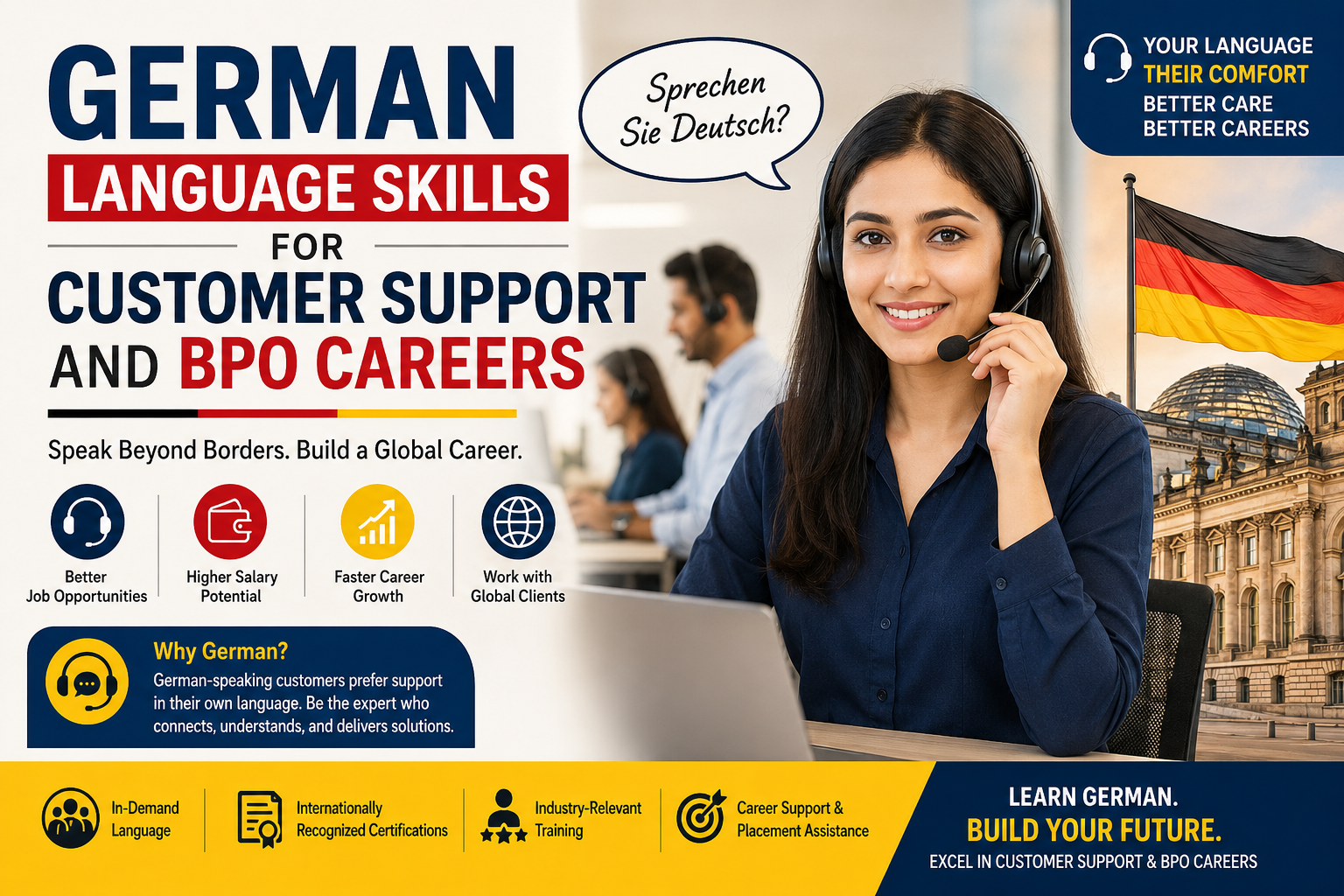
In today's interconnected business environment, companies no longer serve customers from just one country. Organizations across industries are expanding globally and require professionals who can communicate effectively with customers in multiple languages. Among all foreign languages, German has become one of the most valuable skills for professionals seeking rewarding careers in customer support and Business Process Outsourcing (BPO).
Germany is Europe's largest economy and one of India's strongest business partners. Thousands of German companies operate globally and rely on customer support teams to assist their clients. As a result, professionals with German language skills are in high demand across customer service, technical support, IT services, finance, logistics, healthcare, e-commerce, and many other sectors.
Whether you are a student planning your career, a graduate searching for better job opportunities, or a working professional looking to increase your earning potential, learning German can open doors to exciting international careers.
In this comprehensive guide, you'll discover why German language skills are becoming essential in customer support and BPO industries, what career opportunities await you, expected salary packages, required certifications, and how the right training can help you succeed.
Why German Language Skills Are in High Demand
Global businesses strive to provide excellent customer experiences. Customers prefer receiving support in their native language because it creates trust, improves communication, and resolves issues more efficiently.
German is spoken by more than 130 million people worldwide and is an official language in Germany, Austria, Switzerland, Luxembourg, Liechtenstein, and parts of Belgium. Many multinational companies serve German-speaking customers and therefore need skilled professionals who can communicate fluently.
India has become one of the world's leading outsourcing destinations. International companies choose India because of its talented workforce, advanced technology infrastructure, and cost-effective services. Consequently, Indian professionals with German language proficiency enjoy a competitive advantage.
Companies are constantly recruiting German-speaking executives for:
Customer support
Voice process
Email support
Chat support
Technical support
IT helpdesk
Finance and accounting
Banking operations
Human resources
Healthcare support
E-commerce operations
Travel and hospitality services
Learning German significantly expands your employment opportunities beyond traditional customer service roles.
Understanding the BPO Industry
Business Process Outsourcing (BPO) refers to companies outsourcing business operations such as customer service, technical assistance, finance, payroll, data management, and IT support to specialized service providers.
BPO organizations handle customer interactions through multiple communication channels, including:
Voice support
Email support
Live chat
Social media
Technical troubleshooting
Complaint resolution
Sales support
Back-office operations
As businesses expand into German-speaking markets, multilingual customer support becomes increasingly important.
Professionals who speak German help organizations:
Resolve customer issues quickly
Build customer satisfaction
Improve brand reputation
Reduce communication barriers
Increase customer loyalty
This makes German-speaking professionals valuable assets for international organizations.
Why Companies Prefer German-Speaking Professionals
Modern businesses compete on customer experience. Providing support in the customer's native language improves satisfaction and strengthens long-term relationships.
German-speaking professionals help companies:
Better Customer Communication
Customers can explain their concerns more clearly in their own language, leading to faster and more accurate solutions.
Improved Customer Satisfaction
Native-language support creates trust and makes customers feel valued.
Faster Issue Resolution
Language barriers often delay problem-solving. German-speaking agents reduce misunderstandings and improve efficiency.
Increased Business Growth
Satisfied customers are more likely to continue using products and services, contributing to business success.
Stronger Global Presence
Companies that offer multilingual support can confidently expand into German-speaking markets.
Benefits of Learning German for Customer Support Careers
Learning German is much more than adding another language to your resume. It provides long-term career benefits that continue to grow throughout your professional journey.
1. Better Job Opportunities
German language skills qualify you for positions that many candidates cannot apply for due to language requirements.
Instead of competing with thousands of applicants, you enter a niche talent pool where demand exceeds supply.
2. Higher Salary Packages
German-speaking professionals generally receive higher salaries than candidates with only English communication skills.
Companies offer language allowances, incentives, and performance bonuses because multilingual employees are difficult to replace.
3. Faster Career Growth
Professionals with foreign language skills often move into senior positions such as:
Team Leader
Quality Analyst
Trainer
Process Manager
Operations Manager
Client Relationship Manager
International Account Manager
4. International Work Opportunities
Many multinational companies provide opportunities to:
Work with global teams
Collaborate with international clients
Travel abroad
Relocate to European offices
Participate in cross-border projects
5. Job Security
As globalization continues, multilingual professionals remain valuable assets.
Companies are unlikely to reduce multilingual support because customer experience has become a major competitive advantage.
Industries Hiring German Language Professionals
German language skills are useful across numerous industries.
Information Technology (IT)
IT companies require German-speaking professionals for:
Helpdesk support
Software assistance
Technical troubleshooting
Cloud support
Infrastructure support
E-Commerce
Online retailers serving German customers recruit professionals for:
Order management
Customer queries
Returns processing
Product support
Live chat assistance
Banking and Finance
Financial institutions require multilingual professionals for:
Customer relationship management
Loan processing
Banking support
Fraud prevention
Investment assistance
Healthcare
Healthcare outsourcing companies hire German speakers for:
Medical documentation
Appointment scheduling
Insurance support
Patient communication
Healthcare administration
Travel and Hospitality
Travel companies require German-speaking executives for:
Flight reservations
Hotel bookings
Tour assistance
Customer care
Travel support
Manufacturing
Many German manufacturing companies have operations in India.
These companies recruit professionals for:
Client communication
Supply chain support
Procurement
Vendor coordination
Customer relationship management
Logistics
International logistics firms recruit German speakers for:
Shipment tracking
Freight coordination
Customer communication
Documentation support
Popular Job Roles for German Language Professionals
Some of the most common positions include:
German Customer Support Executive
German Voice Process Associate
German Chat Support Specialist
German Email Support Executive
Technical Support Engineer (German)
Service Desk Analyst
Customer Success Associate
Client Relationship Executive
Process Associate (German)
Quality Analyst
Language Specialist
Translation Executive
Localization Specialist
International Sales Executive
Operations Executive
Each role offers excellent opportunities for career advancement and skill development.
Essential Skills Required
Employers look beyond language fluency. Successful professionals combine German proficiency with strong interpersonal and technical skills.
Important skills include:
Excellent spoken German
Good writing skills
Listening ability
Clear pronunciation
Customer handling skills
Problem-solving ability
Patience
Professional communication
Computer literacy
CRM software knowledge
Email etiquette
Teamwork
Time management
Adaptability
Positive attitude
Developing these competencies alongside language training significantly enhances employability.
Salary Opportunities for German Language Professionals in Customer Support and BPO
One of the biggest advantages of learning German is the opportunity to earn a significantly higher salary compared to regular customer support roles. Since there is a limited pool of professionals with strong German language skills, companies are willing to offer attractive compensation packages.
While salaries vary depending on factors such as language proficiency, certification level, location, company, and experience, German-speaking professionals generally enjoy better pay, faster promotions, and additional incentives.
Approximate Salary Ranges in India
| Experience Level | Average Annual Salary |
|---|---|
| Fresher (A2–B1 Level) | ₹3.5–6 LPA |
| 1–3 Years | ₹5–8 LPA |
| 3–5 Years | ₹8–12 LPA |
| Senior Language Specialist | ₹12–18 LPA |
| Team Leader/Manager | ₹15–25 LPA+ |
Professionals with advanced certifications (B2, C1, or C2) and relevant work experience often receive even higher salary packages, especially in multinational companies.
Top Companies Hiring German Language Professionals
Many globally recognized organizations actively recruit German-speaking professionals for customer support, technical assistance, IT services, finance, and business operations.
Some of the industries where German language experts are in demand include:
Information Technology (IT)
Business Process Outsourcing (BPO)
Shared Service Centers (SSC)
Global Capability Centers (GCC)
Banking and Financial Services
Healthcare Process Management
Automotive Companies
E-commerce Platforms
Logistics and Supply Chain
Manufacturing Organizations
Consulting Firms
Telecommunications Companies
Many German multinational companies operating in India also hire bilingual professionals for customer relationship management, operations, technical support, and business coordination.
German Language Levels Explained
Learning German follows the internationally recognized Common European Framework of Reference for Languages (CEFR). These levels indicate your proficiency and help employers assess your communication skills.
A1 – Beginner
At this stage, learners can:
Introduce themselves
Understand simple greetings
Ask basic questions
Communicate using everyday expressions
Suitable for beginners starting their language journey.
A2 – Elementary
Students learn to:
Handle simple conversations
Understand common workplace vocabulary
Write short emails
Communicate in routine situations
Many entry-level customer support roles prefer candidates with at least A2 proficiency.
B1 – Intermediate
Professionals at this level can:
Handle customer conversations confidently
Explain situations clearly
Write professional emails
Participate in workplace discussions
B1 is considered a strong foundation for many multilingual customer support jobs.
B2 – Upper Intermediate
This level enables professionals to:
Handle complex customer interactions
Resolve complaints independently
Understand business communication
Participate in meetings
Many multinational companies prefer candidates with B2 certification for client-facing roles.
C1 – Advanced
Learners become highly proficient in:
Professional communication
Business presentations
Negotiations
Advanced writing
Technical discussions
Professionals at this level often qualify for leadership roles and international assignments.
C2 – Mastery
The highest level of German proficiency, C2 indicates near-native fluency and is ideal for specialized careers, translation, interpretation, and high-level consulting roles.
German Language Certifications That Employers Value
Having a recognized certification strengthens your resume and demonstrates your language proficiency to employers.
Popular certifications include:
Goethe-Zertifikat
TestDaF
telc German
DSH (for higher education in Germany)
These certifications are widely accepted by multinational companies, universities, and organizations across German-speaking countries.
How to Prepare for a Career in German Customer Support
Building a successful career requires more than learning vocabulary. You need practical communication skills, confidence, and workplace readiness.
Here are the essential steps:
1. Build a Strong Foundation
Start with grammar, pronunciation, sentence structure, and everyday vocabulary.
2. Practice Speaking Daily
Regular conversation practice helps improve fluency, confidence, and pronunciation.
3. Improve Listening Skills
Listen to German podcasts, news, movies, and conversations to understand different accents and speaking styles.
4. Learn Business Communication
Understand professional email writing, customer interaction techniques, and workplace etiquette.
5. Gain Technical Knowledge
Basic knowledge of CRM software, Microsoft Office, ticketing systems, and customer service processes increases employability.
6. Obtain a Recognized Certification
A globally recognized certification demonstrates your skills and gives you a competitive edge.
7. Prepare for Interviews
Practice common interview questions in both German and English to improve confidence.
Soft Skills Required for Success
Language skills alone are not enough. Employers also value professionals who possess strong interpersonal abilities.
Important soft skills include:
Active listening
Empathy
Professional etiquette
Positive attitude
Patience
Conflict resolution
Adaptability
Team collaboration
Critical thinking
Decision-making
Time management
Stress management
Customer-centric approach
Developing these qualities can help you perform better and grow faster in your career.
Challenges You May Face—and How to Overcome Them
Like any skill, learning German and working in a multilingual environment comes with challenges.
Pronunciation
German pronunciation may seem difficult initially.
Solution: Practice with native audio resources and speak regularly with trainers.
Grammar
German grammar includes cases, gender, and sentence structures that require consistent practice.
Solution: Focus on understanding concepts rather than memorizing rules.
Confidence While Speaking
Many learners hesitate because they fear making mistakes.
Solution: Participate in speaking sessions, role plays, and mock customer conversations.
Understanding Native Speakers
Native speakers often speak quickly.
Solution: Watch German videos with subtitles and gradually increase listening difficulty.
Why Businesses Need German-Speaking Customer Support Teams
Companies serving German-speaking customers understand that excellent communication directly impacts customer satisfaction.
German-speaking customer support teams help businesses:
Increase customer retention
Resolve issues efficiently
Improve customer loyalty
Build trust with international clients
Enhance brand reputation
Reduce communication barriers
Deliver personalized support
Expand into European markets
Improve operational efficiency
Gain a competitive advantage
As globalization continues, multilingual customer support is becoming a necessity rather than a luxury.
Future Scope of German Language Professionals
The demand for German language experts is expected to continue growing due to:
Expansion of German companies in India
Growth of Global Capability Centers (GCCs)
Increasing outsourcing of customer support services
Rising demand for multilingual digital support
Growth of AI-assisted customer service requiring human language specialists
Expansion of international e-commerce
Increased collaboration between Indian and German businesses
Higher demand for localization and translation services
Professionals who combine German language skills with technical knowledge, customer service expertise, or domain-specific experience will have excellent long-term career prospects.
Why Choose Skill Excellent for German Language Training?
Choosing the right training institute is one of the most important decisions when learning a foreign language. A structured learning approach, experienced trainers, practical exposure, and career support can significantly improve your chances of becoming job-ready.
At Skill Excellent, we believe that learning German is not just about memorizing grammar rules or vocabulary—it is about building the confidence to communicate effectively in real-life and professional situations. Our training programs are designed to help students, fresh graduates, and working professionals develop the language skills required for careers in customer support, BPO, multinational companies, and international business environments.
Experienced and Qualified Trainers
Our German language trainers have extensive teaching experience and focus on helping students understand the language in a practical and engaging manner. They simplify complex grammar concepts, improve pronunciation, and encourage active participation through interactive learning sessions.
Structured Curriculum
The course follows a well-organized curriculum aligned with internationally recognized proficiency levels (A1 to C2). Each level builds upon the previous one, ensuring that learners develop strong language fundamentals before moving to advanced communication skills.
Practical Learning Approach
Language learning is most effective when students actively use the language. At Skill Excellent, emphasis is placed on:
Interactive classroom sessions
Speaking practice
Listening exercises
Reading comprehension
Writing assignments
Vocabulary building
Grammar activities
Real-life conversation practice
This practical approach helps learners gain confidence in using German in professional environments.
Focus on Communication Skills
Many learners understand grammar but hesitate to speak. Our training emphasizes spoken German through role plays, group discussions, presentations, and simulated workplace conversations, helping students become fluent and confident communicators.
Exam Preparation Support
Students planning to pursue internationally recognized German language certifications receive dedicated guidance, including:
Mock tests
Practice papers
Speaking assessments
Writing exercises
Listening practice
Personalized feedback
This structured preparation helps learners perform confidently in certification exams.
Career-Oriented Training
Beyond language learning, Skill Excellent focuses on preparing students for professional success. The training includes communication skills, workplace etiquette, interview preparation, and practical language usage relevant to customer support, BPO, and multinational work environments.
Flexible Learning Options
To accommodate different schedules, Skill Excellent offers flexible learning modes, making it convenient for students, job seekers, and working professionals to pursue German language training.
Career Roadmap: How to Build a Career in German Customer Support and BPO
If you aspire to work in a multilingual customer support role, following a structured career path can help you achieve your goals efficiently.
Step 1: Learn the Basics of German
Begin with the A1 level, focusing on everyday vocabulary, pronunciation, grammar, and sentence formation. Build a strong foundation before progressing to more advanced concepts.
Step 2: Progress to Intermediate Levels
Complete A2 and B1 levels to improve your speaking, listening, reading, and writing skills. At this stage, you should be able to participate in routine workplace conversations and handle common customer interactions.
Step 3: Earn a Recognized Certification
Obtaining certifications such as the Goethe-Zertifikat or other internationally recognized qualifications validates your language proficiency and enhances your resume.
Step 4: Develop Professional Skills
In addition to language proficiency, strengthen skills such as:
Business communication
Email etiquette
Customer relationship management
Basic computer skills
CRM software familiarity
Problem-solving
Team collaboration
These competencies make you more attractive to employers.
Step 5: Gain Practical Experience
Participate in internships, language exchange programs, mock customer support sessions, or volunteer opportunities where you can use German in practical scenarios.
Step 6: Prepare for Job Interviews
Practice answering interview questions in both English and German. Be prepared to demonstrate your language skills through speaking and comprehension exercises.
Step 7: Continue Learning
Language learning is a continuous process. Even after securing a job, continue expanding your vocabulary, improving fluency, and staying updated with professional terminology.
Tips to Succeed in a German Customer Support Career
Success in customer support requires continuous improvement and a customer-first mindset. Here are some practical tips:
Practice speaking German every day.
Read German newspapers, blogs, and articles to expand your vocabulary.
Watch German movies, TV shows, and news channels to improve listening skills.
Maintain a notebook of new words and expressions.
Learn industry-specific terminology related to your field.
Develop active listening skills to understand customer concerns accurately.
Stay patient and empathetic during customer interactions.
Seek feedback from trainers and supervisors to improve your communication.
Stay updated with technological tools used in customer support.
Continue working toward higher German proficiency levels.
Frequently Asked Questions (FAQs)
1. Is German a good language for a career in customer support?
Yes. German is one of the most sought-after foreign languages in customer support and BPO industries due to the large number of German-speaking customers served by multinational companies.
2. What German language level is required for customer support jobs?
Many entry-level roles prefer candidates with A2 or B1 proficiency. Higher-paying and client-facing positions often require B2 or above.
3. Can freshers get a job after learning German?
Yes. Fresh graduates with good communication skills and recognized German language certification can apply for entry-level customer support and BPO positions.
4. Is German difficult to learn?
German has its own grammar rules and pronunciation patterns, but with regular practice, structured training, and guidance from experienced trainers, it is achievable for most learners.
5. Are German language professionals in demand?
Yes. The demand for German-speaking professionals continues to grow across industries such as IT, BPO, finance, healthcare, e-commerce, logistics, and manufacturing.
6. Does learning German increase salary opportunities?
Generally, yes. Professionals with German language skills often receive higher salaries and additional language incentives compared to candidates with only English proficiency.
7. Can I work abroad after learning German?
German language proficiency can improve your eligibility for international career opportunities, especially in German-speaking countries and multinational organizations. Additional visa, qualification, and employer requirements may apply.
Conclusion
As businesses continue to expand globally, multilingual professionals have become indispensable to organizations striving to deliver exceptional customer experiences. German, being one of the most influential languages in international business, offers outstanding career opportunities for individuals interested in customer support, BPO, IT services, finance, healthcare, logistics, and many other sectors.
Learning German not only enhances your communication skills but also broadens your career prospects, increases earning potential, and prepares you for a dynamic global work environment. With the right combination of language proficiency, professional skills, and practical experience, you can build a rewarding and future-ready career.
Whether you are a student planning your future, a recent graduate entering the job market, or a working professional looking to upgrade your skills, investing in German language training can be a transformative step toward achieving your career goals.
At Skill Excellent, we are committed to helping learners develop strong language skills through expert guidance, practical training, and a learner-focused approach. Our goal is to equip students with the confidence and competence needed to succeed in today's competitive international workplace.
Start Your German Language Journey with Skill Excellent
If you're ready to unlock exciting opportunities in customer support, BPO, and multinational companies, now is the perfect time to begin learning German.
With experienced trainers, interactive learning methods, structured courses, and career-focused training, Skill Excellent can help you build the language skills and confidence needed to achieve your professional aspirations.
Take the first step today and prepare for a successful global career with German language training at Skill Excellent.