Introduction
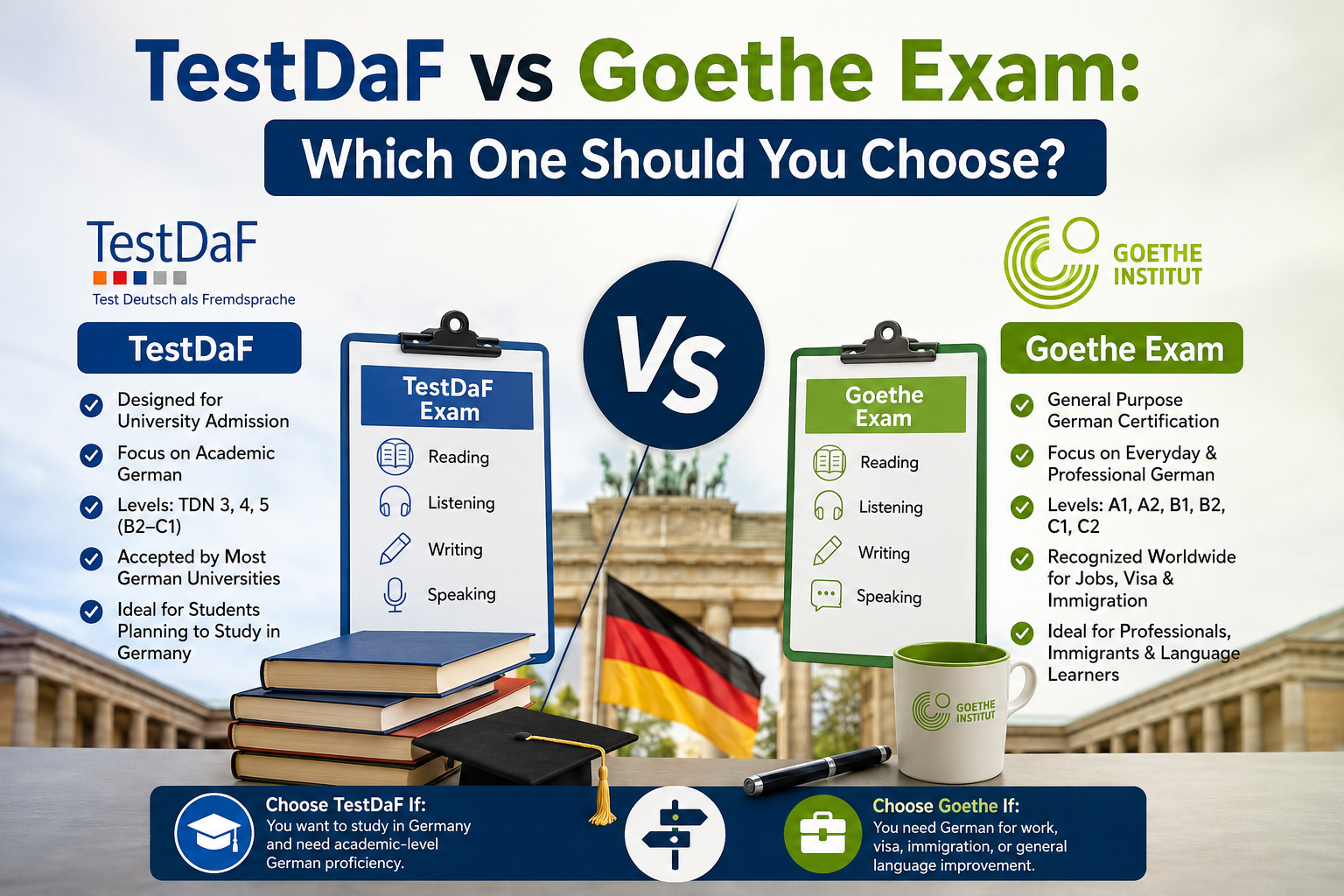
If you're planning to learn German for higher education, career growth, immigration, or personal development, obtaining a recognized German language certification is an important milestone. Among the most respected German proficiency exams worldwide, TestDaF and Goethe-Zertifikat stand out as the top choices.
However, many German language learners often face a common question:
"Should I take the TestDaF exam or the Goethe exam?"
Both certifications are internationally recognized and demonstrate your German language proficiency, but they serve different purposes and cater to different audiences.
In this comprehensive guide, we will compare TestDaF vs Goethe Exam, explain their differences, eligibility, exam structure, difficulty level, costs, benefits, and help you determine which certification is best suited to your goals.
What is the Goethe Exam?
The Goethe-Zertifikat is a German language certification offered by the Goethe-Institut, Germany's official cultural institute that promotes German language and culture worldwide.
The Goethe certification follows the Common European Framework of Reference for Languages (CEFR) and is available at various proficiency levels:
- Goethe A1
- Goethe A2
- Goethe B1
- Goethe B2
- Goethe C1
- Goethe C2
These certifications are recognized by employers, educational institutions, and government authorities globally.
Purpose of Goethe Exams
The Goethe exams are designed for:
- Students learning German
- Professionals seeking career opportunities
- Individuals applying for visas
- Immigrants moving to Germany
- University applicants
- German language enthusiasts
What is TestDaF?
TestDaF (Test Deutsch als Fremdsprache) is a standardized German language examination specifically designed for students who wish to study at German universities.
Unlike Goethe exams, TestDaF focuses primarily on academic German and assesses whether candidates possess the language skills required for university-level education in Germany.
The TestDaF certificate is accepted by nearly all universities in Germany as proof of German language proficiency.
Purpose of TestDaF
TestDaF is ideal for:
- International students
- University applicants
- Research scholars
- Academic professionals
- Individuals planning higher education in Germany
TestDaF vs Goethe Exam: Quick Comparison
| Feature | Goethe Exam | TestDaF |
|---|---|---|
| Purpose | General German proficiency | Academic German proficiency |
| Levels Available | A1 to C2 | B2 to C1 level |
| Conducted By | Goethe-Institut | TestDaF Institute |
| Accepted By | Worldwide institutions and employers | German universities |
| Focus | Everyday and professional German | Academic German |
| Difficulty | Varies by level | Generally advanced |
| Best For | Jobs, visas, immigration, general learning | University admissions |
| Validity | Lifetime | Lifetime |
| International Recognition | Very High | Very High |
Understanding Goethe Exam Levels
One of the biggest advantages of Goethe certifications is flexibility.
Goethe A1
This is the beginner level.
Candidates can:
- Introduce themselves
- Understand simple sentences
- Handle basic conversations
Ideal for:
- Complete beginners
- Family reunion visas
Goethe A2
At this level, learners can:
- Communicate in everyday situations
- Understand common expressions
- Participate in simple discussions
Goethe B1
This level demonstrates independent language use.
Candidates can:
- Manage daily conversations
- Express opinions
- Understand common texts
Many German visa and residency programs accept B1 certification.
Goethe B2
B2 is considered an upper-intermediate level.
Students can:
- Communicate fluently
- Understand complex texts
- Participate in professional discussions
Employers often prefer candidates with B2 certification.
Goethe C1
This advanced level is frequently accepted by universities.
Candidates can:
- Understand academic content
- Use German professionally
- Express ideas effectively
Goethe C2
This is the highest level of German proficiency.
It demonstrates near-native fluency.
Understanding TestDaF Levels
Unlike Goethe, TestDaF does not offer multiple beginner-to-advanced levels.
Instead, it measures academic proficiency using three score bands:
TDN 3
Equivalent to approximately B2 level.
Many universities may not accept only TDN 3.
TDN 4
Equivalent to strong B2/C1 proficiency.
This is the minimum requirement for most German universities.
TDN 5
Represents advanced C1-level German.
Highly preferred by competitive academic programs.
Exam Structure: Goethe vs TestDaF
Goethe Exam Structure
The Goethe exam evaluates four language skills:
Reading
Candidates read texts and answer questions.
Writing
Students write letters, essays, or formal responses.
Listening
Candidates listen to conversations and recordings.
Speaking
Face-to-face or online speaking assessments.
The difficulty varies according to the chosen level.
TestDaF Structure
TestDaF also assesses four core skills:
Reading Comprehension
Academic articles and university-related texts.
Listening Comprehension
Lectures, discussions, and academic conversations.
Writing
Academic essay writing.
Speaking
Computer-based responses to academic situations.
The content is heavily focused on university and educational environments.
Which Exam is More Difficult?
This is one of the most frequently asked questions.
Goethe Exam Difficulty
The difficulty depends entirely on the level selected.
For example:
- Goethe A1 is relatively easy.
- Goethe B1 requires moderate proficiency.
- Goethe C1 and C2 are highly challenging.
Since learners can choose their level, the Goethe route is generally more flexible.
TestDaF Difficulty
TestDaF is considered more demanding because:
- It targets academic German.
- Questions involve university-level topics.
- Strong reading and writing skills are required.
- Speaking tasks are often formal and academic.
Most learners find TestDaF more challenging than Goethe B2.
University Admission: Which Exam is Better?
If your goal is studying in Germany, TestDaF has a clear advantage.
German universities widely accept:
- TestDaF TDN 4 or higher
- Goethe C1
- Goethe C2
However, TestDaF was specifically created for academic admissions.
Therefore, many students choose TestDaF when applying for bachelor's, master's, or doctoral programs.
Winner for University Admission:
TestDaF
Career Opportunities: Which Exam is Better?
For employment purposes, Goethe certifications are generally more versatile.
Many employers recognize:
- Goethe B1
- Goethe B2
- Goethe C1
These certificates prove practical communication skills useful in workplace environments.
Winner for Career Opportunities:
Goethe Exam
Immigration and Visa Purposes
For immigration-related requirements, Goethe certificates are usually preferred.
Examples include:
- Family reunion visas
- Permanent residency applications
- Citizenship requirements
German authorities commonly request:
- Goethe A1
- Goethe B1
depending on the visa category.
Winner for Immigration:
Goethe Exam
Recognition Worldwide
Both certifications enjoy excellent global recognition.
Goethe Recognition
Accepted by:
- Universities
- Employers
- Government agencies
- Immigration authorities
across multiple countries.
TestDaF Recognition
Primarily recognized for:
- German university admissions
- Academic applications
- Educational institutions
Winner:
Tie
Cost Comparison
Exam fees vary by country and testing center.
Generally:
Goethe Exam
Costs depend on level:
- A1–B1: Lower fees
- B2–C2: Higher fees
TestDaF
Usually costs more than lower-level Goethe exams because it is an advanced academic examination.
Always check official testing centers for current pricing.
Advantages of Goethe Exam
1. Multiple Levels Available
Suitable for beginners and advanced learners.
2. Flexible Learning Path
You can progress gradually from A1 to C2.
3. Ideal for Immigration
Widely accepted for visa and residency purposes.
4. Career-Friendly
Employers recognize Goethe certifications globally.
5. Strong Global Presence
Available in numerous countries and cities.
Advantages of TestDaF
1. University-Focused
Specifically designed for higher education.
2. Accepted Across Germany
Recognized by almost all German universities.
3. Academic Skill Assessment
Tests the language skills required for lectures, assignments, and research.
4. Single Examination
No need to complete multiple levels separately.
Who Should Choose Goethe?
Choose Goethe if:
- You are a beginner.
- You want step-by-step certification.
- You need German for work.
- You need German for immigration.
- You want globally recognized language proof.
- You are not yet ready for academic-level German.
Who Should Choose TestDaF?
Choose TestDaF if:
- You want to study in Germany.
- You are applying to German universities.
- You already possess B2/C1-level German.
- You need proof of academic language proficiency.
- Your primary goal is higher education.
Preparation Tips for Both Exams
Build Strong Vocabulary
Learn at least 15–20 new words daily.
Practice Listening
Listen to:
- German podcasts
- News channels
- Audiobooks
Read German Content
Read:
- Newspapers
- Blogs
- Academic articles
Improve Writing
Practice essays, emails, and summaries regularly.
Take Mock Tests
Mock exams help improve:
- Time management
- Accuracy
- Confidence
Final Verdict: TestDaF vs Goethe Exam
Choosing between TestDaF and Goethe depends entirely on your goals.
If you want a German language certification for career growth, immigration, professional opportunities, or gradual language development, the Goethe Exam is the best choice.
If your primary objective is studying at a German university, then TestDaF is often the better option because it is specifically designed to evaluate academic German proficiency.
Choose Goethe If:
✔ You are a beginner or intermediate learner
✔ You need certification for jobs or immigration
✔ You prefer level-based progression
Choose TestDaF If:
✔ You plan to study in Germany
✔ You already have strong German skills
✔ You need university admission requirements
Both certifications are highly respected and can open doors to exciting educational, professional, and international opportunities. The right choice depends on your personal goals, current language level, and future plans in Germany.
Frequently Asked Questions (FAQs)
Is TestDaF harder than Goethe?
Yes, TestDaF is generally considered more difficult because it focuses on academic German and university-level communication.
Is Goethe accepted by German universities?
Yes. Many universities accept Goethe C1 and C2 certificates as proof of German proficiency.
Which certificate is better for jobs?
Goethe certifications are generally more suitable for employment and professional opportunities.
Can I study in Germany with Goethe B2?
Some institutions may accept it, but most universities prefer Goethe C1, TestDaF TDN 4, or equivalent qualifications.
Which certification has more value?
Both have significant value. Goethe is broader and suitable for various purposes, while TestDaF is specialized for academic admissions.