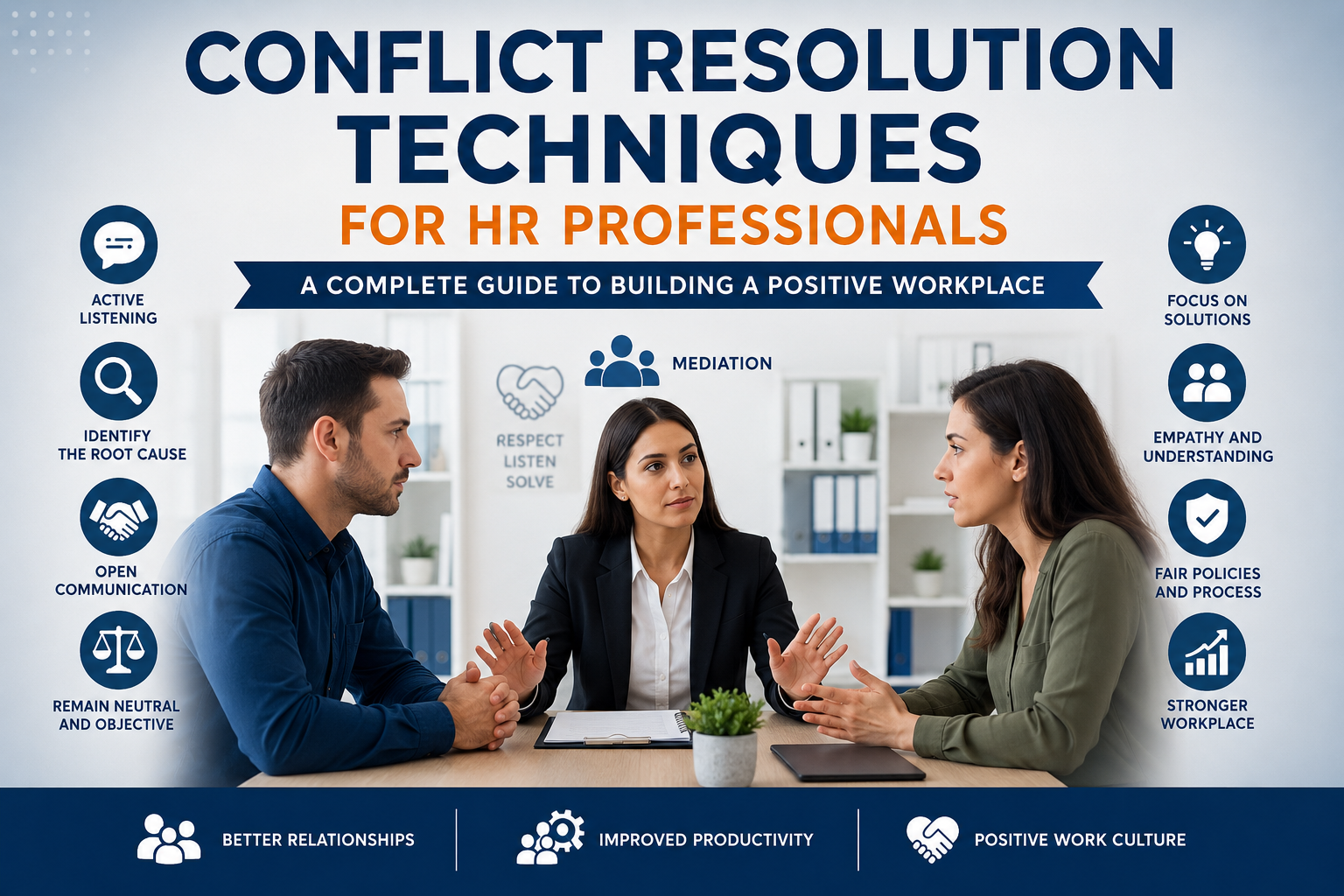
Introduction
In every organization, employees from diverse backgrounds, personalities, experiences, and perspectives work together to achieve common goals. While diversity of thought and experience can drive innovation and growth, it can also lead to workplace conflicts. Differences in communication styles, work expectations, responsibilities, and interpersonal relationships often create disagreements that can affect productivity and employee morale.
This is where Human Resource (HR) professionals play a crucial role. HR professionals are not only responsible for recruitment and employee management but also act as mediators and problem-solvers when workplace conflicts arise. Effective conflict resolution is one of the most valuable skills an HR professional can possess because unresolved conflicts can negatively impact teamwork, employee satisfaction, and overall organizational success.
In today's fast-paced business environment, organizations need HR professionals who can identify, manage, and resolve conflicts efficiently. This article explores the importance of conflict resolution in HR, common workplace conflicts, and practical techniques HR professionals can use to create a healthy and productive work environment.
What is Conflict Resolution in Human Resources?
Conflict resolution refers to the process of addressing disagreements, disputes, or misunderstandings between employees, teams, or management in a constructive manner. The objective is not merely to end the disagreement but to find a solution that benefits all parties involved while maintaining workplace harmony.
For HR professionals, conflict resolution involves:
- Identifying the root cause of conflicts
- Facilitating productive discussions
- Encouraging mutual understanding
- Developing fair solutions
- Preventing future disputes
Successful conflict resolution helps organizations maintain positive employee relationships and a collaborative work culture.
Why Conflict Resolution Skills Are Important for HR Professionals
1. Improves Employee Productivity
Workplace conflicts often distract employees from their tasks and responsibilities. When disagreements remain unresolved, productivity declines as employees spend more time focusing on disputes than work.
HR professionals who resolve conflicts quickly help employees refocus on their responsibilities and contribute effectively to organizational goals.
2. Enhances Workplace Relationships
Strong professional relationships are essential for teamwork and collaboration. Conflict resolution helps employees understand different perspectives and rebuild trust.
3. Reduces Employee Turnover
Employees who experience ongoing workplace conflicts are more likely to become dissatisfied and seek employment elsewhere. Effective conflict management improves employee retention and job satisfaction.
4. Promotes a Positive Work Culture
Organizations that address conflicts fairly create an environment where employees feel respected, valued, and heard.
5. Prevents Legal and Compliance Issues
Certain workplace conflicts can escalate into harassment, discrimination, or legal disputes. HR professionals play a vital role in ensuring organizational compliance and protecting both employees and employers.
Common Types of Workplace Conflicts
Understanding different types of workplace conflicts helps HR professionals address them more effectively.
1. Employee-to-Employee Conflict
This is one of the most common workplace conflicts. It may arise due to:
- Personality differences
- Communication issues
- Competition for resources
- Misunderstandings
2. Manager-Employee Conflict
Conflicts between supervisors and employees may result from:
- Unclear expectations
- Micromanagement
- Performance evaluations
- Lack of feedback
3. Team Conflicts
Team conflicts occur when employees disagree about project goals, responsibilities, deadlines, or work methods.
4. Interdepartmental Conflicts
Different departments often have varying priorities, leading to disputes over resources, budgets, and operational processes.
5. Workplace Harassment and Discrimination Issues
These conflicts are particularly sensitive and require immediate HR intervention to ensure a safe and respectful workplace.
Major Causes of Workplace Conflict
Understanding the root causes helps HR professionals implement effective solutions.
Poor Communication
Miscommunication often leads to misunderstandings, incorrect assumptions, and unnecessary disputes.
Unclear Roles and Responsibilities
Employees may become frustrated when job expectations are not clearly defined.
Personality Differences
People have different communication styles, values, and working methods, which can sometimes create tension.
Competition and Resource Constraints
Limited resources, promotions, and recognition opportunities can create workplace rivalry.
Organizational Changes
Restructuring, mergers, new leadership, and policy changes often lead to uncertainty and conflict.
Effective Conflict Resolution Techniques for HR Professionals
1. Active Listening
Active listening is one of the most important conflict resolution skills.
HR professionals should:
- Listen without interrupting
- Maintain eye contact
- Show empathy
- Ask clarifying questions
- Avoid making assumptions
When employees feel heard, they are more willing to cooperate and seek solutions.
Example:
If two employees disagree about project responsibilities, HR should allow each person to explain their perspective fully before discussing possible solutions.
2. Identify the Root Cause
Many workplace conflicts are symptoms of deeper issues.
Instead of focusing only on surface-level disagreements, HR professionals should investigate:
- What caused the conflict?
- When did it begin?
- What factors contributed to the situation?
Finding the root cause allows for long-term solutions rather than temporary fixes.
3. Encourage Open Communication
Creating a safe environment for honest communication is essential.
HR professionals should encourage employees to:
- Express concerns respectfully
- Discuss issues directly
- Focus on facts rather than emotions
- Avoid personal attacks
Open communication often prevents small disagreements from escalating into major conflicts.
4. Remain Neutral and Objective
One of the most important responsibilities of HR is maintaining impartiality.
HR professionals should:
- Avoid taking sides
- Base decisions on facts
- Follow company policies
- Treat all parties fairly
Neutrality builds trust and credibility throughout the organization.
5. Use Mediation Techniques
Mediation involves helping conflicting parties reach a mutually acceptable solution.
During mediation, HR professionals should:
- Establish ground rules
- Encourage respectful dialogue
- Identify shared interests
- Facilitate compromise
Effective mediation helps preserve workplace relationships while resolving disagreements.
6. Focus on Problem-Solving
Instead of assigning blame, HR professionals should focus on finding practical solutions.
Questions such as:
- What outcome would satisfy both parties?
- How can similar conflicts be prevented?
- What changes can improve collaboration?
These discussions shift attention from conflict to resolution.
7. Develop Emotional Intelligence
Emotional intelligence is the ability to recognize and manage emotions effectively.
HR professionals with strong emotional intelligence can:
- Understand employee concerns
- Respond calmly under pressure
- Build positive relationships
- Resolve disputes more effectively
Emotional intelligence is often the difference between successful and unsuccessful conflict management.
8. Establish Clear Workplace Policies
Clear policies help prevent misunderstandings and disputes.
Organizations should have documented policies regarding:
- Workplace behavior
- Harassment prevention
- Communication standards
- Performance expectations
- Grievance procedures
HR professionals must ensure employees understand these policies.
9. Provide Conflict Resolution Training
Training employees and managers in conflict management skills can significantly reduce workplace disputes.
Training programs may cover:
- Communication skills
- Negotiation techniques
- Team collaboration
- Emotional intelligence
- Workplace ethics
Regular training promotes a culture of respect and understanding.
10. Follow Up After Resolution
Resolving a conflict is only the first step.
HR professionals should follow up with involved employees to ensure:
- Agreements are being followed
- Relationships are improving
- No new issues have emerged
Follow-up demonstrates commitment to long-term workplace harmony.
The Role of Communication in Conflict Resolution
Communication is at the heart of every workplace interaction.
HR professionals should promote:
Transparent Communication
Employees should have access to accurate information and organizational updates.
Respectful Communication
Organizations should encourage respectful dialogue regardless of differences.
Constructive Feedback
Regular feedback helps address concerns before they become major conflicts.
Strong communication practices significantly reduce workplace tensions.
Conflict Resolution Models HR Professionals Can Use
The Interest-Based Relational Approach
This approach focuses on maintaining positive relationships while addressing conflicts.
Key principles include:
- Respecting individual differences
- Separating people from problems
- Working collaboratively toward solutions
The Thomas-Kilmann Conflict Model
This model identifies five conflict-handling styles:
Competing
Prioritizing one's own concerns.
Collaborating
Finding a win-win solution.
Compromising
Both parties make concessions.
Avoiding
Delaying or avoiding confrontation.
Accommodating
Prioritizing the other party's concerns.
HR professionals should understand when each style is appropriate.
Benefits of Effective Conflict Resolution
Organizations that prioritize conflict resolution experience numerous benefits.
Increased Employee Engagement
Employees are more motivated when workplace relationships are healthy.
Better Teamwork
Teams collaborate more effectively when conflicts are addressed constructively.
Higher Productivity
Reduced distractions allow employees to focus on achieving organizational goals.
Improved Employee Retention
Satisfied employees are more likely to remain with the organization.
Stronger Organizational Culture
Conflict resolution contributes to a positive and inclusive work environment.
Challenges HR Professionals Face in Conflict Resolution
Despite best efforts, conflict resolution can be challenging.
Common obstacles include:
- Emotional reactions
- Resistance to compromise
- Lack of trust
- Cultural differences
- Communication barriers
HR professionals must remain patient, professional, and solution-focused.
Future of Conflict Resolution in Human Resources
The modern workplace continues to evolve due to:
- Remote work
- Hybrid work environments
- Global teams
- Digital communication tools
As workplaces become more diverse and technologically connected, conflict resolution skills will become even more valuable.
Future HR professionals must combine traditional mediation techniques with digital communication and emotional intelligence skills to address emerging workplace challenges.
Conclusion
Conflict is an inevitable part of any workplace, but it does not have to be destructive. When managed effectively, conflict can lead to improved communication, stronger relationships, and innovative solutions. HR professionals play a central role in ensuring workplace disputes are resolved fairly and constructively.
By practicing active listening, maintaining neutrality, encouraging open communication, using mediation techniques, and focusing on problem-solving, HR professionals can transform workplace conflicts into opportunities for growth and collaboration.
As organizations continue to prioritize employee well-being and workplace culture, conflict resolution will remain one of the most essential skills for HR professionals. Investing in HR training and conflict management education helps organizations build stronger teams, improve productivity, and create a positive work environment where employees can thrive.