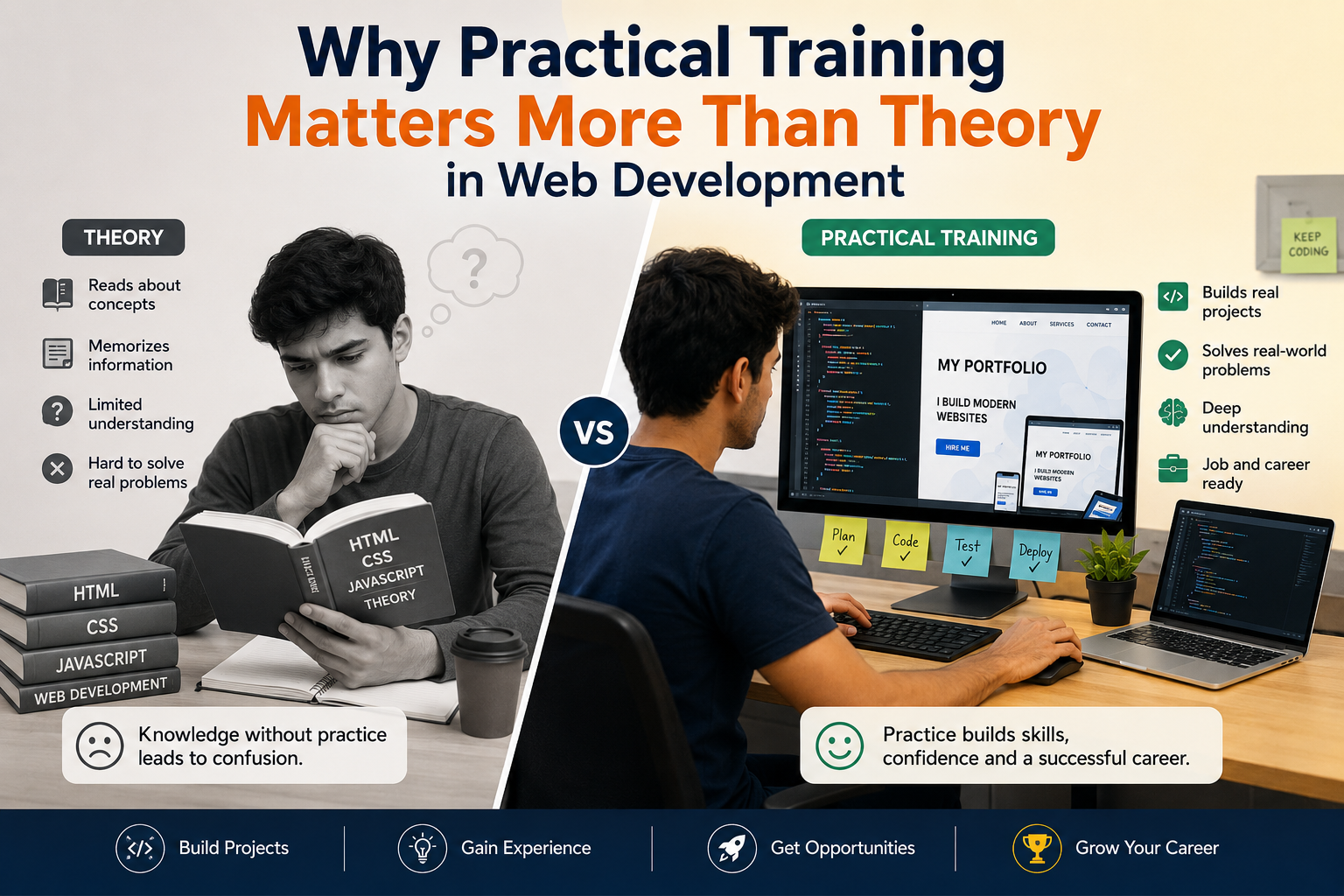
In today’s digital world, web development has become one of the most in-demand skills across industries. From startups and e-commerce brands to multinational corporations, every business needs a strong online presence. Because of this growing demand, thousands of students enroll in web development courses every year. However, one important question remains: Is theoretical knowledge enough to become a successful web developer?
The answer is simple — No.
While theory helps students understand concepts, practical training is what truly transforms learners into skilled professionals. In web development, employers do not just look for certificates or theoretical understanding. They want developers who can build responsive websites, solve real-world problems, debug errors, and create user-friendly applications.
This is why practical training matters far more than theory in web development.
In this blog, we will explore the importance of hands-on learning, real-world projects, coding practice, industry exposure, and why practical experience is the key to becoming a successful web developer.
What Is Practical Training in Web Development?
Practical training refers to the hands-on experience students gain while learning web development. Instead of only reading about programming languages or memorizing definitions, students actively create websites, write code, build projects, and solve real coding problems.
Practical training may include:
Building responsive websites
Designing landing pages
Creating portfolio websites
Developing e-commerce platforms
Working on live projects
Debugging code errors
Learning version control tools like Git
Collaborating on team projects
Hosting websites online
This type of learning helps students understand how web development works in real-life situations.
Why Theory Alone Is Not Enough
Theoretical knowledge is important because it builds the foundation of learning. Students need to understand concepts like HTML structure, CSS styling, JavaScript functions, databases, and frameworks.
However, theory alone has limitations.
A student may know the definition of responsive design but still struggle to create a responsive website. Similarly, someone may memorize JavaScript concepts but fail to apply them in a real project.
Web development is a skill-based field. Skills improve only through practice.
Imagine learning how to drive a car only by reading books. No matter how much theory you study, you cannot become a good driver without actually driving on the road. The same principle applies to web development.
Practical Training Builds Real Skills
One of the biggest advantages of practical training is that it develops real-world skills.
When students work on projects, they learn:
How to structure websites properly
How to write clean and efficient code
How to solve errors and bugs
How to improve website speed
How to create mobile-friendly designs
How to optimize user experience
These skills cannot be fully learned through theory alone.
Hands-on learning allows students to understand the practical application of coding concepts. It improves confidence and prepares learners for professional work environments.
Learning by Doing Improves Understanding
Practical learning helps students retain information more effectively.
Studies show that people learn faster when they actively participate instead of passively reading or listening. In web development, coding regularly strengthens understanding and improves memory.
For example:
A student may read about CSS Flexbox and Grid systems in theory classes. But once they use these concepts to build layouts for real websites, the learning becomes permanent.
Similarly, JavaScript concepts become much clearer when students create interactive features such as:
Image sliders
Login forms
Navigation menus
Calculators
Dynamic web pages
This learning-by-doing approach makes complex concepts easier to understand.
Real Projects Prepare Students for Industry Work
Employers prefer candidates who have practical project experience.
Most companies ask questions like:
Have you built any live websites?
Do you have a portfolio?
Can you solve coding problems?
Have you worked on real projects?
This is because companies need developers who can contribute immediately.
Practical training gives students exposure to real-world development environments. They learn how projects are planned, designed, developed, tested, and launched.
By working on projects, students also learn:
Time management
Team collaboration
Client requirements
Problem-solving
Communication skills
These professional skills are extremely valuable in the tech industry.
Practical Experience Boosts Confidence
Many students feel nervous during interviews because they only know theoretical concepts. They may struggle when interviewers ask practical coding questions.
Practical training solves this problem.
When students regularly build projects and practice coding, they become more confident in their abilities. They can explain their work clearly and demonstrate their technical skills.
Confidence plays a major role in:
Job interviews
Freelance client meetings
Team discussions
Technical presentations
A confident developer has better chances of success in the competitive tech industry.
Error Solving Is Learned Through Practice
One of the most important skills in web development is debugging.
Even experienced developers face coding errors daily. What makes a skilled developer different is the ability to identify and fix those issues efficiently.
Theory may explain what errors are, but only practical experience teaches students how to solve them.
When students work on real projects, they encounter challenges such as:
Broken layouts
JavaScript bugs
Server errors
Responsive design issues
Browser compatibility problems
By solving these problems repeatedly, they become stronger developers.
Practical learning teaches patience, analytical thinking, and troubleshooting abilities.
Practical Training Makes Students Job-Ready
Today, companies prioritize skills over degrees.
A student with strong practical knowledge often performs better than someone who only has theoretical understanding.
Practical training helps students become job-ready because they learn:
Industry-standard tools
Modern frameworks
Real development workflows
Team collaboration systems
Project deployment methods
Many training institutes now focus on project-based learning because employers demand skilled developers who can work efficiently from day one.
Importance of Portfolio Development
A portfolio is one of the most powerful tools for web developers.
It showcases a developer’s practical abilities through live projects and designs.
Practical training helps students create impressive portfolios that include:
Personal websites
Business websites
E-commerce stores
Web applications
Responsive layouts
UI/UX projects
A strong portfolio increases opportunities for:
Freelancing
Internships
Remote jobs
Full-time employment
In many cases, a good portfolio matters more than academic marks.
Practical Learning Encourages Creativity
Web development is not only about coding. It also involves creativity and problem-solving.
Practical projects encourage students to think creatively while designing websites and applications.
They learn how to:
Choose layouts
Create attractive interfaces
Improve user experience
Design mobile-friendly pages
Add animations and interactivity
Creativity develops naturally through experimentation and practice.
This creative thinking helps developers stand out in the industry.
Better Understanding of Modern Technologies
Technology changes rapidly in the web development field.
New tools, frameworks, and design trends appear frequently. Practical training helps students stay updated with modern technologies because they actively work with them.
Some modern technologies include:
React.js
Node.js
Tailwind CSS
Bootstrap
MongoDB
Express.js
APIs
GitHub
Hands-on experience with these technologies makes students more competitive in the job market.
Practical Training Improves Problem-Solving Skills
Every web development project involves challenges.
Developers constantly solve problems related to:
Website performance
User interface design
Database connections
Security
Mobile responsiveness
Practical training trains the brain to think logically and solve technical problems effectively.
Problem-solving is one of the most valuable skills employers look for in developers.
Freelancing Opportunities Increase with Practical Skills
Freelancing has become a major career option for web developers.
Clients do not ask freelancers for theoretical certificates. They care about results and project quality.
Practical training helps students gain the confidence to:
Build websites for clients
Handle real projects
Communicate professionally
Meet deadlines
Deliver quality work
With strong practical skills, developers can earn money through freelancing even before completing their studies.
Internship Opportunities Become Easier
Companies offering internships usually prefer candidates who already have project experience.
Practical training improves the chances of getting internships because students already know how to work with coding tools and development environments.
Internships further enhance industry experience and help students understand professional workflows.
Teamwork and Collaboration Skills
Modern web development often involves teamwork.
Developers work with:
Designers
Backend developers
Content writers
Marketing teams
Project managers
Practical training introduces students to collaborative work environments where they learn communication and coordination skills.
These experiences prepare students for real company culture.
Why Companies Prefer Practically Skilled Developers
Companies want employees who can solve real problems and contribute immediately.
A practically trained developer can:
Build websites faster
Debug errors efficiently
Understand client requirements
Adapt to technologies quickly
Work independently
This saves companies time and training costs.
As a result, candidates with hands-on experience are often preferred during hiring.
Role of Coding Practice in Success
Coding is like a muscle — the more you practice, the stronger you become.
Regular coding practice improves:
Logic-building
Speed
Accuracy
Confidence
Creativity
Students who code daily become more comfortable with programming concepts and development tools.
Consistency is the key to becoming an expert web developer.
Practical Training Creates Industry Exposure
Hands-on learning exposes students to real-world scenarios.
They learn:
How websites are deployed
How hosting works
How domains are connected
How APIs integrate
How users interact with websites
This industry exposure makes learning more meaningful and realistic.
Online Learning Platforms and Practical Education
Modern online learning platforms now focus heavily on practical assignments and projects.
Students can learn through:
Coding bootcamps
Live projects
Coding challenges
Hackathons
Internship programs
These practical learning methods are far more effective than traditional memorization-based education.
Balancing Theory and Practical Learning
Although practical training is extremely important, theory should not be ignored completely.
The best learning approach combines:
Strong theoretical foundations
Continuous practical implementation
Theory explains “why” something works, while practical training teaches “how” to make it work.
Both are important, but practical experience plays the bigger role in becoming a professional web developer.
Future of Practical Learning in Web Development
The future of education is becoming more skill-focused.
Companies are shifting toward hiring developers based on:
Skills
Portfolios
Real-world projects
Problem-solving ability
This trend makes practical training more valuable than ever before.
Educational institutes that focus on hands-on learning will continue producing better developers for the modern tech industry.
Conclusion
In the world of web development, practical training is the bridge between knowledge and success.
Theory provides understanding, but practical experience builds confidence, skills, creativity, and industry readiness. Students who actively work on projects, solve real problems, and practice coding regularly become far more capable developers than those who rely only on theoretical learning.
Practical training prepares students for:
Real jobs
Freelancing opportunities
Client projects
Technical interviews
Team collaboration
Industry challenges
As technology continues to evolve, companies will increasingly prefer developers who can demonstrate practical abilities rather than just academic qualifications.
If you truly want to succeed in web development, focus not only on learning concepts but also on applying them through consistent practice and real-world projects.
Because in web development, the best way to learn is simple:
Learn by building.