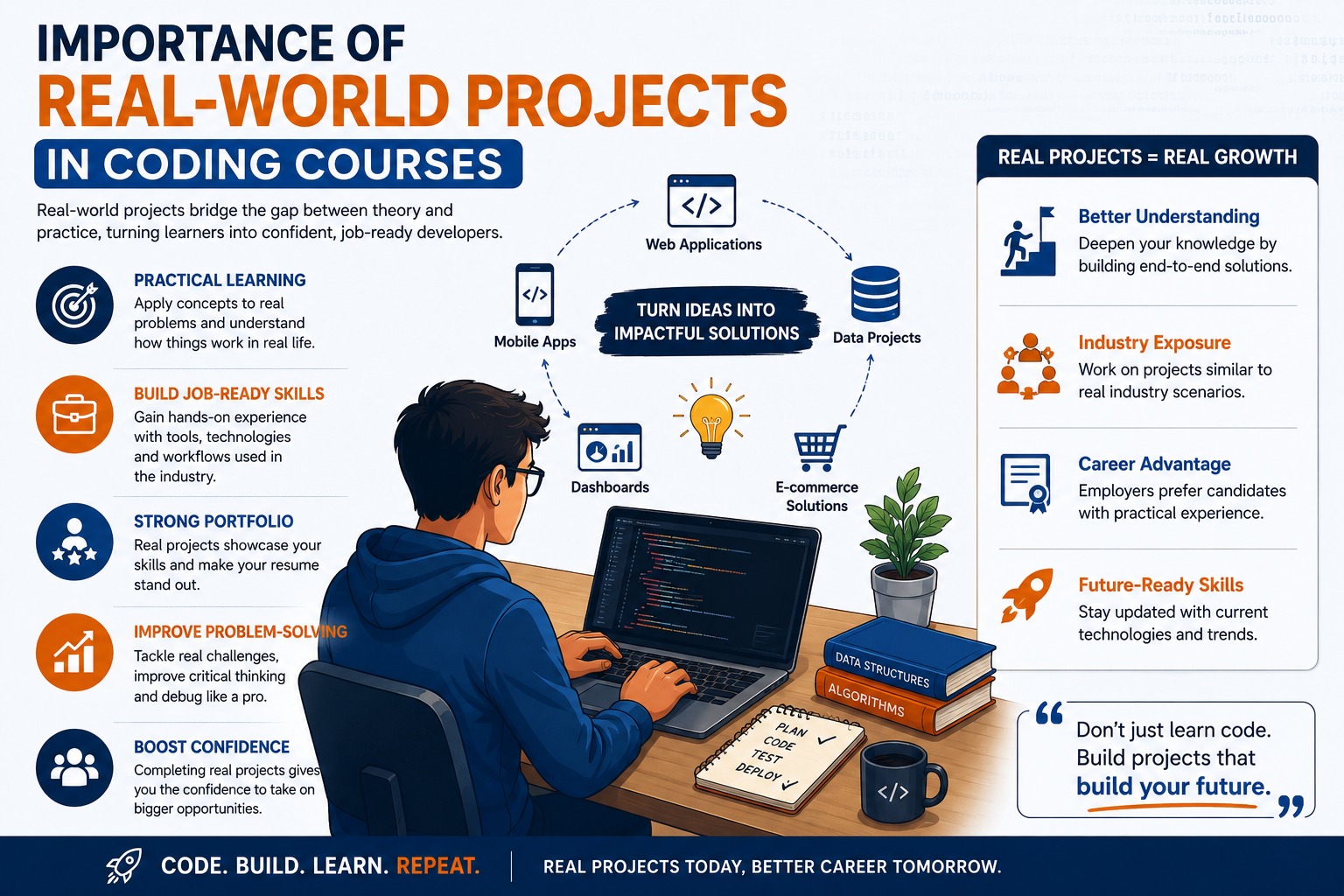
In today’s technology-driven world, coding has become one of the most valuable skills for students and professionals alike. From web development and mobile apps to artificial intelligence and cybersecurity, programming skills are opening doors to countless career opportunities. However, learning programming through theory alone is no longer enough. Employers today look for practical experience, problem-solving abilities, and hands-on expertise. This is where real-world projects in coding courses play a crucial role.
Real-world projects bridge the gap between classroom learning and industry expectations. They allow students to apply coding concepts in practical scenarios, build confidence, create portfolios, and gain job-ready skills. Whether someone is learning Python, JavaScript, Java, data science, or full-stack development, project-based learning helps transform theoretical knowledge into real expertise.
This blog explores the importance of real-world projects in coding courses, their benefits, how they improve employability, and why every coding student should prioritize hands-on learning.
What Are Real-World Projects in Coding Courses?
Real-world projects are practical assignments designed to simulate actual industry challenges. Instead of only reading about concepts or solving textbook problems, students work on applications, systems, or tools similar to what developers build in professional environments.
Examples include:
Building a responsive website
Creating an e-commerce platform
Developing a mobile app
Designing a chatbot
Building a weather application using APIs
Creating a student management system
Developing AI-based recommendation systems
Designing a portfolio website
Creating games using programming languages
Building data analytics dashboards
These projects help learners understand how coding is used in real businesses and industries.
Why Traditional Coding Learning Is Not Enough
Many learners spend months studying programming syntax, watching tutorials, or memorizing concepts. Yet, when asked to build an actual application, they struggle. This happens because coding is a practical skill.
Reading about programming is similar to reading about swimming—you only improve by practicing.
Traditional learning methods often focus on:
Memorizing syntax
Solving small theoretical exercises
Understanding definitions
Completing multiple-choice tests
While these are useful for foundational knowledge, they do not fully prepare students for real software development environments.
Real-world projects solve this problem by giving learners opportunities to:
Apply concepts practically
Work with real tools and technologies
Debug errors
Manage project structures
Collaborate with teams
Build functional applications
Benefits of Real-World Projects in Coding Courses
1. Improves Practical Coding Skills
One of the biggest advantages of project-based learning is the development of practical coding skills.
When students work on real projects, they:
Write actual code
Fix bugs
Optimize performance
Structure applications properly
Understand coding workflows
For example, learning HTML and CSS theoretically is very different from building a complete responsive website.
Practical implementation helps learners:
Retain concepts better
Gain confidence
Understand coding logic deeply
This hands-on exposure transforms beginners into skilled developers.
2. Enhances Problem-Solving Abilities
Programming is not just about writing code—it is about solving problems.
Real-world projects expose students to:
Unexpected bugs
Integration challenges
User interface issues
Database errors
Performance bottlenecks
By overcoming these challenges, students develop critical thinking and analytical abilities.
For instance:
A login system may fail due to authentication issues.
An API may return incorrect data.
A mobile app may crash because of memory problems.
Solving these practical issues improves debugging and logical reasoning skills, which are highly valued in the tech industry.
3. Builds Industry-Ready Experience
Employers prefer candidates who can contribute immediately. Real-world projects prepare students for professional environments by teaching:
Version control systems like Git and GitHub
Team collaboration
Agile methodologies
Deployment processes
Testing and debugging
Documentation practices
Students become familiar with workflows used in software companies.
This practical exposure significantly increases employability.
4. Strengthens Resume and Portfolio
A strong portfolio can often matter more than certificates.
Recruiters frequently ask:
What projects have you built?
Can you demonstrate your skills?
Do you have GitHub repositories?
Have you solved real problems?
Real-world projects provide tangible proof of skills.
Examples of impressive portfolio projects:
E-commerce websites
AI chatbots
Social media applications
Task management apps
Blogging platforms
Machine learning models
A portfolio showcasing practical applications helps candidates stand out from the competition.
5. Boosts Confidence
Many beginners feel intimidated by coding because they only focus on theory. However, completing projects gives learners a sense of achievement.
Every successful project:
Increases motivation
Builds self-confidence
Encourages experimentation
Reduces fear of complex coding tasks
When students realize they can create functional applications, they become more enthusiastic about learning advanced concepts.
6. Encourages Creativity and Innovation
Real-world projects allow students to explore their creativity.
Instead of simply following tutorials, learners can:
Design unique user interfaces
Add innovative features
Solve everyday problems
Experiment with technologies
For example:
A student passionate about fitness may build a workout tracker app.
A music enthusiast may create a playlist recommendation system.
This freedom encourages innovation and entrepreneurial thinking.
7. Helps Understand Team Collaboration
Software development in companies is rarely a solo activity. Developers often work in teams consisting of:
Front-end developers
Back-end developers
UI/UX designers
Testers
Project managers
Project-based coding courses teach collaboration skills through:
Group assignments
Shared repositories
Team discussions
Code reviews
Students learn:
Communication skills
Task management
Conflict resolution
Collaborative development workflows
These soft skills are equally important in tech careers.
8. Provides Exposure to Real Development Tools
Real-world projects introduce students to industry-standard tools such as:
GitHub
Visual Studio Code
Docker
Firebase
AWS
APIs
Databases
Frameworks like React, Angular, Django, and Node.js
This exposure helps learners become comfortable with modern development ecosystems.
Employers highly value candidates familiar with these tools.
9. Makes Learning More Engaging
Theory-heavy coding courses can become boring and overwhelming. Real-world projects make learning interactive and exciting.
Students enjoy:
Seeing visual outputs
Building functional apps
Creating useful tools
Solving meaningful challenges
This engagement improves:
Learning retention
Course completion rates
Student motivation
Interactive learning environments lead to better educational outcomes.
Importance of Real-World Projects for Different Coding Fields
Web Development
Projects help students learn:
Front-end development
Responsive design
Back-end integration
Database management
API usage
Example projects:
Blogging websites
Portfolio websites
E-commerce stores
Online learning platforms
Data Science and AI
Real-world projects teach:
Data cleaning
Visualization
Machine learning
Predictive analytics
Model deployment
Example projects:
Stock market prediction
Recommendation systems
Sentiment analysis
Fraud detection systems
Mobile App Development
Projects help students understand:
User experience
Mobile responsiveness
App performance
API integration
Cross-platform development
Example projects:
Food delivery apps
Fitness trackers
Chat applications
Expense trackers
Cybersecurity
Project-based learning in cybersecurity includes:
Ethical hacking labs
Network security simulations
Vulnerability testing
Security monitoring systems
Practical exposure is essential because cybersecurity is highly hands-on.
Game Development
Game development projects teach:
Animation
Physics engines
Game logic
User interaction
Performance optimization
Students learn by creating playable games instead of only studying theory.
How Real-World Projects Improve Job Opportunities
Employers Value Experience Over Certificates
Many companies prioritize practical skills over academic scores.
Recruiters often evaluate:
GitHub profiles
Personal portfolios
Project complexity
Real problem-solving abilities
Candidates with strong projects are more likely to:
Get interviews
Pass technical assessments
Receive job offers
Demonstrates Initiative
Building projects independently shows:
Passion for coding
Self-learning ability
Dedication
Curiosity
Employers appreciate proactive learners who continuously improve their skills.
Helps During Technical Interviews
Projects give students real examples to discuss during interviews.
Candidates can explain:
Technologies used
Challenges faced
Solutions implemented
Lessons learned
This creates stronger interview conversations and demonstrates expertise.
Best Types of Real-World Projects for Coding Students
Beginner-Level Projects
Calculator apps
To-do lists
Personal portfolios
Weather apps
Quiz systems
Intermediate-Level Projects
E-commerce websites
Blogging platforms
Chat applications
Expense trackers
Online booking systems
Advanced-Level Projects
AI-powered applications
Social media platforms
Cloud-based systems
Blockchain applications
Real-time collaboration tools
Students should gradually increase project complexity as they improve.
Role of Coding Institutes in Project-Based Learning
A high-quality coding institute should provide:
Hands-on assignments
Live projects
Industry mentorship
Portfolio development
Internship opportunities
Hackathons and coding challenges
The best coding courses focus not only on teaching syntax but also on building real applications.
Before joining a course, students should check:
Whether projects are included
The quality of mentorship
Technologies covered
Industry relevance of assignments
Common Challenges Students Face in Real-World Projects
Fear of Failure
Many beginners hesitate to start projects because they fear making mistakes.
However, errors are part of the learning process. Debugging teaches valuable lessons.
Lack of Guidance
Students may struggle without mentorship. Good coding courses provide:
Project roadmaps
Code reviews
Mentorship sessions
Peer collaboration
Overcomplicated Projects
Beginners sometimes attempt overly advanced applications too early.
The best approach is:
Start small
Build consistently
Improve gradually
Tips for Making the Most of Real-World Projects
Choose Meaningful Projects
Build projects related to:
Personal interests
Industry trends
Real user problems
Meaningful projects increase motivation.
Focus on Problem Solving
Do not just copy tutorials.
Instead:
Customize features
Add improvements
Solve unique challenges
This develops true coding ability.
Maintain a GitHub Portfolio
Upload projects regularly to GitHub.
This helps:
Track progress
Showcase skills
Build professional credibility
Learn Deployment
Deploy projects online using platforms like:
Netlify
Vercel
Heroku
AWS
Live applications make portfolios more impressive.
Document Your Projects
Good documentation includes:
Project overview
Features
Technologies used
Installation steps
Screenshots
Documentation reflects professionalism.
Future of Coding Education: Project-Based Learning
The future of coding education is moving rapidly toward experiential learning.
Modern tech education now emphasizes:
Practical skills
Real business applications
Collaborative development
Industry-focused training
Online learning platforms and coding bootcamps increasingly use:
Capstone projects
Live coding sessions
Hackathons
Internship simulations
This shift reflects changing employer expectations.
Why Students Prefer Project-Based Coding Courses
Students today want:
Career-focused learning
Job-ready skills
Interactive education
Real experience
Project-based learning delivers all these benefits.
Compared to purely theoretical courses, practical training:
Feels more rewarding
Produces faster skill growth
Improves career outcomes
This is why coding bootcamps and modern tech institutes heavily emphasize hands-on projects.
Final Thoughts
The importance of real-world projects in coding courses cannot be overstated. In today’s competitive tech landscape, theoretical knowledge alone is not enough. Practical experience is what transforms learners into skilled developers.
Real-world projects:
Improve coding skills
Enhance problem-solving abilities
Build confidence
Strengthen resumes
Prepare students for industry challenges
Increase job opportunities
Whether someone is learning web development, app development, AI, cybersecurity, or data science, hands-on projects are essential for success.
The best way to master coding is by building real applications, solving actual problems, and continuously practicing. Every project completed becomes a stepping stone toward becoming a professional developer.
If you are planning to join a coding course, choose one that prioritizes project-based learning. The experience gained from real-world projects will not only improve your technical skills but also prepare you for a successful career in the tech industry.