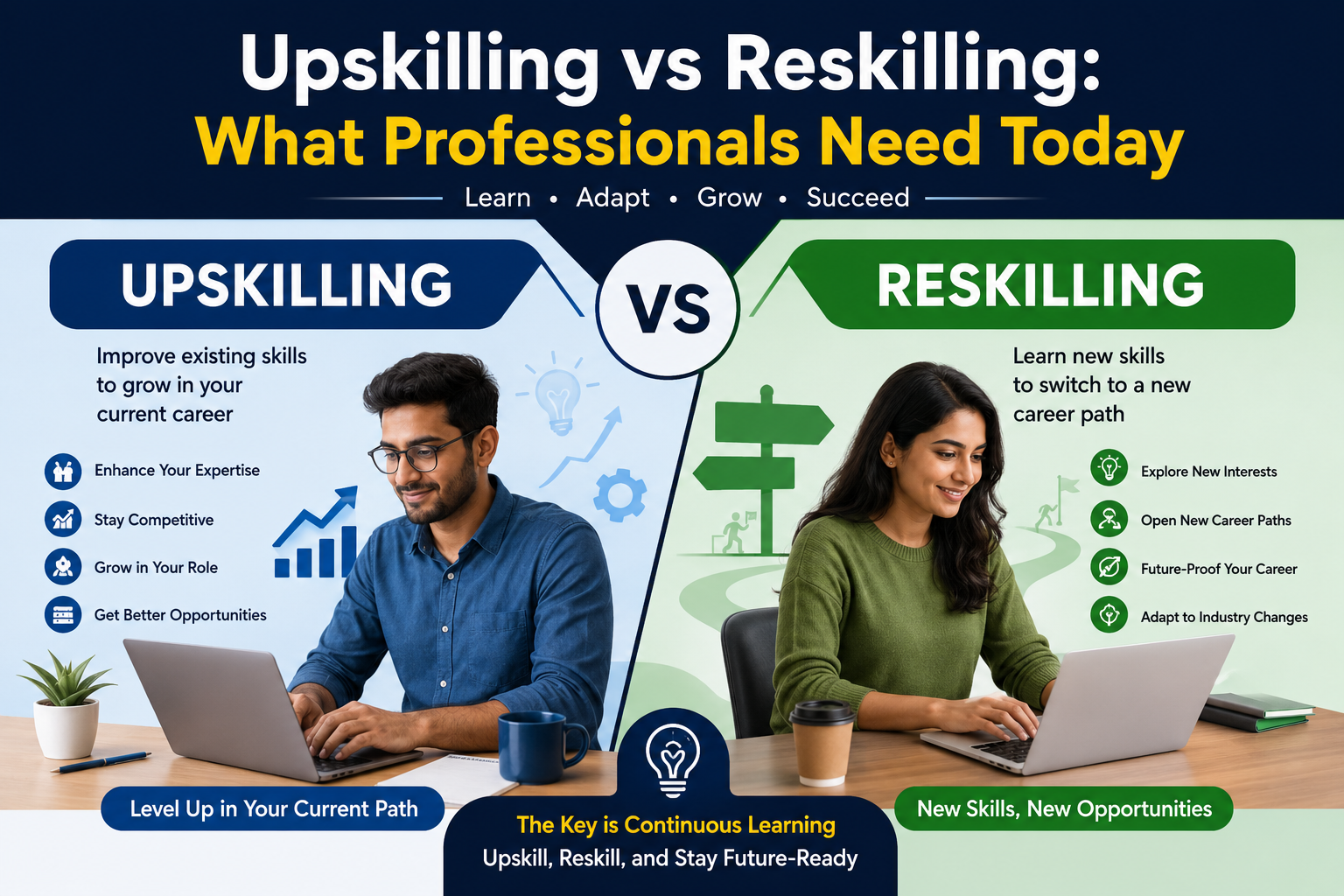
In today’s rapidly evolving professional world, staying relevant is no longer optional — it is essential. Technological advancements, automation, artificial intelligence, remote work culture, and changing industry demands are transforming how businesses operate. As a result, professionals across industries are facing a critical question: Should they focus on upskilling or reskilling?
While both concepts aim to improve employability and career growth, they serve different purposes. Understanding the difference between upskilling and reskilling can help professionals make smarter career decisions and remain competitive in the modern workforce.
This blog explores the meaning, importance, differences, benefits, challenges, and future of upskilling and reskilling. Whether you are a student, employee, manager, or entrepreneur, this guide will help you understand what professionals truly need today.
What Is Upskilling?
Upskilling refers to the process of learning new skills or improving existing skills to perform better in your current role or industry.
In simple words, upskilling helps professionals become more advanced in the career path they are already following.
For example:
A digital marketer learning AI-powered marketing tools
A teacher learning online teaching technologies
A software developer learning cloud computing
An HR professional mastering data analytics
The goal of upskilling is career growth, better productivity, higher salaries, and improved job security.
Example of Upskilling
Imagine a graphic designer who already knows Photoshop. If they learn motion graphics, UI/UX design, or AI image tools, they are upskilling themselves to stay competitive.
What Is Reskilling?
Reskilling means learning completely new skills to switch careers or move into a different role or industry.
Unlike upskilling, reskilling prepares professionals for jobs that may be very different from their current positions.
For example:
A sales executive learning coding to become a web developer
A factory worker learning digital operations management
A journalist transitioning into content marketing
A customer service executive learning cybersecurity
Reskilling is especially important when jobs become outdated due to automation or industry changes.
Example of Reskilling
A retail employee whose role is affected by automation may learn data entry, digital marketing, or e-commerce management to transition into a new field.
Difference Between Upskilling and Reskilling
| Aspect | Upskilling | Reskilling |
|---|---|---|
| Purpose | Improve current skills | Learn entirely new skills |
| Career Path | Same industry/role | Different role or industry |
| Goal | Career advancement | Career transition |
| Learning Focus | Advanced knowledge | Fresh knowledge |
| Example | Learning advanced Excel | Learning coding from scratch |
Both are valuable, but the choice depends on career goals and market demands.
Why Upskilling and Reskilling Matter Today
The modern workforce is changing faster than ever before. Technologies like Artificial Intelligence (AI), automation, machine learning, blockchain, and cloud computing are replacing repetitive tasks and creating entirely new job opportunities.
According to global workforce studies, millions of jobs may disappear due to automation, while millions of new digital jobs will emerge.
This means professionals cannot rely only on degrees earned years ago. Continuous learning has become the new normal.
Major Reasons Why Skill Development Is Important
1. Rapid Technological Change
Technology evolves every year. Professionals who fail to adapt may become outdated in the job market.
2. Increased Competition
Companies now hire based on skills rather than just qualifications. Skilled professionals stand out.
3. Remote and Digital Work Culture
Digital communication, collaboration tools, and virtual workspaces require modern technical skills.
4. AI and Automation
AI is automating repetitive jobs, making creative, analytical, and technical skills more valuable.
5. Career Growth Opportunities
Professionals with updated skills often receive better promotions, salaries, and leadership roles.
Industries Being Transformed by Technology
Almost every industry today is experiencing digital transformation.
1. Healthcare
Technology is improving patient management, telemedicine, AI diagnostics, and digital healthcare systems.
Professionals now need skills in healthcare technology and data management.
2. Banking and Finance
Digital banking, fintech, blockchain, and AI-based fraud detection are changing financial services.
Professionals must learn digital finance tools and analytics.
3. Education
Online learning platforms and AI-based teaching tools are reshaping education.
Teachers are increasingly learning virtual teaching methods.
4. Marketing
Traditional marketing is shifting toward digital marketing, influencer marketing, SEO, and AI-driven campaigns.
5. Manufacturing
Automation and robotics are changing factory operations.
Workers need technical and digital operational skills.
Benefits of Upskilling for Professionals
Better Career Growth
Professionals with advanced skills often get promoted faster.
Higher Salary Potential
Companies are willing to pay more for skilled employees who can solve modern business challenges.
Improved Job Security
Employees with updated knowledge remain valuable to organizations.
Increased Confidence
Learning new tools and technologies improves confidence and performance.
Stronger Professional Reputation
Upskilled employees become industry experts and leaders.
Benefits of Reskilling for Professionals
Career Flexibility
Reskilling allows professionals to move into high-demand industries.
Protection Against Automation
People in declining industries can transition into future-proof careers.
Better Employment Opportunities
New skills open doors to modern job roles.
Personal Growth
Learning something completely new improves adaptability and confidence.
Increased Earning Opportunities
High-demand industries often offer better salaries and career progression.
Top Skills in Demand in 2026
Professionals looking to future-proof their careers should focus on high-demand skills.
Technical Skills
Artificial Intelligence (AI)
Data Analytics
Cloud Computing
Cybersecurity
Digital Marketing
Coding and Programming
UI/UX Design
Blockchain Technology
Soft Skills
Communication Skills
Leadership
Emotional Intelligence
Problem-Solving
Creativity
Adaptability
Critical Thinking
Team Collaboration
Companies today value both technical expertise and human-centered skills.
Upskilling vs Reskilling: Which One Should You Choose?
The answer depends on your career situation.
Choose Upskilling If:
You enjoy your current field
Your industry is evolving
You want promotions or salary growth
Your job still has future demand
Example:
A digital marketer learning AI tools for automation.
Choose Reskilling If:
Your job is becoming outdated
You want a career change
Your industry has limited growth
Automation threatens your role
Example:
A traditional salesperson moving into digital marketing.
Best Platforms for Learning New Skills:
Today, learning is more accessible than ever.
Popular Online Learning Platforms
1. Coursera
Offers university-certified courses in technology, business, and professional skills.
2. Udemy
Provides affordable practical courses for beginners and professionals.
3. LinkedIn Learning
Excellent for professional and corporate skill development.
4. Google Skillshop
Offers free certifications in Google Ads, analytics, and digital marketing.
5. edX
Provides courses from top global universities.
Role of Companies in Employee Development:
Organizations today understand that employee learning is essential for growth.
Many companies are investing heavily in training programs because hiring new employees can be more expensive than training existing ones.
How Companies Support Learning
Internal training sessions
Online certification programs
Mentorship initiatives
Leadership development workshops
Skill-based promotions
Businesses that encourage learning often experience better productivity and employee retention.
Challenges Professionals Face While Learning:
Although learning new skills is beneficial, professionals often face obstacles.
Lack of Time
Busy work schedules make learning difficult.
Fear of Change
Many professionals hesitate to leave their comfort zones.
Financial Constraints
Some certification programs can be expensive.
Information Overload
Too many learning options can create confusion.
Lack of Motivation
Consistency becomes difficult without clear goals.
Tips to Successfully Upskill or Reskill:
Set Clear Career Goals
Know why you want to learn a skill.
Learn Step by Step
Avoid trying to master everything at once.
Practice Regularly
Practical implementation improves retention.
Build a Portfolio
Showcase your projects and certifications.
Stay Updated
Industries evolve constantly, so continuous learning matters.
Future of Work and Continuous Learning:
The future workplace will prioritize adaptability over traditional qualifications.
Experts predict that lifelong learning will become one of the most important career habits.
Professionals who continuously improve themselves will have stronger career stability, higher income opportunities, and better adaptability to change.
Companies will increasingly hire people based on practical skills, creativity, and problem-solving abilities rather than only degrees.
This means the ability to learn quickly may become the most valuable skill of all.
Conclusion:
The debate between upskilling vs reskilling is not about choosing one over the other. Both are essential in today’s evolving professional environment.
Upskilling helps professionals grow within their current careers, while reskilling enables career transformation into new opportunities. In a world driven by technology and innovation, staying static is risky.
Professionals who invest in learning remain relevant, adaptable, and competitive.
Whether you are a student planning your future, a graduate searching for direction, or an experienced employee aiming for growth, continuous learning is the key to long-term success.
The future belongs to those who are willing to learn, adapt, and evolve.
FAQs:
What is the difference between upskilling and reskilling?
Upskilling improves existing skills for career growth, while reskilling teaches new skills for changing careers.
Why is upskilling important today?
Upskilling helps professionals stay competitive, improve productivity, and increase career opportunities.
Which industries require reskilling the most?
Industries heavily affected by automation, such as manufacturing, retail, and traditional administrative roles, often require reskilling.
Can online courses help with career growth?
Yes, online learning platforms provide affordable and flexible ways to develop in-demand skills.
What are the best skills to learn in 2026?
AI, data analytics, cybersecurity, digital marketing, cloud computing, communication, and leadership are among the top skills in demand.