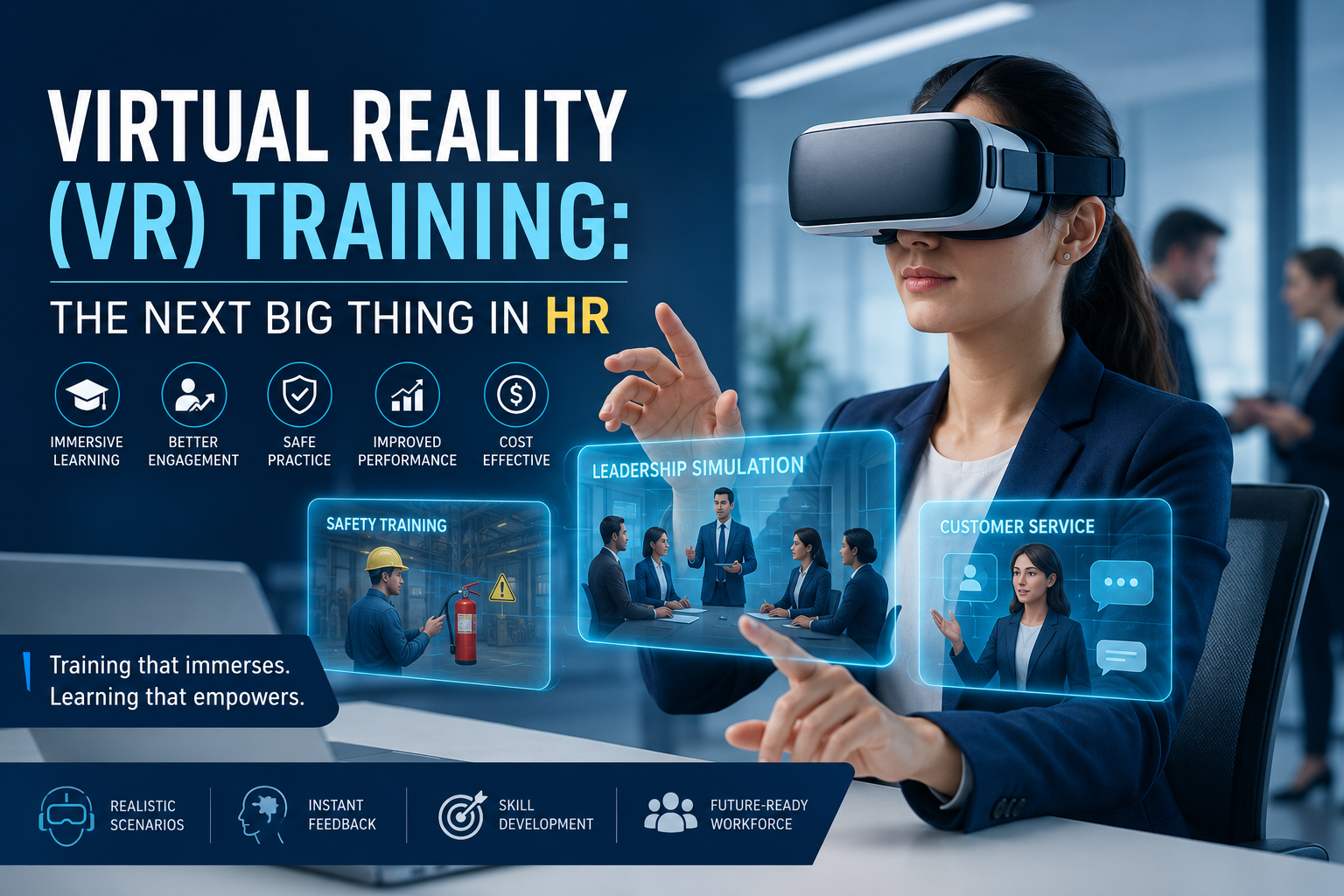
The workplace is evolving faster than ever before. From artificial intelligence to hybrid work environments, organizations are constantly searching for innovative ways to train employees effectively. Among the most transformative technologies redefining Human Resources today is Virtual Reality (VR) Training.
Once associated mainly with gaming and entertainment, Virtual Reality has now become a powerful tool for corporate learning and employee development. Companies across industries are adopting VR training to improve employee engagement, enhance skill development, reduce training costs, and create safer learning environments.
In 2026, VR is no longer just a futuristic concept—it is becoming an essential part of modern HR strategies.
This blog explores how Virtual Reality is transforming HR training, its benefits, use cases, challenges, future trends, and why organizations should invest in VR-based learning programs.
What is Virtual Reality (VR) Training?
Virtual Reality Training refers to the use of immersive digital environments where employees can learn, practice, and interact in simulated workplace scenarios using VR headsets and software.
Instead of reading manuals or attending traditional classroom sessions, employees enter a virtual environment where they can:
Perform tasks
Solve problems
Interact with virtual coworkers or customers
Practice real-world situations
Receive instant feedback
VR creates a highly realistic learning experience that improves knowledge retention and practical skill development.
Why HR Departments are Adopting VR Training
Traditional training methods often struggle to maintain employee engagement. Long presentations, static videos, and theoretical modules may fail to prepare employees for real workplace situations.
HR teams are increasingly turning to VR because it offers:
Interactive learning experiences
Better engagement
Faster skill acquisition
Reduced training risks
Personalized learning
As organizations focus more on employee experience and performance optimization, VR training is emerging as a game-changing solution.
How VR Training Works in HR
VR training combines several technologies:
Virtual Reality headsets
3D simulations
Motion tracking
Artificial Intelligence
Interactive learning software
Employees wear VR headsets and enter digitally created environments designed specifically for training purposes.
For example:
A customer service employee can practice handling difficult customers.
A factory worker can learn machine operations safely.
A healthcare professional can simulate emergency procedures.
A manager can improve leadership and communication skills.
The system tracks performance, behavior, response time, and decision-making abilities for assessment and improvement.
Major Benefits of Virtual Reality Training in HR
1. Improved Employee Engagement
One of the biggest challenges in corporate training is keeping employees engaged.
VR training transforms passive learning into active participation. Employees become part of the learning process instead of simply observing it.
Interactive simulations make training:
More enjoyable
More realistic
More memorable
Studies show immersive learning significantly increases employee attention and participation levels.
2. Better Knowledge Retention
Employees tend to remember experiences better than lectures.
VR training uses experiential learning, allowing employees to:
Practice tasks repeatedly
Learn through action
Experience consequences in real time
This leads to higher retention rates compared to traditional training methods.
Organizations using VR often report:
Faster learning
Reduced error rates
Improved long-term memory retention
3. Safe Learning Environment
Many industries involve high-risk tasks where mistakes can be dangerous.
VR allows employees to practice risky procedures safely without real-world consequences.
Examples include:
Fire safety training
Industrial machinery operation
Medical procedures
Emergency response drills
Employees gain confidence before performing tasks in real environments.
4. Cost-Effective Training
While VR implementation may seem expensive initially, it can reduce long-term training costs.
Organizations save money on:
Travel expenses
Physical training materials
Instructor costs
Equipment damage
Venue arrangements
VR training can also be scaled easily across multiple locations.
5. Consistent Training Experience
Traditional training often varies depending on instructors or locations.
VR ensures every employee receives:
The same learning material
The same scenarios
The same quality of training
This consistency improves organizational standards and compliance.
6. Real-Time Performance Analytics
Modern VR training systems collect valuable performance data such as:
Completion rates
Reaction times
Error frequency
Decision-making patterns
Behavioral analysis
HR professionals can use this data to:
Identify skill gaps
Improve training programs
Personalize learning experiences
Measure ROI
Industries Using VR Training Successfully
Healthcare
Hospitals and medical institutions use VR for:
Surgical simulations
Emergency response training
Patient communication practice
Medical procedure rehearsals
Healthcare professionals can practice complex procedures without risking patient safety.
Manufacturing
Manufacturing companies use VR to train workers on:
Machinery operations
Safety procedures
Equipment maintenance
Hazard management
This reduces workplace accidents and improves productivity.
Retail
Retail organizations use VR for:
Customer service training
Store management simulations
Product demonstrations
Conflict resolution scenarios
Employees can practice handling customers in realistic situations.
Aviation
Airlines have long used simulation-based training.
VR now enhances:
Pilot training
Cabin crew emergency drills
Aircraft maintenance learning
It improves preparedness while reducing operational costs.
Corporate Offices
Companies use VR for:
Leadership development
Team collaboration
Diversity and inclusion training
Communication skills
Remote onboarding
Virtual workplaces create engaging employee experiences.
VR Training for Employee Onboarding
Employee onboarding is one of the most promising applications of VR in HR.
Traditional onboarding often overwhelms new employees with information. VR makes onboarding interactive and engaging.
New hires can:
Explore virtual office environments
Meet digital team members
Learn company processes
Understand workplace culture
Practice job responsibilities
This improves:
Employee confidence
Faster adaptation
Early productivity
Retention rates
Role of VR in Soft Skills Training
Soft skills are increasingly important in modern workplaces.
VR helps employees practice:
Communication
Leadership
Emotional intelligence
Negotiation
Public speaking
Conflict resolution
Unlike traditional role-play exercises, VR creates realistic emotional and social interactions.
Employees receive immediate feedback on their behavior and communication styles.
VR Training and Remote Work
Remote and hybrid work models have changed employee training requirements.
VR creates immersive virtual workplaces where remote employees can:
Attend meetings
Collaborate with teams
Participate in simulations
Receive interactive training
This improves engagement and reduces the isolation often experienced in remote work environments.
Diversity, Equity, and Inclusion (DEI) Training Through VR
Many organizations now use VR for diversity and inclusion training.
VR enables employees to experience different perspectives and workplace situations, helping build:
Empathy
Awareness
Cultural understanding
For example, employees can experience simulations related to:
Workplace discrimination
Accessibility challenges
Bias recognition
Inclusive communication
This makes DEI training more impactful than traditional presentations.
Challenges of Implementing VR Training
Despite its advantages, VR training also comes with challenges.
1. High Initial Investment
VR hardware, software development, and implementation can be costly for smaller organizations.
Companies need to invest in:
VR headsets
Training software
Content development
Technical support
However, costs are decreasing as technology becomes more accessible.
2. Technical Limitations
Some organizations may face:
Hardware compatibility issues
Internet connectivity problems
Software maintenance challenges
Employees unfamiliar with VR may also require technical assistance initially.
3. Motion Sickness and User Comfort
Some users experience:
Motion sickness
Eye strain
Dizziness
Modern VR systems are improving rapidly to reduce these issues.
4. Resistance to Change
Employees and management may hesitate to adopt new technologies.
Successful VR implementation requires:
Proper change management
Employee education
Leadership support
Organizations must communicate the value and benefits clearly.
Future Trends of VR Training in HR
The future of VR in HR looks extremely promising.
AI-Powered VR Learning
Artificial Intelligence will personalize VR training experiences based on:
Employee performance
Learning speed
Skill gaps
Behavioral patterns
AI-driven simulations will become smarter and more adaptive.
Metaverse-Based Workplaces
Many organizations are exploring virtual workplaces within the metaverse.
Future HR training may include:
Virtual offices
Digital collaboration spaces
Immersive team-building exercises
The metaverse could redefine corporate learning entirely.
Affordable VR Solutions
As technology advances, VR equipment is becoming:
More affordable
More lightweight
More user-friendly
This will increase adoption among small and medium businesses.
Gamification in Training
Gamified VR learning experiences will continue to grow.
Features like:
Rewards
Leaderboards
Challenges
Achievements
will make employee training more engaging and motivating.
How HR Teams Can Start Implementing VR Training
Organizations planning to adopt VR training should follow a strategic approach.
Step 1: Identify Training Needs
Determine where VR can create the most impact.
Ideal areas include:
Safety training
Leadership development
Customer service
Technical skill learning
Step 2: Choose the Right Technology
Select suitable:
VR hardware
Training software
Content providers
Focus on scalability and user experience.
Step 3: Start Small
Begin with pilot programs before large-scale implementation.
Measure:
Employee feedback
Learning outcomes
ROI
This helps improve future deployment.
Step 4: Train HR and Managers
HR professionals and leaders must understand how VR systems work.
Provide technical training and support for smooth adoption.
Step 5: Continuously Improve
Analyze performance data regularly and update VR content to match evolving business needs.
Why VR Training is the Future of HR
The modern workforce expects engaging, technology-driven learning experiences.
Virtual Reality offers:
Realistic simulations
Personalized learning
Faster skill development
Better employee engagement
Improved workplace safety
As organizations compete for talent and productivity, VR training provides a strong competitive advantage.
Companies that invest in immersive learning technologies today are likely to build more skilled, confident, and future-ready workforces tomorrow.
Conclusion
Virtual Reality Training is transforming the future of Human Resources and corporate learning. What once seemed like science fiction is now becoming an essential business tool.
From onboarding and leadership development to safety training and remote collaboration, VR is helping organizations create smarter, safer, and more engaging learning environments.
Although challenges like implementation costs and technical adaptation still exist, the long-term benefits far outweigh the obstacles.
As technology continues to evolve, VR training will become more accessible, more intelligent, and more integrated into everyday workplace learning.
Organizations that embrace VR today are not just upgrading their training methods—they are preparing their workforce for the future of work.