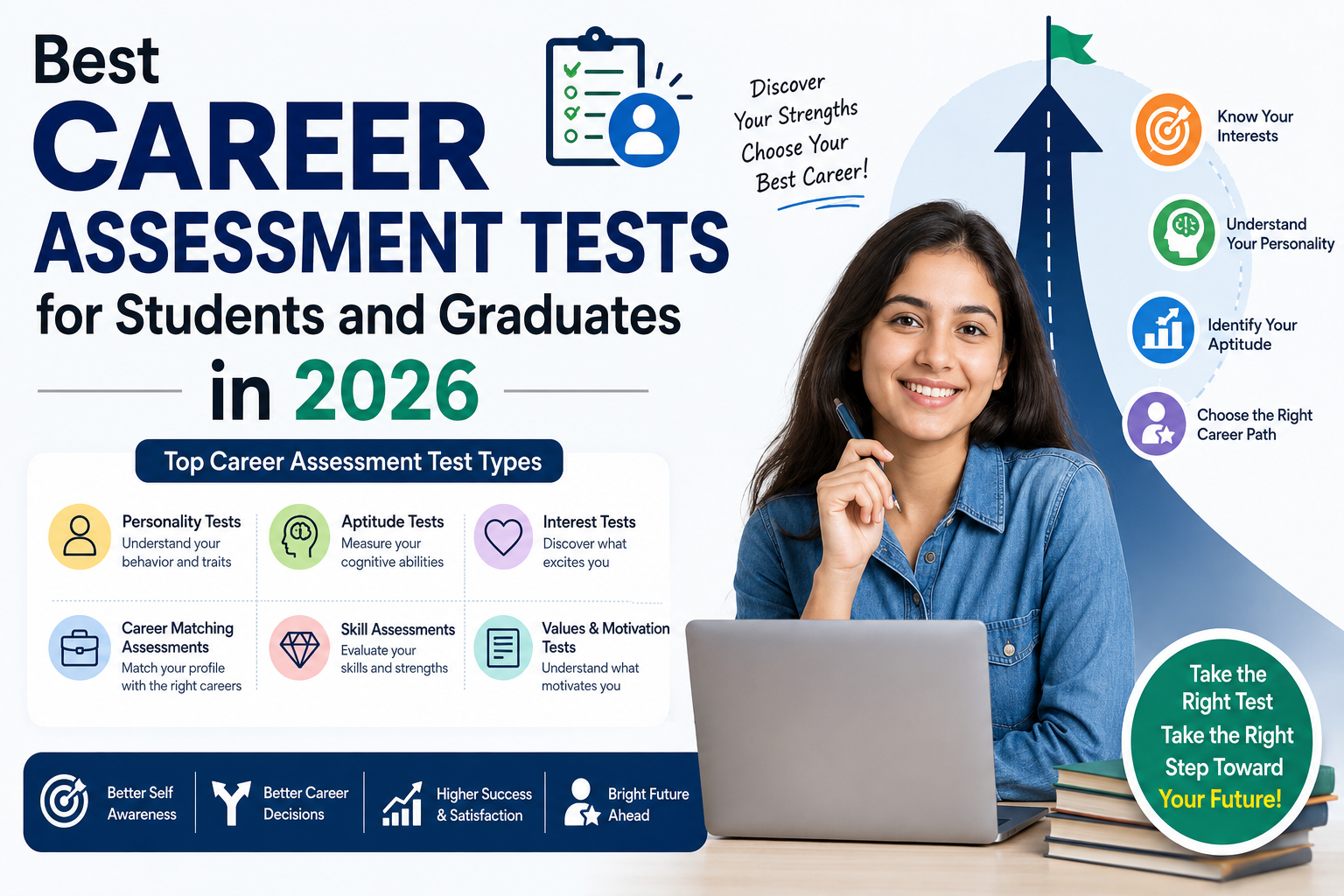
Choosing the right career is one of the most important decisions in a student’s life. Yet, millions of students and graduates remain confused about which career path suits their personality, skills, interests, and future goals. In today’s rapidly changing job market, selecting a career based only on trends, peer pressure, or salary expectations can lead to dissatisfaction and career instability.
This is where career assessment tests become valuable.
Career assessment tests help students and graduates understand their strengths, interests, personality traits, aptitude, and work preferences. These scientifically designed tools provide insights that make career decision-making easier, smarter, and more personalized. According to recent career guidance studies, interest-based and psychometric assessments are increasingly being used in schools, colleges, and career counseling centers to help students choose suitable career paths.
In this detailed guide, we will explore the best career assessment tests for students and graduates in 2026, how they work, their benefits, limitations, and how to choose the right one for your future.
What Are Career Assessment Tests?
Career assessment tests are structured evaluations designed to analyze different aspects of an individual’s personality, interests, aptitude, values, skills, and behavioral patterns. These tests help identify careers that align with a person’s natural abilities and preferences.
Career tests generally fall into four major categories:
Personality Tests
Aptitude Tests
Interest-Based Tests
Skills & Values Assessments
Some advanced career assessment platforms combine all four elements to provide more accurate career recommendations.
Modern career tests now use AI-powered algorithms, psychometric analysis, and labor market trends to suggest career paths with better long-term growth opportunities.
Why Career Assessment Tests Are Important in 2026
The job market is changing faster than ever due to:
Artificial Intelligence (AI)
Automation
Remote work culture
Digital transformation
Emerging careers
Changing industry demands
Experts predict that many traditional jobs will evolve significantly over the next decade. Career assessments help students adapt by identifying transferable skills, personality fit, and future-ready career options.
Key Benefits of Career Assessment Tests
1. Better Career Clarity
Students gain a clear understanding of suitable career options.
2. Reduced Career Confusion
Tests narrow down choices based on strengths and interests.
3. Improved Decision Making
Students avoid random career selection influenced by society or trends.
4. Increased Career Satisfaction
People tend to perform better in careers aligned with their personality and interests.
5. Identification of Hidden Strengths
Assessments often reveal talents students may not recognize themselves.
6. Personalized Career Planning
Many tests suggest courses, industries, and job roles.
Best Career Assessment Tests for Students and Graduates
1. Holland Code Career Test (RIASEC)
The Holland Code Career Test, also known as the RIASEC test, is one of the most trusted and widely used career assessments globally. Developed by psychologist John Holland, it classifies individuals into six personality-interest categories:
Realistic
Investigative
Artistic
Social
Enterprising
Conventional
The test matches these categories with suitable career environments and occupations. It is highly recommended for students exploring career directions for the first time.
Best For:
School students
College students
Graduates unsure about career direction
Advantages:
Scientifically validated
Easy to understand
Strong career mapping system
Linked with occupational databases
Suggested Careers:
Engineering
Design
Healthcare
Business Management
Teaching
IT
2. Myers-Briggs Type Indicator (MBTI)
The Myers-Briggs Type Indicator (MBTI) is one of the world’s most popular personality assessments. It categorizes people into 16 personality types based on four psychological dimensions:
Introvert (I) vs Extrovert (E)
Sensing (S) vs Intuition (N)
Thinking (T) vs Feeling (F)
Judging (J) vs Perceiving (P)
This assessment helps students understand how they think, communicate, make decisions, and work with others.
Best For:
Personality understanding
Career compatibility
Workplace behavior analysis
Advantages:
Improves self-awareness
Helps in career exploration
Useful for communication and teamwork
Limitations:
Many experts believe MBTI should not be used as the only career decision-making tool because personality can evolve over time. Reddit discussions also suggest combining MBTI with aptitude and interest assessments for better accuracy.
3. O*NET Interest Profiler
The O*NET Interest Profiler is developed using the Holland Code framework and backed by occupational data. It connects career interests with real-world job roles, industries, required education levels, and employment trends.
Best For:
Career exploration
Students seeking practical job insights
Future career planning
Advantages:
Government-backed career data
Free access
Large career database
Reliable occupational matching
Recommended For:
Students who want realistic job-market-oriented career suggestions.
4. Big Five Personality Test
The Big Five Personality Test, also known as the OCEAN model, measures five major personality dimensions:
Openness
Conscientiousness
Extraversion
Agreeableness
Neuroticism
Research shows that the Big Five model has stronger scientific backing compared to several other personality assessments. It helps predict work behavior, leadership style, and workplace compatibility.
Best For:
Career personality analysis
Professional growth
Leadership assessment
Advantages:
Scientifically reliable
Useful for long-term career planning
Helps understand workplace behavior
5. DISC Personality Assessment
The DISC assessment measures four behavioral styles:
Dominance
Influence
Steadiness
Conscientiousness
DISC helps students understand communication patterns, leadership abilities, teamwork style, and decision-making approaches.
Best For:
Leadership careers
Communication-heavy professions
Team-based environments
Careers Suitable For:
Sales
HR
Marketing
Management
Public Relations
6. CareerExplorer Assessment
CareerExplorer uses machine learning and psychometric analysis to suggest career paths. It compares personality traits, interests, workplace preferences, and skills with thousands of careers.
Best For:
Graduates
Career changers
Deep career exploration
Advantages:
AI-driven recommendations
Extensive career database
Detailed compatibility reports
Unique Feature:
Provides compatibility percentages for different careers.
7. MAPP Career Test
The Motivational Appraisal Personal Potential (MAPP) Test focuses on motivation and work preferences rather than only aptitude or personality.
Best For:
Students exploring motivation-driven careers
Graduates seeking job satisfaction
Advantages:
Matches careers with work motivation
Identifies preferred work environments
Suitable for long-term planning
8. StrengthsFinder Assessment
StrengthsFinder identifies an individual’s top talents and strengths. Instead of focusing on weaknesses, it emphasizes areas where a person naturally performs best.
Best For:
Skill development
Leadership growth
Career confidence building
Advantages:
Positive psychology approach
Useful for professional development
Enhances self-confidence
9. Aptitude Tests
Aptitude tests measure natural abilities in areas such as:
Numerical reasoning
Verbal reasoning
Logical thinking
Mechanical reasoning
Spatial ability
Experts emphasize that aptitude tests are different from personality tests because they objectively measure performance under pressure.
Best For:
Engineering aspirants
Competitive exam preparation
Technical career selection
Advantages:
Measures actual abilities
Identifies cognitive strengths
Useful for specialized careers
How to Choose the Right Career Assessment Test
Not all career tests serve the same purpose. Students should choose assessments based on their goals.
| Goal | Recommended Test |
|---|---|
| Career direction | Holland Code |
| Personality understanding | MBTI / Big Five |
| Workplace behavior | DISC |
| Motivation analysis | MAPP |
| Aptitude measurement | Aptitude Tests |
| Deep career matching | CareerExplorer |
| Strength identification | StrengthsFinder |
Career experts recommend combining multiple assessments for more accurate results.
Common Mistakes Students Make While Taking Career Tests
1. Treating One Test as the Final Answer
No single assessment can completely define your ideal career.
2. Giving Inaccurate Answers
Students often choose socially desirable answers instead of honest responses.
3. Ignoring Professional Guidance
Career counselors help interpret assessment results effectively.
4. Choosing Careers Only Based on Salary
Long-term success depends on skill alignment and job satisfaction.
5. Ignoring Emerging Careers
Many future careers did not exist a decade ago.
Are Free Career Assessment Tests Reliable?
Many free career tests provide useful insights, especially those based on scientifically validated frameworks like:
Holland Code
Big Five
O*NET
DISC
However, free tests may sometimes offer limited reports compared to professional psychometric assessments. Comprehensive career counseling platforms combine assessments with expert interpretation for better accuracy.
Career Assessment Tests vs Career Counselling
Career assessments and career counseling work best together.
| Career Assessment Tests | Career Counselling |
|---|---|
| Provides data and insights | Provides human guidance |
| Measures personality and aptitude | Helps interpret results |
| Suggests career options | Helps create action plans |
| Automated process | Personalized mentoring |
Professional counselors help students connect assessment results with real-world opportunities, educational paths, and industry trends.
What Students Are Saying About Career Tests
Online communities and student discussions reveal mixed opinions about career assessments. Many students say tests become useful only when combined with coaching, self-reflection, and real-life exploration.
One common observation from Reddit users is:
“Use career assessments as guidance, not destiny.”
This is important because career growth is dynamic and continuously evolving.
Future of Career Assessment Tests
The future of career assessment is becoming more advanced with:
AI-powered career matching
Real-time labor market integration
Skill-gap analysis
Behavioral analytics
Personalized career roadmaps
Industry demand forecasting
Modern assessments now consider automation risk, future salary trends, remote work compatibility, and emerging industries.
Final Thoughts
Career assessment tests are powerful tools that help students and graduates make smarter career decisions. They provide clarity, self-awareness, and direction during one of life’s most critical phases.
However, career assessments should never be viewed as magical solutions. The most effective career planning strategy combines:
Career assessments
Self-reflection
Skill development
Industry research
Professional career counseling
Real-world exposure
Whether you are a student confused after 10th or 12th grade, a college graduate unsure about your future, or a young professional planning a career shift, the right career assessment test can become the starting point of a fulfilling and successful career journey.
In 2026, with careers evolving faster than ever, understanding yourself is no longer optional — it is essential.
FAQs
Which is the best career assessment test for students?
The Holland Code (RIASEC) test is widely considered one of the best career assessment tests for students because it directly connects interests with career options.
Are career assessment tests accurate?
Career assessments are helpful but should be used as guidance tools rather than absolute answers.
Can career tests help graduates choose jobs?
Yes, graduates can use career assessments to identify suitable industries, roles, and work environments.
Are free career tests worth taking?
Yes, especially scientifically validated tests like O*NET, Holland Code, and Big Five assessments.
Should students take multiple career tests?
Yes, combining personality, aptitude, and interest-based assessments usually gives more accurate career insights.