Introduction
Artificial Intelligence (AI) is transforming industries at an unprecedented pace—and web development is no exception. With AI tools now capable of generating code, designing layouts, and even building websites in minutes, a pressing question arises for students: Can AI replace web developers?
The short answer is no—but the full story is far more nuanced. For students considering a career in web development, understanding how AI is reshaping the field is essential to staying relevant and future-ready. Let’s explore the truth behind the hype.
The Rise of AI in Web Development
Over the past few years, AI-powered tools have become increasingly sophisticated.
Platforms can now:
1.Generate HTML, CSS, and JavaScript code automatically
2.Suggest design layouts and user interfaces
3.Debug errors and optimize performance
4.Build entire websites with minimal human input
These advancements have made web development faster and more accessible than ever before. Tasks that once took hours can now be completed in minutes.
However, speed and automation don’t necessarily mean replacement.
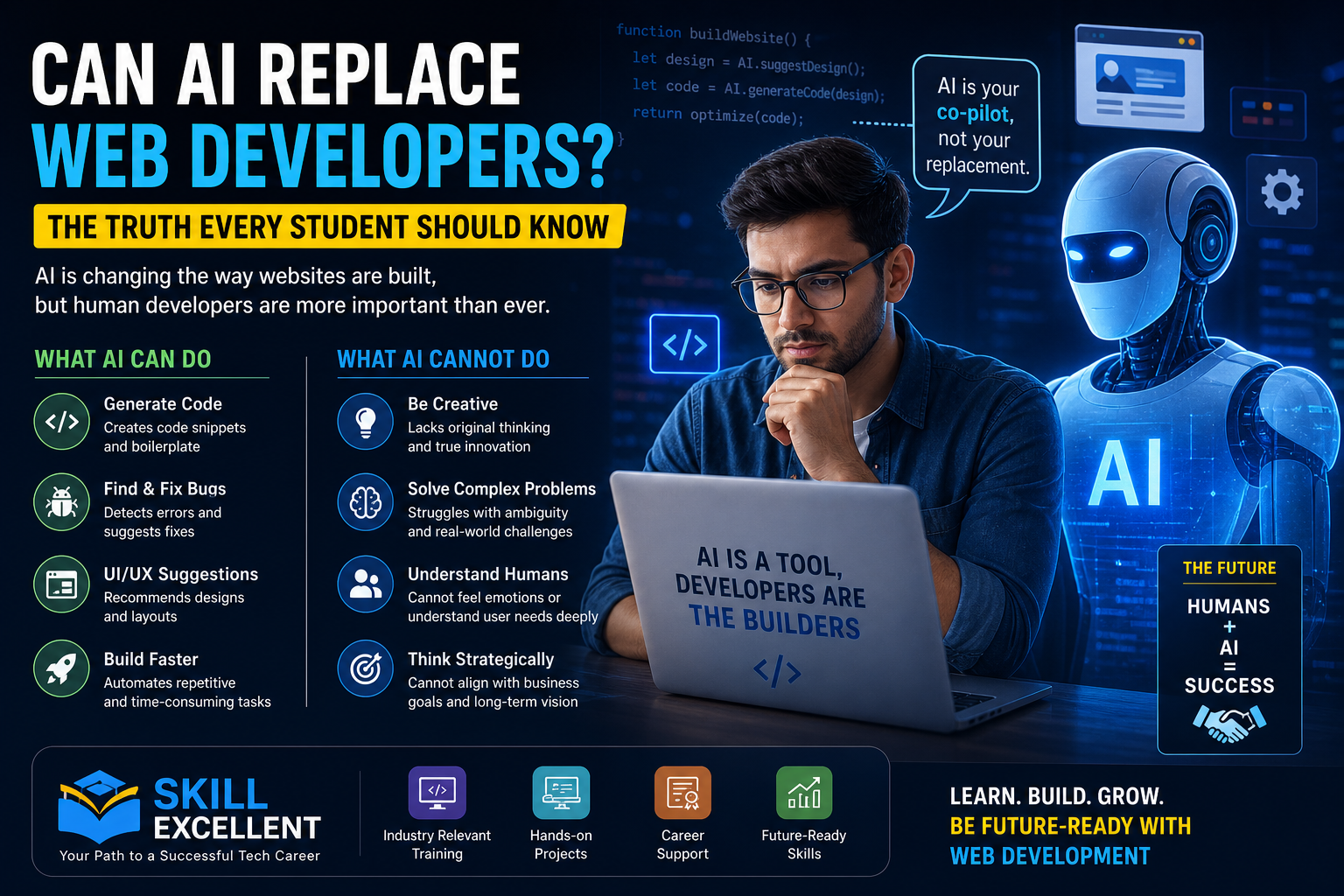
What AI Can Do (And Do Well)
AI excels at handling repetitive, data-driven, and structured tasks. In web development, this includes:
1. Code Generation
AI tools can quickly generate boilerplate code, saving developers time on routine tasks.
2. Bug Detection and Fixing
Machine learning algorithms can identify errors and suggest fixes, improving code quality.
3. UI/UX Suggestions
AI can analyze user behavior and recommend design improvements for better user experience.
4. Website Builders
No-code and low-code platforms powered by AI allow users to create basic websites without deep technical knowledge.
These capabilities make AI a powerful assistant—but not a complete replacement.
What AI Cannot Replace
Despite its impressive abilities, AI has clear limitations. There are several critical areas where human developers remain indispensable:
1. Creativity and Innovation
AI works based on existing data and patterns. It cannot truly innovate or think outside the box like a human developer. Unique, brand-driven designs and creative problem-solving still require human input.
2. Complex Problem Solving
Real-world projects often involve complex requirements, unexpected challenges, and custom solutions. AI struggles with ambiguity and nuanced decision-making.
3. Understanding Business Needs
Web development is not just about coding—it’s about solving business problems. Developers must understand client goals, target audiences, and market trends—something AI cannot fully grasp.
4. Human Experience and Emotion
Creating engaging digital experiences requires empathy and understanding of human behavior. AI lacks emotional intelligence, which is crucial for user-centric design.
The Changing Role of Web Developers
Rather than replacing developers, AI is transforming their roles. The future web developer is not just a coder but a problem solver, strategist, and AI collaborator.
Here’s how the role is evolving:
1.From Manual Coding to Smart Development: Developers now use AI tools to speed up workflows.
2.From Execution to Strategy: More focus on planning, architecture, and user experience.
3.From Individual Work to Collaboration with AI: Developers guide AI tools to achieve better results.
In simple terms, AI is becoming a co-pilot—not a replacement.
Why Students Should Not Fear AI
It’s natural for students to feel uncertain about the future. However, AI should be seen as an opportunity rather than a threat.
1. Increased Productivity
AI helps developers work faster and more efficiently, making them more valuable in the job market.
2. Lower Entry Barriers
Beginners can now learn and build projects more easily with AI assistance.
3. New Career Opportunities
AI is creating new roles such as:
AI-assisted developer
Prompt engineer
Automation specialist
4. Competitive Advantage
Students who learn how to use AI tools effectively will have a significant edge over others.
Skills Students Must Learn in 2026
To stay relevant in the AI-driven era, students must go beyond basic coding and focus on future-ready skills:
🔹 Strong Fundamentals
Master core technologies like HTML, CSS, JavaScript, and frameworks.
🔹 Problem-Solving Skills
Develop logical thinking and the ability to handle real-world challenges.
🔹 AI Tool Integration
Learn how to use AI tools for coding, testing, and optimization.
🔹 UX/UI Understanding
Focus on creating user-friendly and engaging digital experiences.
🔹 Continuous Learning
Technology evolves rapidly—staying updated is key to long-term success.
The Role of Training Institutes Like Skill Excellent
In this evolving landscape, choosing the right training institute is crucial. A modern web development course should not just teach coding but also prepare students for the future.
At Skill Excellent, students can:
Learn industry-relevant technologies
Work on real-world projects
Understand AI tools and their applications
Gain practical, hands-on experience
This approach ensures that students are not just job-ready—but future-ready.
The Future: Humans + AI = Success
The future of web development is not about humans vs AI—it’s about humans working with AI. Businesses will always need skilled professionals who can think critically, design creatively, and solve problems effectively.
AI will continue to evolve, but it will always require human direction, creativity, and decision-making.
Conclusion
So, can AI replace web developers? The truth is—it cannot fully replace them. While AI can automate tasks and improve efficiency, it lacks the creativity, critical thinking, and human understanding that developers bring to the table.
For students, the key takeaway is clear:
Don’t compete with AI—learn to work with it.
By building strong fundamentals, embracing new technologies, and continuously upgrading skills, aspiring developers can not only survive but thrive in the AI-driven future.
The demand for web developers is not disappearing—it’s evolving. And those who adapt will lead the next generation of digital innovation.