Introduction
In an increasingly globalized job market, language skills are no longer just an added advantage—they are a strategic necessity. Among foreign languages, French holds a special place due to its global presence and relevance across industries. But simply learning French is not enough. What truly elevates your profile is earning internationally recognized certifications like DELF (Diplôme d'Études en Langue Française) and DALF (Diplôme Approfondi de Langue Française).
These certifications do more than validate your language skills—they can transform your career trajectory. Let’s explore how.
What Are DELF and DALF Certifications?
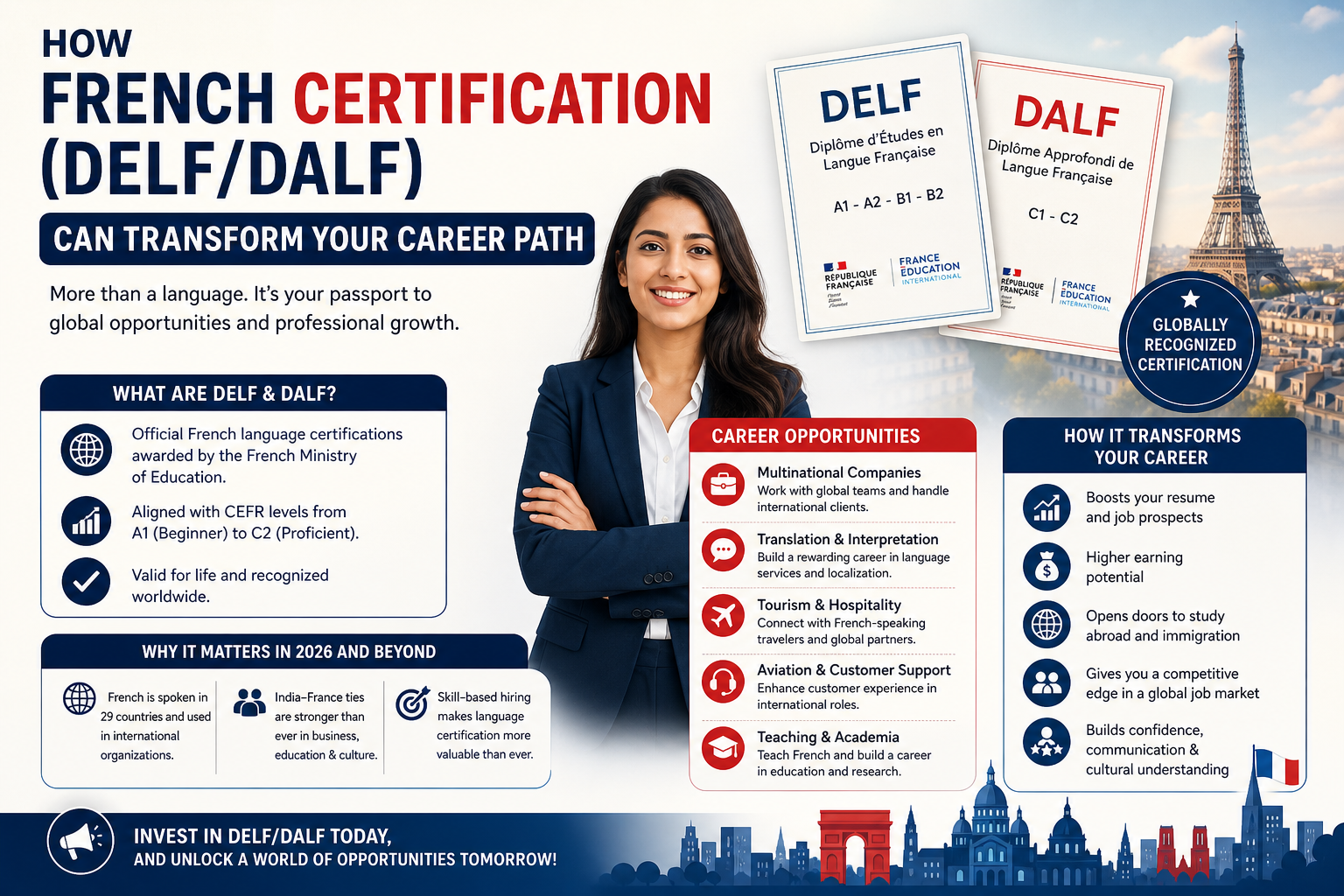
DELF and DALF are official qualifications awarded by the French Ministry of Education. They are globally recognized and align with the CEFR (Common European Framework of Reference for Languages).
Certification Levels:
DELF (A1–B2): Beginner to upper-intermediate levels
DALF (C1–C2): Advanced to near-native proficiency
Each level tests four essential skills:
1.Listening
2.Reading
3.Writing
4.Speaking
These certifications are valid for life, making them a long-term investment in your career.
Why Certification Matters More Than Just Learning
Many candidates claim language proficiency on their resumes, but recruiters often look for proof. This is where DELF/DALF certifications stand out.
The Psychological Advantage:
Recruiters trust verified credentials more than self-assessed skills. A certification acts as concrete evidence of your ability.
What it signals:
Professional commitment
Standardized skill level
Global readiness
In short, certification turns your language skill into a credible, measurable asset.
Career Opportunities After DELF/DALF
One of the biggest benefits of French certification is access to diverse career paths.
1. Corporate & Multinational Companies
Many global companies operate in French-speaking regions. Roles include:
Business Development Executive
International Sales Manager
Client Relationship Manager
French certification makes you a valuable asset for handling international clients.
2. Translation & Interpretation
Certified professionals can work as:
Translators
Interpreters
Localization specialists
With increasing demand for multilingual content, this field offers flexible and high-paying opportunities.
3. Tourism & Hospitality Industry
French-speaking tourists travel extensively, especially to India.
Career roles:
Tour guides
Hotel managers
Travel consultants
Knowing French enhances customer experience and boosts employability.
4. Aviation & Customer Support
Airlines and global support centers prefer candidates with foreign language skills.
Example roles:
Cabin crew
International customer support executive
French certification can give you a strong edge in these roles.
5. Teaching & Academia
If you reach advanced levels (DALF), you can pursue:
French language teaching
Academic research
Training and coaching
This is a stable and respected career path.
Study Abroad & Immigration Benefits
French certification is often a requirement for studying in France and other French-speaking countries.
Key advantages:
Required for admission to many universities
Increases chances of scholarships
Helps in visa and immigration processes
For countries like Canada, French proficiency can even improve your immigration score.
Salary Boost & Career Growth
Professionals with DELF/DALF certification often enjoy better salary packages compared to non-certified candidates.
Why?
They can handle international roles
They bring additional value to the organization
They reduce dependency on translators
In many industries, bilingual professionals earn significantly higher due to their unique skill set.
Competitive Edge in a Crowded Job Market
In 2026, employers are shifting toward skill-based hiring. Degrees alone are no longer enough.
How DELF/DALF helps:
Differentiates your resume
Adds a global dimension to your profile
Increases interview call chances
When two candidates have similar qualifications, the one with a certified language skill often wins.
Flexibility & Accessibility of Learning
Preparing for DELF/DALF is easier than ever, thanks to:
Online courses
Hybrid learning models
Practice platforms and mock tests
You can prepare alongside your studies or job, making it a practical upskilling option.
Personal Growth & Confidence
Beyond career benefits, learning French and achieving certification contributes to personal development.
You gain:
Better communication skills
Cultural awareness
Increased confidence
It also enhances cognitive abilities like memory and problem-solving.
Common Mistakes to Avoid
While pursuing certification, many learners make avoidable mistakes:
Not practicing speaking regularly
Ignoring exam patterns
Skipping mock tests
Relying only on theory
Consistent practice and structured preparation are key to success.
Final Thoughts:
Is DELF/DALF Worth It?
Absolutely. DELF and DALF certifications are more than just language qualifications—they are career-transforming tools.
Key Takeaways:
Globally recognized and lifelong validity
Opens doors to international careers
Boosts salary and job opportunities
Essential for study abroad and immigration
In a world driven by global connections, being multilingual is no longer optional. With DELF/DALF certification, you don’t just learn a language—you unlock a future full of possibilities.