Introduction
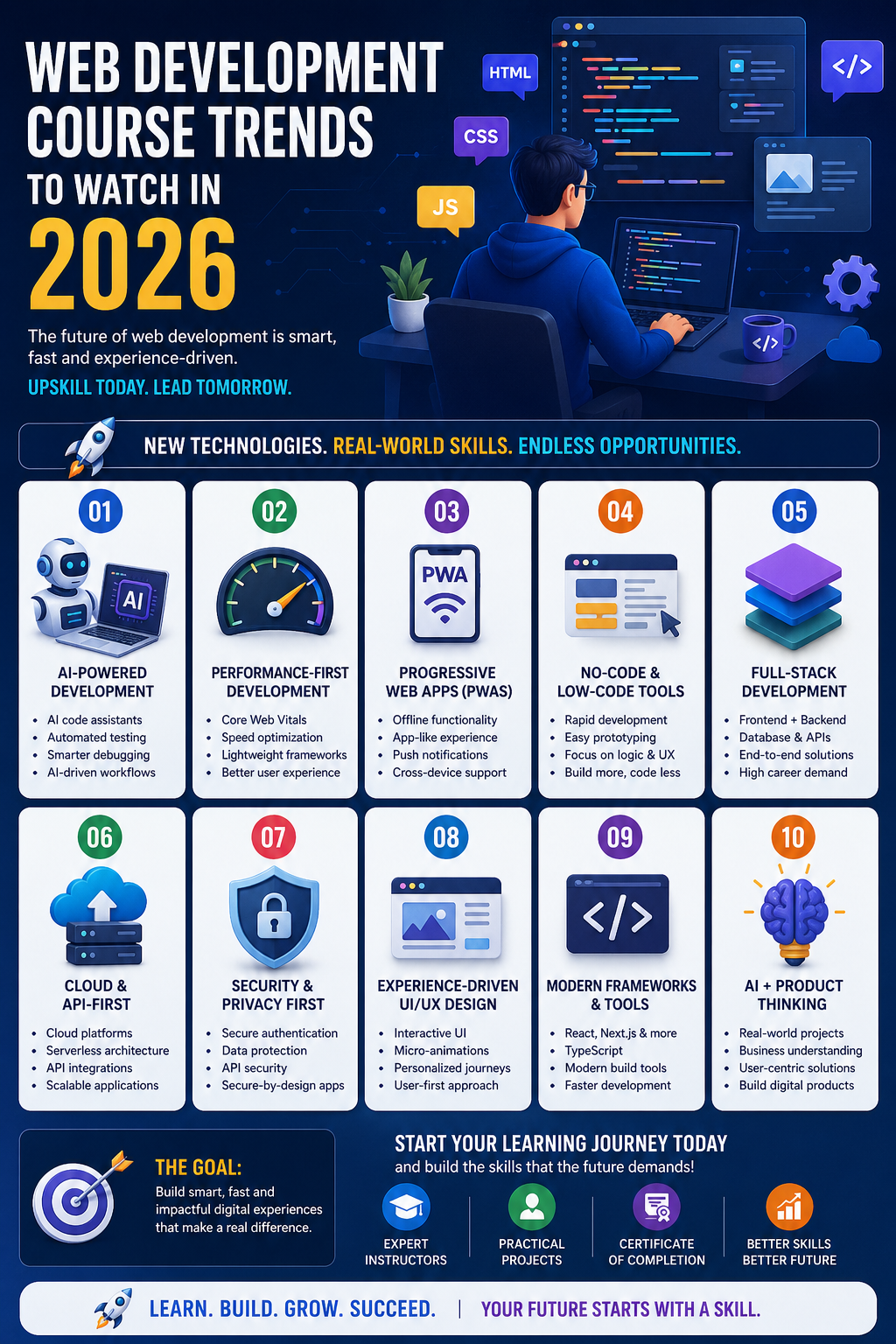
Web development in 2026 is no longer limited to building static websites. It has transformed into creating intelligent, fast, and highly interactive digital experiences. As businesses demand more advanced solutions, web development courses are also evolving to match industry needs.
Let’s explore the most important trends shaping web development learning in 2026.
AI-Powered Development is Becoming the Core Skill
Artificial Intelligence is no longer optional—it’s becoming a core part of web development courses.
Modern courses now teach:
AI-assisted coding tools
Automated debugging and testing
AI-generated UI/UX designs
Developers are shifting from writing every line of code to guiding AI systems and improving outputs.
This means students must learn:
Prompt engineering
AI tools like code assistants
Smart automation workflows
Performance-First Development is a Priority
In 2026, speed is everything. Users expect websites to load in under 2 seconds, and search engines reward high-performance sites.
Web development courses now focus on:
Core Web Vitals
Page speed optimization
Lightweight frameworks
The goal is simple: build faster, smoother, and more efficient websites.
Progressive Web Apps (PWAs) Are Dominating
Websites are becoming more like mobile apps, thanks to Progressive Web Applications (PWAs).
Courses now include:
Offline functionality
App-like user experiences
Push notifications
PWAs offer a seamless experience across devices and are becoming a must-learn skill for developers.
No-Code & Low-Code Tools Are Rising
Not everyone needs to be a hardcore coder anymore.
Modern courses are integrating:
No-code platforms
Low-code development tools
Rapid prototyping techniques
These tools help developers build faster and focus more on logic and user experience rather than repetitive coding.
Full-Stack Development is the New Standard
Companies now prefer developers who can handle:
Frontend (UI/UX)
Backend (server & database)
APIs and integrations
Web development courses in 2026 are designed to create full-stack developers, making them more versatile and job-ready.
Cloud & API-First Development
Modern web apps are powered by cloud services and APIs.
Courses now teach:
Cloud platforms
Serverless architecture
API integrations
This allows developers to build scalable and flexible applications without managing complex infrastructure.
Security & Privacy Are Essential Skills
With increasing cyber threats, security is no longer optional.
Web development courses now include:
Secure authentication
Data protection practices
API security
Developers must build secure-by-design applications to protect user data.
Experience-Driven UI/UX Design
Web development is not just coding—it’s about creating experiences.
Trending skills include:
Interactive UI
Micro-animations
Personalized user journeys
Websites in 2026 adapt to user behavior in real time, making UX a critical part of development.
Modern Frameworks & Tools Dominate Learning
Courses now focus on industry tools like:
React, Next.js
TypeScript
Modern build tools
These frameworks help developers build scalable and maintainable applications faster.
Web Development is Becoming AI + Product Thinking
In 2026, developers are not just coders—they are problem solvers and product thinkers.
Courses now emphasize:
Real-world projects
Business understanding
User-centric design
Websites are no longer static—they are dynamic digital products connected to business goals.
Final Thoughts
Web development courses in 2026 are designed to prepare you for a future driven by AI, speed, and user experience.
To stay ahead, focus on:
Learning AI tools
Building real projects
Understanding full-stack development
Prioritizing performance and UX
Because in today’s world, it’s not just about building websites—
👉 It’s about building smart, fast, and impactful digital experiences.