Introduction
Reaching an advanced level in French is an impressive achievement—but true mastery begins when you stop translating and start thinking in the language. Many learners plateau at the B2 level because they rely heavily on their native language as a bridge. In 2026, with access to immersive tools and smarter learning methods, advanced learners are shifting toward cognitive strategies that train the brain to operate directly in French. This transition is what separates fluent speakers from truly proficient ones.
Why Thinking in French Matters
Thinking in French allows for faster processing, more natural expression, and better comprehension. Instead of mentally translating every sentence, your brain begins to associate words, emotions, and ideas directly with French structures. This leads to:
Improved speaking fluency
Greater confidence in real-time conversations
Enhanced listening comprehension
More authentic pronunciation and expression
At an advanced level, fluency is no longer about vocabulary—it’s about mental processing.
The Science Behind Language Thinking
Language learning is deeply connected to cognitive processes. When you think in your native language and translate into French, your brain performs extra work, slowing down communication. However, when you train your brain to think directly in French, you create new neural pathways that bypass translation.
This concept is known as target language thinking, where thoughts are formed directly in the second language. Over time, this reduces cognitive load and improves linguistic agility, allowing you to respond more naturally in conversations.
Key Cognitive Strategies to Think in French
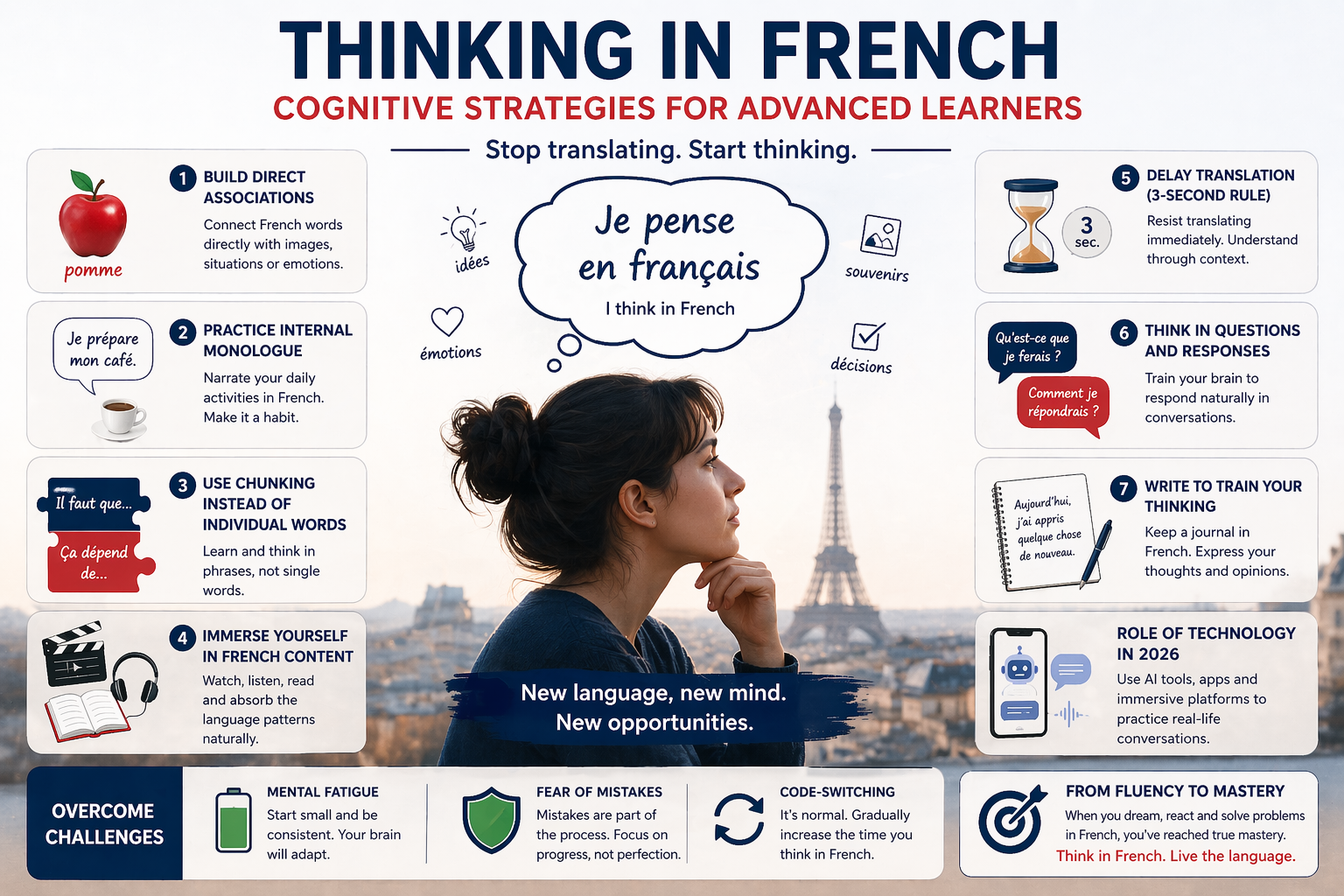
1. Build Direct Associations (Word–Meaning Connection)
Instead of translating French words into your native language, associate them directly with images, situations, or emotions. For example, when you hear “pomme”, visualize an apple rather than thinking of the English word.
This strengthens memory and speeds up recall, making your responses more spontaneous.
2. Practice Internal Monologue in French
Train your brain by narrating your daily activities in French:
“Je prépare mon café.”
“Je dois répondre à cet email.”
This constant mental practice helps you build fluency without external pressure. Over time, your thoughts will naturally shift into French.
3. Use Chunking Instead of Individual Words
Advanced learners should focus on phrases rather than isolated vocabulary. Native speakers think in chunks like:
“Il faut que…”
“Ça dépend de…”
Learning these expressions as complete units reduces the need for grammar translation and improves natural speech flow.
4. Immerse Yourself in French Content
Surrounding yourself with French media is one of the most effective ways to rewire your thinking. Watch films, listen to podcasts, and read articles in French regularly.
Pay attention to how native speakers structure sentences and express ideas. This exposure helps your brain absorb patterns subconsciously.
5. Delay Translation (The 3-Second Rule)
When you encounter a new word or phrase, resist the urge to translate immediately. Give your brain a few seconds to understand the meaning through context.
This practice strengthens comprehension skills and encourages thinking directly in French rather than relying on your native language.
6. Think in Questions and Responses
Simulate real-life conversations in your mind:
“Qu’est-ce que je ferais dans cette situation ?”
“Comment je répondrais à cette question ?”
This prepares your brain for spontaneous communication and builds confidence in speaking situations.
7. Write to Train Your Thinking
Writing is a powerful cognitive tool. Maintain a journal in French where you express your thoughts, opinions, and daily experiences.
Unlike speaking, writing allows you to process language more deeply, helping reinforce direct thinking patterns.
Overcoming Common Challenges
Mental Fatigue
Thinking in a second language can be exhausting initially. Start with short sessions and gradually increase your practice time.
Fear of Mistakes
Advanced learners often hesitate due to fear of making errors. Remember, thinking in French is a process—mistakes are part of learning.
Code-Switching
Switching between languages is natural. The goal is not perfection but increasing the frequency of thinking in French over time.
Role of Technology in 2026
Modern tools have made it easier than ever to train your brain in French. AI-powered language apps, voice assistants, and immersive platforms now provide real-time feedback and conversation simulations.
These tools allow learners to practice thinking and responding in French in realistic scenarios, accelerating the transition from translation to direct cognition.
From Fluency to Mastery
Fluency means you can communicate effectively, but mastery means you can think, feel, and express yourself naturally in the language. When you start dreaming, reacting emotionally, or solving problems in French, you’ve reached a deeper level of proficiency.
This shift doesn’t happen overnight—it requires consistent practice, patience, and the right strategies.
Conclusion
Thinking in French is the ultimate milestone for advanced learners. It transforms your language skills from mechanical translation to natural communication. By adopting cognitive strategies like internal monologue, immersion, chunking, and delayed translation, you can train your brain to operate directly in French.
In 2026, language learning is no longer limited to classrooms. With the right mindset and tools, you can immerse yourself in French anytime, anywhere. The key is simple: stop translating, start thinking—and let the language become a part of you.