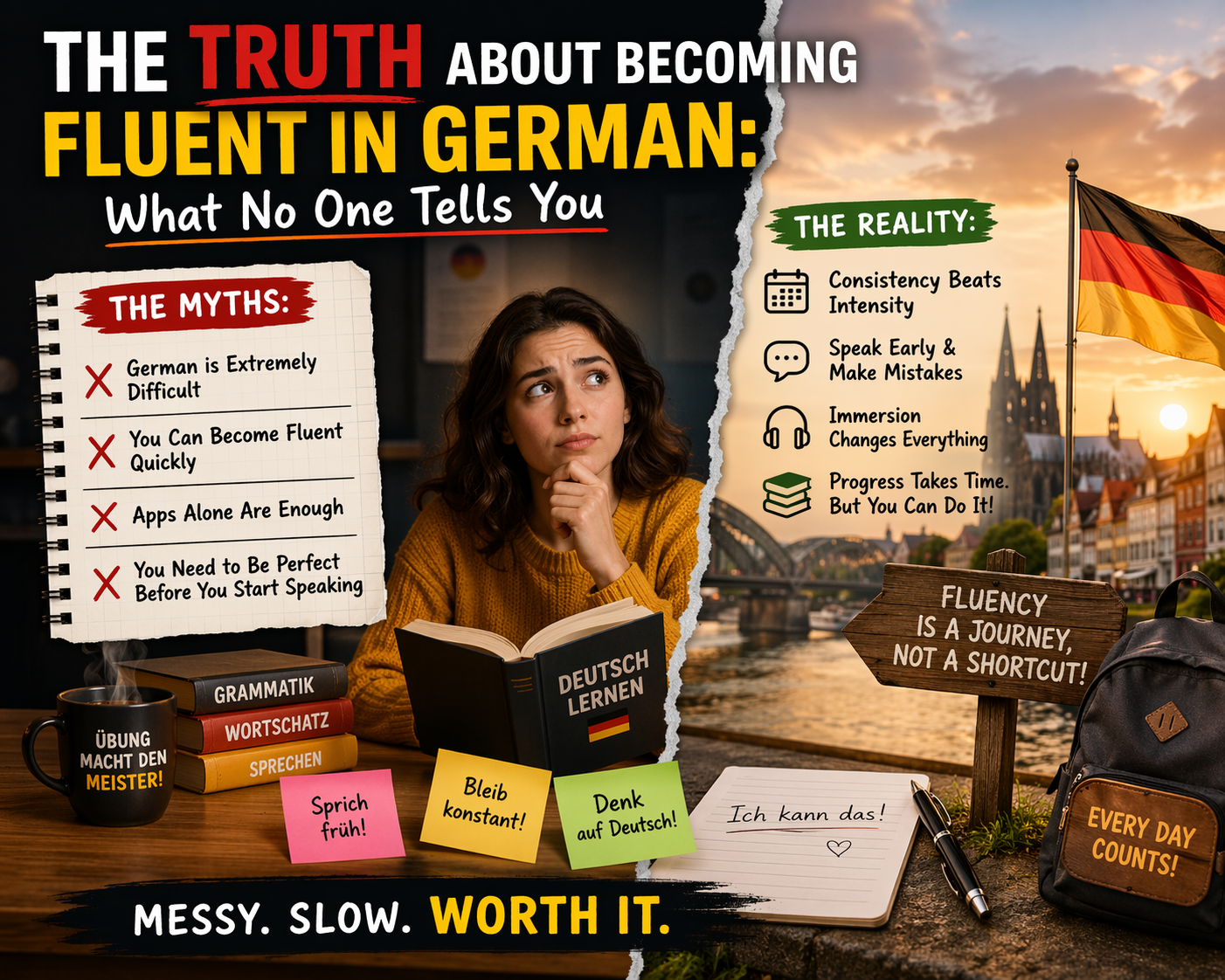
Introduction:
“Learn German in 3 months.”
“Become fluent fast.”
“Speak like a native in no time.”
You’ve probably seen these promises everywhere—on YouTube, ads, and language apps. But here’s the truth: becoming fluent in German is not as simple—or as fast—as most people claim.
And that’s not a bad thing.
In fact, once you understand what really goes into fluency, learning German becomes easier, more realistic, and way more enjoyable.
In this blog, we’ll break down the real truth about learning German, uncover myths, and give you practical strategies that actually work.
What Does “Fluent in German” Actually Mean?
Before we go further, let’s clear one major confusion:
👉 Fluency ≠ Perfection
Many learners think fluency means:
Speaking without mistakes
Knowing every word
Sounding like a native
But that’s not true.
In reality:
You can hold conversations comfortably
You can understand most everyday situations
You can express your thoughts clearly (even with mistakes)
Experts suggest that conversational comfort may require around 3,000 words, while full fluency can exceed 10,000+ words
So yes—fluency is a spectrum, not a finish line.
The Biggest Myths About Learning German
Myth 1: “German is extremely difficult”
German has a reputation for being hard—and yes, it has complex grammar. But here's the truth:
German rules are consistent
Once you learn patterns, things become easier
There are fewer exceptions than English
👉 The real issue isn’t difficulty—it’s how you learn it.
Myth 2: “You can become fluent quickly”
Let’s be honest:
Fluency takes time.
From real learner experiences:
“It’s a combination of input, immersion and realistic goals.”
Some people take:
1–2 years (with immersion)
3–5 years (with regular study)
Even longer with inconsistent practice
👉 There is no fixed timeline.
Myth 3: “Apps alone can make you fluent”
Apps are helpful—but limited.
They can:
Teach vocabulary
Help with basic grammar
Improve listening
But they cannot replace real conversation.
👉 Fluency requires:
Speaking
Thinking in German
Real-life interaction
- The Real Challenges No One Talks About:
1. Understanding ≠ Speaking:
One of the biggest frustrations learners face:
👉 “I understand German… but I can’t speak it.”
This is extremely common.
Even experts say learners often:
Understand well
But “freeze when it is time to speak”
Why this happens:
Passive learning (listening/reading only)
Fear of mistakes
Lack of speaking practice
- 2. Grammar Can Feel Overwhelming:
German grammar includes:
4 cases (nominative, accusative, dative, genitive)
Gendered nouns (der, die, das)
Complex word order
This can feel intimidating.
But here’s the truth:
👉 You don’t need to master all grammar to speak.
Focus on:
Basic sentence structure
Common verbs
Practical usage
- 3. You’ll Hit a Plateau:
Every learner faces this stage:
You improve quickly at first
Then suddenly… progress slows down
This is normal.
Even advanced learners (B2/C1 level) struggle with:
Understanding native speakers
Speaking fluently in real-time
👉 This phase is called the “intermediate plateau”
4. Vocabulary Overload is Real:
German has:
Long compound words
Thousands of terms
Context-based meanings
Trying to memorize everything is a mistake.
Instead:
Focus on high-frequency words
Learn vocabulary in context
- 5. Fear of Speaking Will Hold You Back:
This is the biggest hidden problem.
Many learners:
Wait to feel “ready”
Avoid speaking
Fear embarrassment
But here’s the truth:
👉 “Don’t wait to be perfect… just try.”
Fluency comes from:
Speaking badly → improving → speaking better
The Truth About How Fluency Actually Happens
Now let’s talk about what really works.
1. Consistency Beats Intensity:
You don’t need:
5 hours a day
You need:
20–30 minutes daily
Short, consistent practice works better because:
It builds memory
It prevents burnout
It creates habits
- 2. Speaking Early is a Game-Changer:
Most people delay speaking.
Big mistake.
👉 Start speaking from Day 1
Even if:
You only know 10 words
You make mistakes
Because:
Confidence grows with use
Fluency is a skill, not knowledge
- 3. You Must Think in German:
Translation slows you down.
German is not just English with different words.
👉 It has its own structure and logic
Real progress happens when:
You stop translating
You start thinking directly in German
- 4. Immersion is Non-Negotiable:
You don’t need to move to Germany—but you must create immersion.
Examples:
Watch German shows
Listen to podcasts
Change phone language
Talk to native speakers
Immersion helps you:
Understand natural speech
Learn pronunciation
Absorb sentence patterns
- 5. Vocabulary + Grammar Together = Fluency:
Many learners separate them.
Wrong approach.
You should:
Learn words in sentences
Practice grammar in real context
Because:
Language is about communication, not rules
- The 70% Rule: The Secret Nobody Talks About
Here’s a powerful concept:
👉 Speak when you feel 70% ready—not 100%
Why?
Waiting for perfection delays progress
Real conversations teach faster
Confidence grows through action
- Real Advice from Learners (What Actually Works):
From real learner experiences:
“Consistency is more important than long study sessions.”
“Speak whenever you can—even to yourself.”
“Immersion and daily exposure matter the most.”
👉 Notice a pattern?
No shortcuts.
Just smart, consistent effort.
Practical Strategy to Become Fluent in German
Here’s a realistic roadmap:
Beginner Level (A1–A2):
Focus on:
Basic vocabulary (daily life)
Simple grammar
Listening practice
Do:
Learn 5–10 words daily
Speak simple sentences
Use apps + videos
- Intermediate Level (B1–B2)
Focus on:
Speaking confidence
Sentence building
Real conversations
Do:
Talk to language partners
Watch German content
Practice writing
- Advanced Level (C1–C2):
Focus on:
Fluency in expression
Understanding natives
Cultural context
Do:
Debate topics
Think in German
Consume advanced content
- How Long Does It Really Take?
Here’s the honest answer:
👉 It depends on:
Time invested
Learning method
Consistency
Rough estimate:
Conversational: 6–12 months
Fluent: 2–5 years
But remember:
👉 Progress is not linear.
The Emotional Side No One Talks About
Learning German isn’t just academic—it’s emotional.
You will feel:
Frustrated
Stuck
Embarrassed
But also:
Proud
Excited
Confident
👉 The key is to keep going.
Final Truth: There Is No Secret Formula:
Let’s simplify everything:
There is no:
Magic app
Secret trick
Shortcut
Fluency comes from:
Consistency
Practice
Patience
- Conclusion:
Becoming fluent in German is not about perfection—it’s about progress.
It’s messy.
It’s slow.
It’s uncomfortable.
But it’s also:
Rewarding
Exciting
Life-changing
👉 If you stay consistent, speak regularly, and embrace mistakes—you will become fluent.