Introduction
Learning French can feel overwhelming at first—new sounds, unfamiliar grammar, and lots of vocabulary. But here’s the truth: you don’t need thousands of words to start speaking French. In fact, mastering just 100 essential French words can help you understand basic conversations, express yourself, and build a strong foundation.
This beginner-friendly guide is designed to help you learn must-know French vocabulary in a structured and practical way. Instead of random word lists, we’ve grouped vocabulary into real-life categories like greetings, food, travel, and daily activities—so you can actually use what you learn.
Whether you're a student, traveler, or language enthusiast, this SEO-optimized French vocabulary guide will help you start speaking French faster and smarter.
Why Learning Basic French Vocabulary is Important
Before jumping into the list, let’s understand why vocabulary matters:
🧠 Builds confidence – You can start speaking from Day 1
🗣️ Improves communication – Even simple words can form sentences
📚 Makes grammar easier – Vocabulary gives context to rules
✈️ Helps in travel – Essential for real-life situations
👉 Pro Tip: Focus on daily-use words instead of rare vocabulary. That’s exactly what this guide covers.
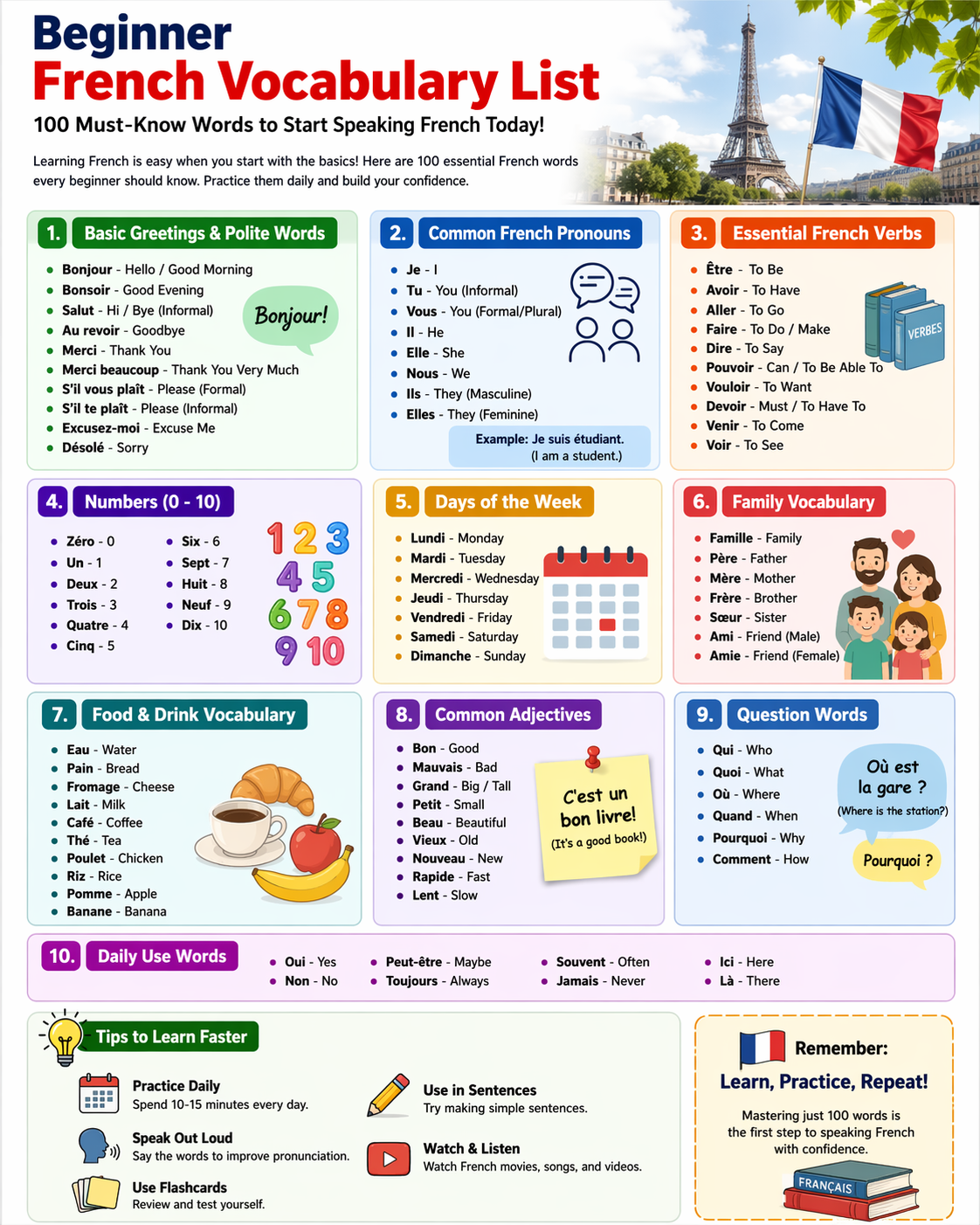
100 Must-Know French Words for Beginners
1. Basic Greetings & Polite Words
These are the first words you’ll use in any conversation:
Bonjour — Hello / Good morning
Bonsoir — Good evening
Salut — Hi / Bye (informal)
Au revoir — Goodbye
Merci — Thank you
Merci beaucoup — Thank you very much
S’il vous plaît — Please (formal)
S’il te plaît — Please (informal)
Excusez-moi — Excuse me
Désolé — Sorry
👉 These words are used daily—practice them aloud!
2. Common French Pronouns
Pronouns help you form sentences:
Je — I
Tu — You (informal)
Vous — You (formal/plural)
Il — He
Elle — She
Nous — We
Ils — They (masculine)
Elles — They (feminine)
👉 Example: Je suis étudiant (I am a student)
3. Essential French Verbs
Verbs are the backbone of communication:
Être — To be
Avoir — To have
Aller — To go
Faire — To do/make
Dire — To say
Pouvoir — Can / To be able to
Vouloir — To want
Devoir — Must / To have to
Venir — To come
Voir — To see
👉 Learn these first—they are used in almost every sentence.
4. Numbers (0–10)
Numbers are super important for daily life:
Zéro — 0
Un — 1
Deux — 2
Trois — 3
Quatre — 4
Cinq — 5
Six — 6
Sept — 7
Huit — 8
Neuf — 9
Dix — 10
👉 Once you master these, you can move to higher numbers easily.
5. Days of the Week
Lundi — Monday
Mardi — Tuesday
Mercredi — Wednesday
Jeudi — Thursday
Vendredi — Friday
Samedi — Saturday
Dimanche — Sunday
6. Family Vocabulary
Famille — Family
Père — Father
Mère — Mother
Frère — Brother
Sœur — Sister
Ami — Friend (male)
Amie — Friend (female)
👉 Example: Ma mère est gentille (My mother is kind)
7. Food & Drink Vocabulary
Eau — Water
Pain — Bread
Fromage — Cheese
Lait — Milk
Café — Coffee
Thé — Tea
Poulet — Chicken
Riz — Rice
Pomme — Apple
Banane — Banana
👉 Useful when ordering food in a restaurant.
8. Common Adjectives
Adjectives help describe things:
Bon — Good
Mauvais — Bad
Grand — Big
Petit — Small
Beau — Beautiful
Vieux — Old
Nouveau — New
Rapide — Fast
Lent — Slow
👉 Example: C’est un bon livre (It’s a good book)
9. Question Words
These are essential for conversations:
Qui — Who
Quoi — What
Où — Where
Quand — When
Pourquoi — Why
Comment — How
👉 Example: Où est la gare ? (Where is the station?)
10. Daily Use Words
Oui — Yes
Non — No
Peut-être — Maybe
Toujours — Always
Souvent — Often
Jamais — Never
Ici — Here
Là — There
How to Use These Words in Real Life
Learning words is not enough—you need to use them in context.
Example Sentences:
Bonjour, je suis étudiant.
Je veux du café.
Où est la maison ?
Merci beaucoup !
👉 Start forming simple sentences daily.
Tips to Memorize French Vocabulary Faster
1. Use the “Room Method”
Associate words with places in your home.
2. Practice Daily
Spend just 10–15 minutes daily reviewing words.
3. Speak Out Loud
Pronunciation improves memory.
4. Use Flashcards
Apps or physical cards both work.
5. Watch French Content
Movies, reels, and songs help reinforce vocabulary.
Common Mistakes Beginners Make
❌ Memorizing without practice
❌ Ignoring pronunciation
❌ Learning too many words at once
❌ Not revising regularly
👉 Focus on consistency over quantity.
Conclusion
Learning French doesn’t have to be difficult. By mastering these 100 must-know French words, you’re already on your way to understanding and speaking the language.
The key is simple:
👉 Learn → Practice → Repeat
Start using these words in your daily life, and you’ll see progress faster than you expect.