Introduction
Learning a new language can feel overwhelming, especially when you’re just starting out. One of the smartest and most effective ways to build a strong foundation in French is by learning vocabulary related to your daily environment. And what’s more familiar than your own home?
That’s why mastering room-by-room French vocabulary is a powerful strategy for beginners. It helps you connect words with real-life objects you see every day, making learning more natural and memorable.
Why Learning Home Vocabulary is Important for Beginners
When you learn French using everyday surroundings:
You practice consistently without extra effort
You associate words with real objects, improving recall
You build practical vocabulary you’ll actually use in conversations
Instead of memorizing random words, you learn useful vocabulary like “table,” “bed,” “kitchen,” and “mirror”—things you interact with daily.
How Room-Based Learning Improves Memory
This method works because of contextual learning. When you link a word to a physical space or object:
Your brain creates stronger memory connections
You learn faster through visual association
You retain vocabulary for a longer time
For example, every time you sit on your sofa, you’ll remember: Le canapé.
What You’ll Learn in This Guide:
In this blog, you’ll discover:
Essential French vocabulary for every room
Easy example sentences
A practice section to test yourself
Smart tips to memorize faster
Let’s explore your house—en français!
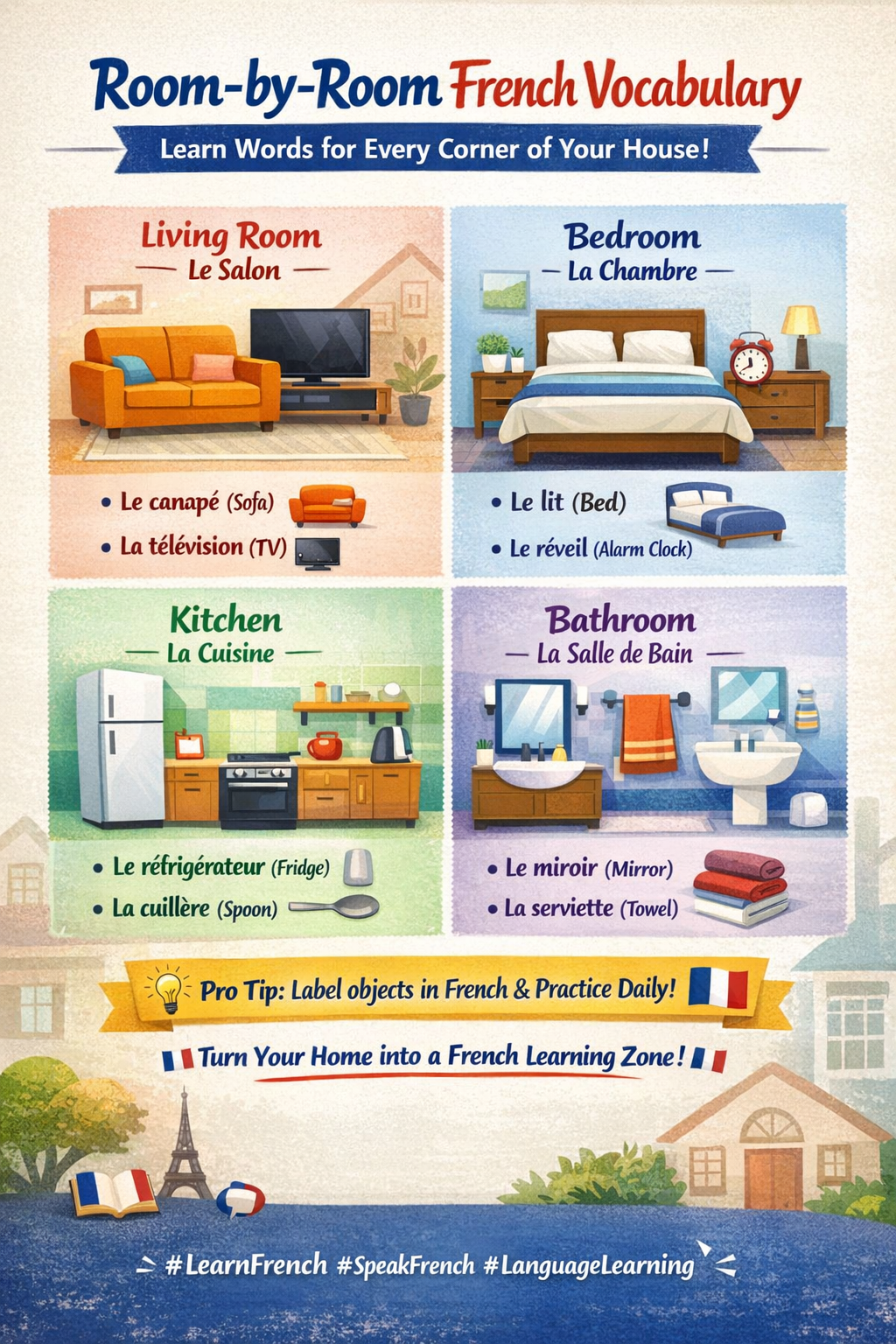
1. Living Room Vocabulary (Le Salon):
The living room, or le salon, is where we relax, watch TV, and spend time with family.
Common Words
Le salon — Living room
Le canapé — Sofa
La chaise — Chair
La table — Table
La télévision — Television
La lampe — Lamp
Le tapis — Carpet/Rug
La fenêtre — Window
La porte — Door
Example Sentences
Le canapé est confortable.
(The sofa is comfortable.)
La télévision est sur la table.
(The TV is on the table.)
👉 Tip: Sit in your living room and say these words out loud while pointing at objects.
2. Bedroom Vocabulary (La Chambre):
Your bedroom, or la chambre, is your personal space for rest and relaxation.
Common Words
La chambre — Bedroom
Le lit — Bed
L’oreiller — Pillow
La couverture — Blanket
L’armoire — Wardrobe
La table de nuit — Bedside table
La lampe — Lamp
Le miroir — Mirror
Le réveil — Alarm clock
Example Sentences
Le lit est grand.
(The bed is big.)
Le réveil est sur la table de nuit.
(The alarm clock is on the bedside table.)
👉 Pro Tip: Before sleeping, revise 5 words from your bedroom.
3. Kitchen Vocabulary (La Cuisine):
The kitchen, or la cuisine, is full of useful vocabulary because it includes many everyday objects.
Common Words
La cuisine — Kitchen
Le réfrigérateur — Refrigerator
Le four — Oven
La cuisinière — Stove
L’évier — Sink
L’assiette — Plate
Le verre — Glass
La cuillère — Spoon
Le couteau — Knife
La fourchette — Fork
Example Sentences
Le réfrigérateur est dans la cuisine.
(The refrigerator is in the kitchen.)
La cuillère est sur la table.
(The spoon is on the table.)
👉 Practice idea: While eating, name each object in French.
4. Bathroom Vocabulary (La Salle de Bain):
The bathroom, or la salle de bain, is another great place to practice daily vocabulary.
Common Words
La salle de bain — Bathroom
La douche — Shower
La baignoire — Bathtub
Le lavabo — Sink
Le miroir — Mirror
La serviette — Towel
Le savon — Soap
Le shampooing — Shampoo
Les toilettes — Toilet
Example Sentences
La serviette est propre.
(The towel is clean.)
Le miroir est au-dessus du lavabo.
(The mirror is above the sink.)
👉 Morning routine tip: Say each item’s name while getting ready.
5. Dining Room Vocabulary (La Salle à Manger):
The dining room, or la salle à manger, is where meals are shared.
Common Words
La salle à manger — Dining room
La table — Table
La chaise — Chair
L’assiette — Plate
Le verre — Glass
La nappe — Tablecloth
La nourriture — Food
Le repas — Meal
Example Sentences
La table est dans la salle à manger.
(The table is in the dining room.)
Le repas est prêt.
(The meal is ready.)
👉 Practice: Describe your meal in French daily.
6. Study Room / Office Vocabulary (Le Bureau):
The study room or office, le bureau, is essential for students and professionals.
Common Words
Le bureau — Office/desk
L’ordinateur — Computer
Le livre — Book
Le cahier — Notebook
Le stylo — Pen
La chaise — Chair
La table — Desk
L’imprimante — Printer
Example Sentences
L’ordinateur est sur le bureau.
(The computer is on the desk.)
Le livre est sur la table.
(The book is on the table.)
👉 Study tip: Switch your study environment language to French.
7. Balcony / Outdoor Area (Le Balcon / Le Jardin):
Outdoor spaces also provide great vocabulary opportunities.
Common Words
Le balcon — Balcony
Le jardin — Garden
La plante — Plant
La fleur — Flower
La chaise — Chair
La table — Table
Le soleil — Sun
L’air — Air
Example Sentences
La plante est sur le balcon.
(The plant is on the balcony.)
Les fleurs sont dans le jardin.
(The flowers are in the garden.)
👉 Tip: Spend time outside and describe what you see in French.
Practice Section:
Let’s test your learning!
1. Match the Following
| French Word | English Meaning |
|---|---|
| Le lit | ? |
| La cuisine | ? |
| Le miroir | ? |
2. Fill in the Blanks
Le ______ est dans la chambre. (lit)
La ______ est sur la table. (lampe)
Le ______ est dans la cuisine. (four)
3. Speaking Practice
Try saying:
“The chair is in the living room”
“The book is on the table”
“The plant is on the balcony”
- Tips to Remember Home Vocabulary Faster:
1. Label Objects in Your House
Stick notes on objects:
Mirror → Le miroir
Door → La porte
This creates constant exposure.
2. Practice Speaking Daily
Even 10 minutes a day can improve fluency.
Speak sentences like:
La table est grande.
Le lit est confortable.
3. Use Flashcards
Apps like Anki or Quizlet help you revise regularly.
4. Create Your Own Sentences
Instead of memorizing, use words in context:
Le livre est sur le bureau.
La cuisine est propre.
- Conclusion:
Learning French doesn’t have to be difficult or boring. By focusing on room-by-room vocabulary, you turn your home into a real-life classroom.
Let’s quickly recap:
You learned vocabulary for every room in your house
You practiced with real-life examples
You discovered easy memorization techniques
The key is daily practice. The more you use these words, the more natural they will feel.