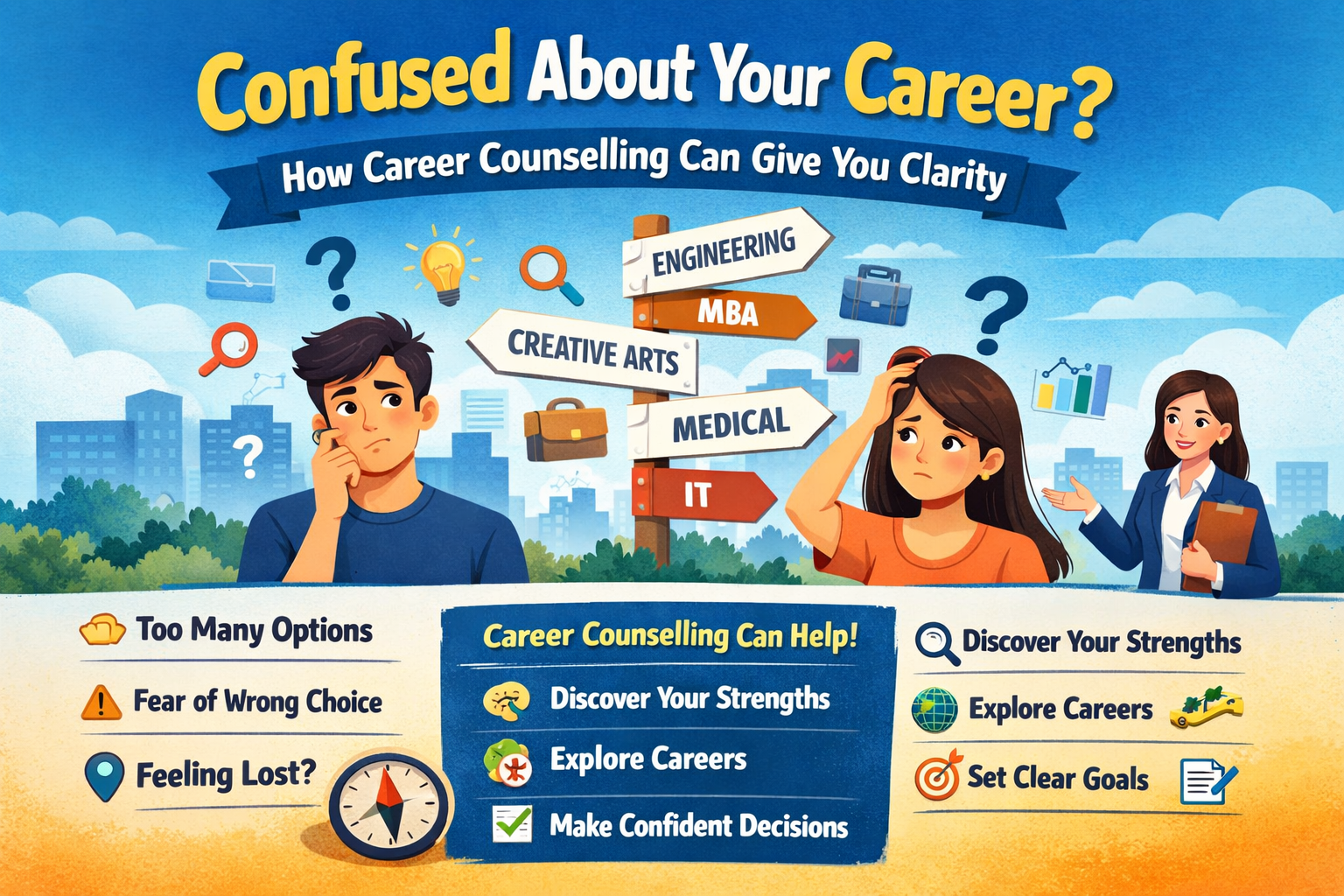
Introduction:
Choosing the right
career is one of the most important decisions in life, yet it is also one of
the most confusing ones. Today, both students and working professionals often
find themselves stuck in a maze of endless career options, expectations, and
uncertainties. The pressure to “choose the right path” can feel overwhelming.
With the rise of new
industries, digital careers, and unconventional job roles, the number of
opportunities has increased—but so has confusion. Many individuals struggle
with questions like:
- “What should I do after 10th or
12th?” - “Is this career right for me?”
- “What if I fail or regret my
decision later?”
This confusion often
leads to stress, self-doubt, and poor career choices.
This is where career
counselling becomes a game-changer. It provides structured guidance,
clarity, and confidence to help individuals make informed decisions about their
future.
In this blog, we will
explore how career counselling works, why people feel confused, and how it can
help you find the right direction in your career journey.
Why People Feel
Confused About Their Career:
Career confusion is
more common than you think. Let’s understand the major reasons behind it:
1. Lack of Awareness
About Career Options
Most students are only
aware of traditional careers like engineering, medicine, or government jobs.
They are unaware of emerging fields such as digital marketing, data science,
UI/UX design, and entrepreneurship.
2. Pressure from
Parents or Society
Many individuals choose
careers based on family expectations or societal norms rather than personal
interest. This often leads to dissatisfaction later.
3. Not Knowing Personal
Strengths and Interests
A major reason for
confusion is the lack of self-awareness. Many people don’t know:
- What they are good at
- What they enjoy doing
- What kind of work suits their
personality
4. Fear of Job Security
and Salary
People often choose
“safe” careers due to fear of financial instability, even if they are not
passionate about them.
5. Following Trends
Without Research
Choosing careers just
because they are trending (like coding, AI, or UPSC preparation) without
understanding the requirements leads to confusion and burnout.
6. Multiple Interests
but No Clear Direction
Some individuals are
multi-talented and interested in many fields, which makes it difficult to
choose one path.
What is Career
Counselling?
Career counselling is a
structured process that helps individuals understand themselves and make
informed career decisions.
Simple Definition:
Career counselling is
professional guidance provided by trained experts to help individuals choose
the right career based on their interests, skills, personality, and goals.
Key Features:
- Conducted by trained career
counsellors or coaches - Uses scientific tools like aptitude
and personality tests - Includes one-on-one discussions
- Focuses on long-term career growth
Career counselling is
not about telling you what to do—it’s about helping you discover what is best
for you.
How Career Counselling
Gives You Clarity:
Understanding Your
Interests:
Career counselling
helps identify what truly excites and motivates you. Through assessments and
discussions, it uncovers your passions.
For example:
- Do you enjoy creative work?
- Do you like solving problems?
- Do you prefer working with people
or data?
Matching your interests
with your career leads to long-term satisfaction.
Identifying Your
Strengths:
Everyone has unique
abilities. Career counselling helps analyze:
- Natural talents
- Academic strengths
- Personality traits
This ensures that you
choose a career where you can perform well and grow faster.
Exploring Career
Options:
One of the biggest
advantages is exposure to multiple career paths.
You learn about:
- Traditional careers
- Modern and emerging fields
- Alternative career paths
For example, someone
interested in art can explore:
- Graphic design
- Animation
- UI/UX design
- Content creation
This broadens your
perspective.
Setting Clear Career
Goals:
Career counselling
helps you move from confusion to clarity by setting:
- Short-term goals (courses, skills)
- Long-term goals (career growth, specialization)
It provides a
step-by-step roadmap to achieve your dreams.
Removing Doubts and
Fear:
Talking to an expert
reduces anxiety and confusion. You gain confidence because your decisions are
backed by logic and guidance.
Who Should Take Career
Counselling?
Career counselling is
useful for everyone—not just students.
Students After 10th
Class
Choosing the right
stream (Science, Commerce, Arts) becomes easier.
Students After 12th
Class
Helps in selecting the
right course and college.
College Students
Guides specialization
and career direction.
Fresh Graduates
Helps in choosing jobs
or higher education.
Working Professionals
Useful for career
switching or growth planning.
Anyone Feeling Confused
If you feel stuck or
unsure, counselling can help.
Benefits of Career
Counselling:
1. Clear Career
Direction
Eliminates confusion
and provides a focused path.
2. Saves Time and Money
Avoids wrong course
selection and career changes.
3. Better
Decision-Making
Helps you choose based
on facts, not assumptions.
4. Builds Confidence
You feel more confident
about your choices.
5. Goal Setting
Provides structured
planning for success.
6. Career Satisfaction
Choosing the right path
leads to long-term happiness.
When is the Right Time
for Career Counselling?
Timing plays a crucial
role in making the right career decision.
After 10th Standard
To choose the right
stream.
After 12th Standard
To select graduation
courses.
Before Choosing a
Degree
Ensures alignment with
career goals.
Before Career Switching
Helps professionals
move in the right direction.
When Feeling Stuck in a
Job
Provides clarity for
growth or change.
After Graduation
Guides specialization
and job opportunities.
Career Counselling
Process:
Understanding the
process makes it easier to trust the system.
Step 1: Career
Discussion
Initial conversation to
understand your background, interests, and concerns.
Step 2: Interest &
Aptitude Assessment
Tests to evaluate your
skills, interests, and capabilities.
Step 3: Skill
Evaluation
Analyzing your
strengths and improvement areas.
Step 4: Career Option
Exploration
Identifying suitable
career paths based on your profile.
Step 5: Career Roadmap
Creation
Designing a structured
plan for your career.
Step 6: Action Plan
Concrete steps like
courses, internships, and skill development.
Common Myths About
Career Counselling:
Myth 1: It is Only for
Weak Students
Reality: It is for
everyone who wants clarity.
Myth 2: Only Students
Need It
Reality: Professionals
also benefit greatly.
Myth 3: Counsellors
Decide Your Career
Reality: They guide—you
make the final decision.
Myth 4: It is Expensive
Reality: Many
affordable and even free options are available.
Myth 5: One Session is
Enough
Reality: Career
planning is a continuous process.
Tips to Get the Most
from Career Counselling:
Be Honest
Share your true
interests and concerns openly.
Ask Questions
Clear all your doubts
during sessions.
Discuss Goals Clearly
Explain your
expectations and ambitions.
Keep an Open Mind
Be willing to explore
new options.
Follow the Roadmap
Take action on the
guidance provided.
Conclusion:
Career confusion is not
a problem—it is a sign that you care about your future. In today’s fast-changing
world, feeling uncertain about your career is completely normal.
However, staying
confused for too long can lead to wrong decisions and missed opportunities.
Career counselling
provides:
- Clarity
- Direction
- Confidence
It helps you understand
yourself better and choose a career that aligns with your interests, strengths,
and goals.
Remember, the right
guidance at the right time can completely transform your future.
So if you are feeling
confused, don’t ignore it—take action. A small step towards career counselling
today can lead to a successful and fulfilling career tomorrow.