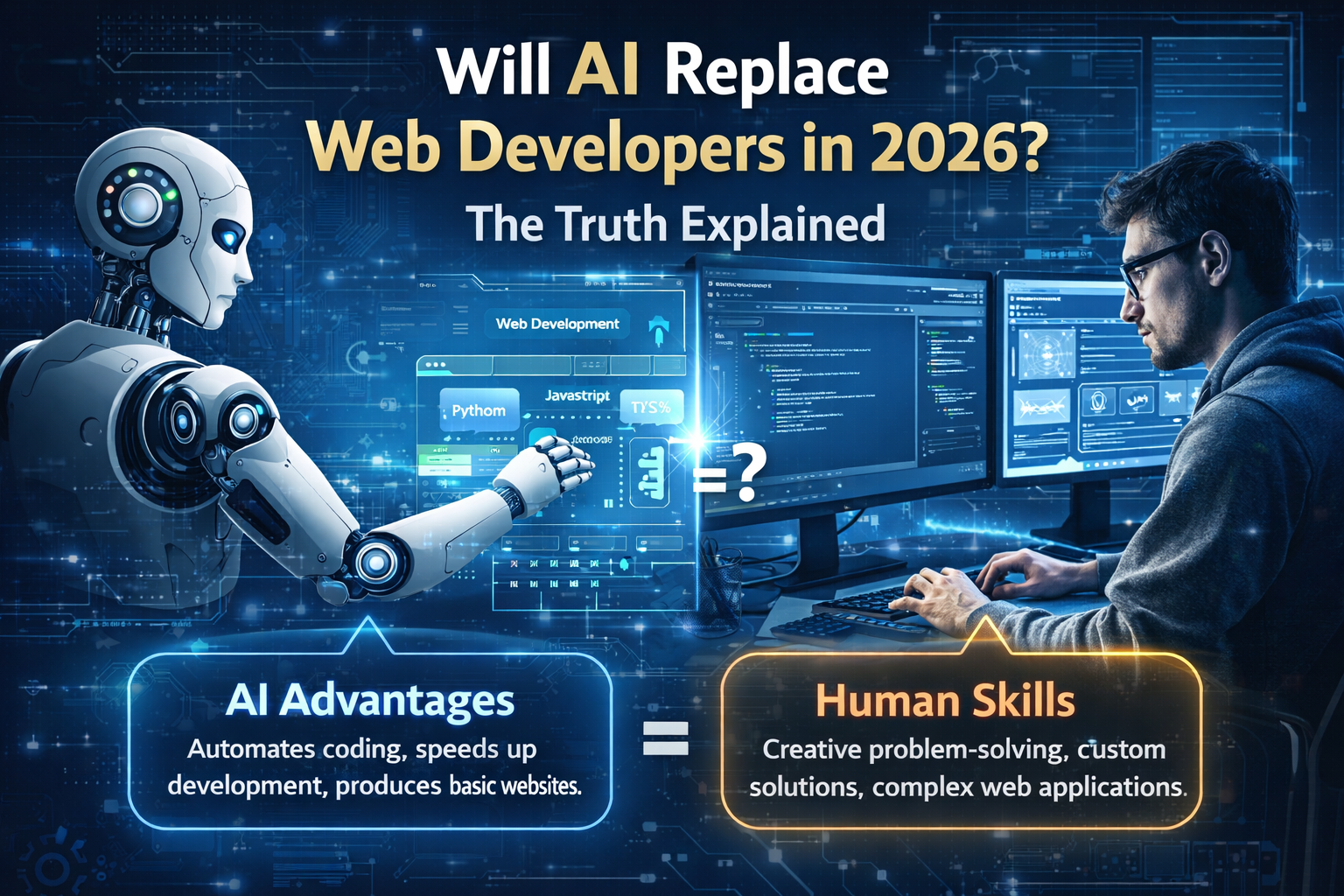
Introduction:
Artificial Intelligence
is no longer a futuristic concept—it is already transforming industries across
the globe. From healthcare to finance and education to marketing, AI is reshaping
how we work. One of the most impacted fields is web development.
Tools like ChatGPT and GitHub
Copilot are capable of writing code, fixing bugs, generating designs, and even
suggesting improvements in real time. This rapid evolution has led to a growing
concern among students, developers, and aspiring tech professionals:
Will AI replace web
developers in 2026?
This question is not
just about job security—it’s about the future of an entire industry.
The truth is nuanced.
AI is powerful, but it is not a complete replacement for human developers.
Instead, it is a tool that is transforming how developers work, increasing
productivity, and changing skill requirements.
In this comprehensive
SEO-optimized blog, we will explore:
- What AI in web development really
means - Current capabilities of AI tools in
2026 - The limitations of AI
- Which roles are at risk and which
are safe - Future trends in the industry
- Skills you must learn to stay
relevant
By the end, you will
have a clear understanding of whether web development is still a good career
choice in the AI era.
What Does AI in Web
Development Actually Mean?
Before jumping to
conclusions, it’s important to understand what AI in web development truly
involves.
Definition of AI in
Coding
AI in web development
refers to the use of machine learning models and intelligent systems to assist
developers in writing, optimizing, and maintaining code. It does not mean that
AI independently builds complex applications from scratch without human involvement.
Instead, AI acts as a co-pilot—helping
developers perform tasks faster and more efficiently.
Popular AI Tools in Web
Development
Several AI-powered
tools are widely used today:
- ChatGPT – Generates code, explains
concepts, and debugs errors - GitHub Copilot – Suggests code in
real-time while typing - Tabnine – Provides intelligent code
predictions - Figma – Assists in UI/UX design
These tools are not
replacing developers—they are enhancing their capabilities.
Key Capabilities of AI
AI can:
- Generate code snippets
- Suggest improvements
- Detect bugs and errors
- Automate repetitive tasks
- Assist in UI/UX design
AI Assistance vs Full
Automation
This is where most
confusion lies.
- AI Assistance: AI helps developers complete tasks
faster - Full Automation: AI replaces developers entirely
As of 2026, AI is
excellent at assistance but far from full automation.
Current Capabilities of
AI in Web Development (2026):
AI has made significant
progress, and its capabilities are impressive. Let’s break down what it can do
today.
1 Code Generation:
AI tools can now
generate:
- HTML, CSS, and JavaScript code
- Basic web pages and landing pages
- Backend APIs and functions
For example, with a
simple prompt like “Create a responsive portfolio website,” AI can generate a
complete structure within seconds.
However, complex
applications still require human expertise.
2 UI/UX Design
Assistance:
Design plays a crucial
role in web development. AI tools like Figma help by:
- Suggesting layouts
- Generating components
- Improving user experience
But creativity,
branding, and emotional design still rely heavily on human designers.
3 Debugging &
Testing:
AI can:
- Identify bugs quickly
- Suggest possible fixes
- Automate test cases
This reduces
development time significantly and improves efficiency.
4 Automation of
Repetitive Tasks:
AI is especially
powerful in handling repetitive tasks such as:
- Code documentation
- Refactoring code
- Performance optimization
This allows developers
to focus on more important and complex aspects of projects.
Limitations of AI (Why
It Can’t Replace Developers Fully):
Despite its
capabilities, AI has several critical limitations that prevent it from
replacing web developers entirely.
1 Lack of Creativity
& Human Thinking:
AI works based on
existing data. It does not truly “think” or innovate.
- It cannot create original ideas
- It struggles with unique design
concepts - It lacks emotional intelligence
Human creativity
remains irreplaceable.
2 No Real Business
Understanding:
Web development is not
just about writing code—it’s about solving problems.
AI cannot fully:
- Understand client requirements
- Align with business goals
- Make strategic decisions
Developers play a key
role in bridging the gap between technology and business.
3 Security &
Scalability Issues:
AI-generated code may:
- Contain security vulnerabilities
- Lack scalability for large systems
- Require manual review and testing
Security is a critical
area where human expertise is essential.
4 Dependency on Human
Input:
AI depends heavily on:
- Clear instructions (prompts)
- Human supervision
- Continuous feedback
Without human input, AI
cannot function effectively.
Jobs Most at Risk vs
Safe Roles:
AI will impact some
roles more than others.
1 Roles That May
Decline:
The following roles may
see reduced demand:
- Junior developers performing
repetitive tasks - Basic website builders
- Template-based designers
These roles are easier
to automate.
2 Roles That Will
Thrive:
On the other hand,
high-value roles will grow:
- Full-stack developers
- UI/UX designers
- AI-integrated developers
- Problem-solving experts
These roles require
critical thinking and creativity—areas where AI struggles.
AI vs Web Developers:
Collaboration, Not Competition:
The biggest
misconception is that AI and developers are competitors.
In reality, they are
collaborators.
How Developers Use AI
Developers use AI to:
- Write code faster
- Automate repetitive tasks
- Debug efficiently
Increased Productivity
AI can:
- Reduce development time
significantly - Improve code quality
- Increase efficiency
The Reality
A popular saying in the
tech industry is:
“AI won’t replace you,
but a developer using AI will.”
This highlights the
importance of adapting to new tools.
Future of Web
Development in the AI Era:
The future of web
development is evolving rapidly.
Rise of No-Code and
Low-Code Platforms
Platforms like:
- Webflow
- Wix
allow users to build
websites without coding.
However, they are
limited for complex applications.
Shift from Coding to
Problem-Solving:
Developers will:
- Spend less time writing code
- Focus more on solving real-world
problems
Growing Demand for
AI-Skilled Developers:
Companies now prefer
developers who:
- Understand AI tools
- Can integrate AI into applications
Evolution of Job Roles:
New roles are emerging:
- AI Developer
- Prompt Engineer
- Automation Specialist
The industry is not
shrinking—it’s evolving.
Skills You Must Learn
to Stay Relevant in 2026:
To succeed in the AI
era, you need to upgrade your skillset.
1 Technical Skills:
Focus on:
- React
- Next.js
- API integration
- Backend development
2 Soft Skills:
Soft skills are
becoming more important:
- Critical thinking
- Creativity
- Communication
3 New-Age Skills:
Modern developers
should learn:
- Prompt engineering
- AI workflows
- Automation tools
These skills will give
you a competitive edge.
Should You Still Learn
Web Development in 2026?
The answer is a strong yes.
Why Demand Still Exists
- Every business needs an online
presence - Digital transformation is
increasing - Startups are growing rapidly
Opportunities in Web
Development:
You can explore:
- Freelancing
- Remote jobs
- Startup projects
- Tech companies
Web development remains
one of the most in-demand skills.
Conclusion:
So, will AI replace web
developers in 2026?
No, it will not. But it
will transform the industry significantly.
AI is:
- Automating repetitive tasks
- Increasing productivity
- Changing workflows
But it cannot replace:
- Human creativity
- Problem-solving ability
- Strategic thinking