1. Introduction
Many people believe that learning German is extremely difficult. Words like “complicated grammar,” “long words,” and “harsh pronunciation” often discourage beginners before they even start. But here’s the truth — these fears are often exaggerated.
German is actually one of the most logical and structured languages you can learn. With the right approach, consistency, and mindset, you can go from zero to fluent faster than you think.
In today’s global world, German is becoming increasingly valuable. It is the most widely spoken native language in Europe and is essential for careers in engineering, business, research, and international trade. Countries like Germany, Austria, and Switzerland offer amazing opportunities for students and professionals who know the language.
In this complete guide, you’ll learn:
Why German seems difficult (but isn’t)
What actually makes it easier than other languages
A step-by-step roadmap from beginner to fluent
Practical tips to speed up your learning
Common mistakes to avoid
The benefits of learning German
Tools and resources to get started
Let’s break the myth and make German simple.
2. Why People Think German is Difficult
Before we prove that German is easy, let’s understand why it has a “difficult” reputation.
2.1 Long Words and Compound Nouns
German is famous for its long words like:
Donaudampfschifffahrtsgesellschaftskapitän
These words can look scary, but they are just combinations of smaller words. Once you break them down, they become easy to understand.
2.2 Grammar Rules
German grammar includes:
Cases (nominative, accusative, dative, genitive)
Gender (masculine, feminine, neuter)
Sentence structure
At first glance, this seems overwhelming — but there’s a twist (we’ll get to that soon).
2.3 Pronunciation Concerns
Some sounds like “ch” or “ü” are unfamiliar to English speakers, making people nervous about speaking.
2.4 Comparison with Other Languages
Many learners compare German to simpler languages like Spanish and assume it’s harder. But compared to languages like Chinese or Arabic, German is actually much easier for English speakers.
3. Why German is Actually Easier Than You Think
Now let’s flip the perspective.
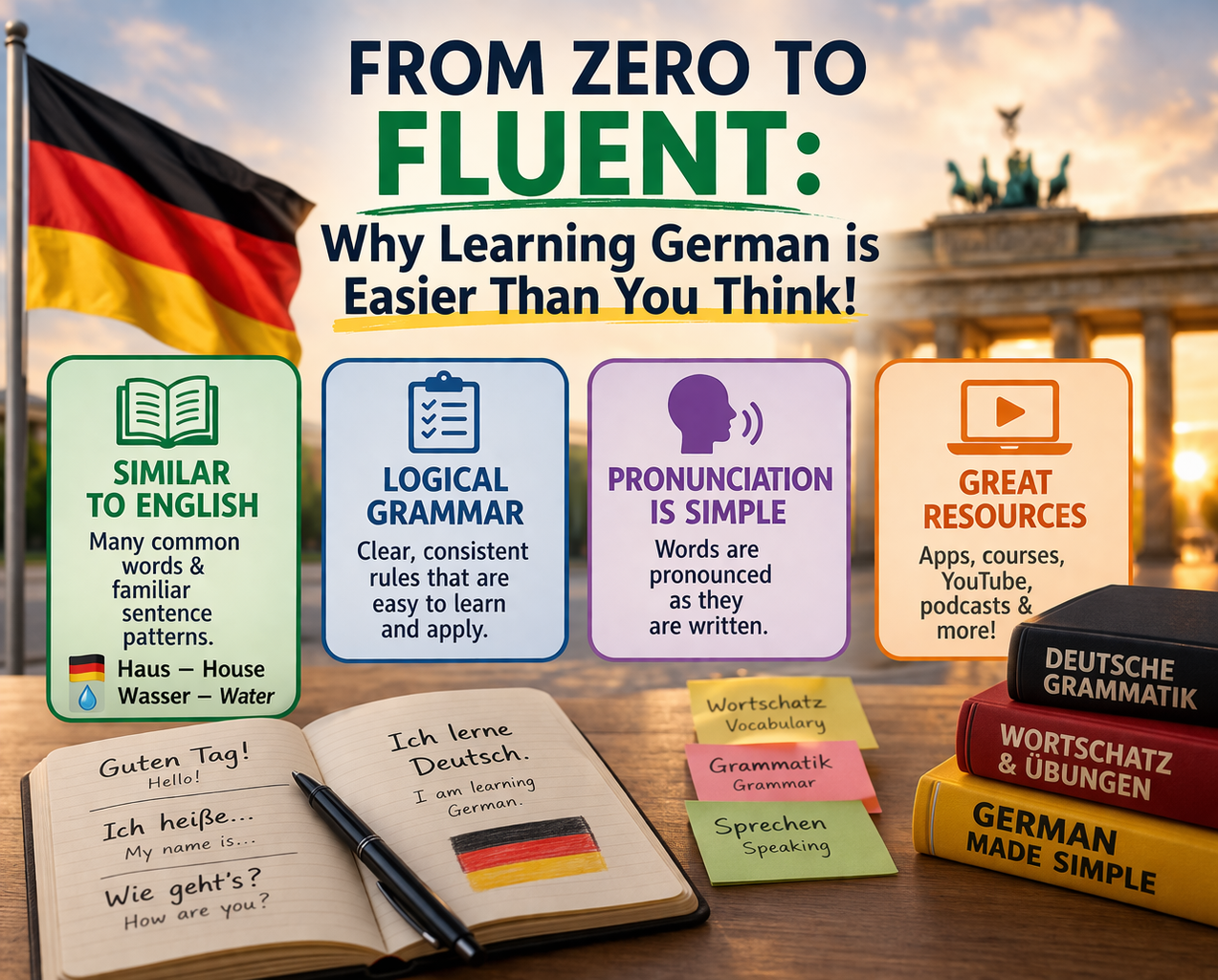
3.1 Similarities with English
German and English belong to the same Germanic language family. That means they share many similarities.
Examples:
Haus → House
Wasser → Water
Freund → Friend
Even sentence structures can feel familiar:
“Ich habe Hunger” → “I have hunger”
This makes learning German vocabulary faster than you expect.
3.2 Logical Grammar Structure
Unlike English, German grammar is highly logical and consistent.
Rules rarely change
Exceptions are fewer compared to English
Once you learn a rule, you can apply it everywhere
For example:
Verb placement follows patterns
Sentence construction is predictable
This consistency actually makes German easier in the long run.
3.3 Phonetic Pronunciation
One of the biggest advantages of German is its pronunciation.
Words are pronounced exactly as they are written
Very few silent letters
Reading becomes easy quickly
Unlike English (where “though,” “through,” and “tough” sound different), German is straightforward.
3.4 Abundance of Learning Resources
Today, learning German is easier than ever.
Popular apps like Duolingo and Babbel make learning fun and interactive.
You also have:
YouTube tutorials
Podcasts
Online courses
Language exchange platforms
Plus, German proficiency is structured into levels (A1 to C2), giving you a clear learning path.
4. Step-by-Step Roadmap: From Zero to Fluent
Let’s break your journey into three stages.
4.1 Beginner Level (A1–A2)
At this stage, focus on building your foundation.
What to learn:
Basic vocabulary (1000–1500 words)
Common phrases
Simple sentence formation
Greetings and introductions
Key skills:
Listening to simple conversations
Speaking basic sentences
Reading short texts
Tip: Don’t wait to be perfect — start speaking from day one.
4.2 Intermediate Level (B1–B2)
Now you start becoming independent in the language.
What to focus on:
Grammar improvement
Complex sentence structures
Expanding vocabulary
Skills to develop:
Holding conversations
Writing paragraphs and emails
Understanding movies and podcasts
At this level, you can:
Travel comfortably
Handle daily communication
Study basic academic content
4.3 Advanced Level (C1–C2)
This is where fluency happens.
What you’ll achieve:
Speak confidently like a native
Understand advanced texts and discussions
Use German professionally
You’ll be able to:
Work in German-speaking environments
Study at German universities
Consume native content effortlessly
5. Practical Tips to Learn German Faster
Want to speed up your progress? Follow these proven strategies:
5.1 Learn 10–15 Words Daily
Consistency beats intensity. Small daily learning builds massive vocabulary over time.
5.2 Practice Speaking from Day One
Don’t wait until you “feel ready.” Speaking early improves confidence and fluency.
5.3 Watch German Content
Watch:
Movies
Series
YouTube videos
Use subtitles at first, then gradually remove them.
5.4 Use Flashcards & Spaced Repetition
Apps like Anki help you remember words efficiently using spaced repetition.
5.5 Join Language Communities
Practice with real people:
Language exchange platforms
Online groups
Local classes
Real interaction is the fastest way to improve.
6. Common Mistakes to Avoid
Avoid these traps that slow down learning:
6.1 Focusing Only on Grammar
Grammar is important — but speaking matters more.
6.2 Fear of Making Mistakes
Mistakes are part of learning. The more you make, the faster you improve.
6.3 Inconsistent Practice
Learning once a week won’t work. Daily practice is key.
6.4 Translating Everything from English
Think in German instead of translating. This builds fluency faster.
7. Benefits of Learning German
Learning German opens many doors.
7.1 Career Opportunities
Germany has one of the strongest economies in the world. German skills are valuable in:
Engineering
IT
Business
Healthcare
7.2 Study Opportunities
Germany offers:
Affordable education
World-class universities
Scholarships for international students
7.3 Travel & Cultural Experience
Knowing German enhances your travel experience across Europe.
7.4 Cognitive Growth
Learning a new language improves:
Memory
Problem-solving skills
Multitasking ability
8. Tools & Resources for Learning German
Here are some powerful tools:
Mobile Apps
Duolingo
Babbel
Memrise
Online Learning
YouTube channels
Online courses
Virtual classes
Books
Grammar guides
Vocabulary books
Practice workbooks
Audio Resources
Podcasts
Audiobooks
9. How Long Does It Take to Become Fluent?
The timeline depends on your effort and consistency.
Realistic Estimates:
Basic conversation: 3–6 months
Intermediate fluency: 6–12 months
Advanced fluency: 1–2 years
Factors That Affect Speed:
Daily practice time
Learning method
Exposure to the language
Speaking practice
Consistency is the biggest factor.
10. Motivation: Real-Life Success Stories
Thousands of learners have gone from zero to fluent.
What they have in common:
Consistency
Practice
Patience
They didn’t wait for the “perfect time” — they started.
And so can you.
11. Conclusion
German is not as difficult as it seems. In fact, it is one of the most logical and structured languages you can learn.
Let’s recap:
It shares similarities with English
Grammar is consistent and predictable
Pronunciation is straightforward
Resources are easily available
The real secret is simple:
Consistency + Practice = Fluency
If you start today and stay consistent, you’ll be surprised how quickly you progress.
So don’t wait.
Start your German learning journey today — from zero to fluent. 🚀