Introduction
Learning French is an exciting journey, but one of the biggest challenges learners face is mastering verb conjugations. Unlike English, French verbs change depending on the subject, tense, and mood. This can feel overwhelming at first, especially when you encounter irregular verbs and silent endings.
However, the good news is that French verb conjugation follows logical patterns. Once you understand these patterns and practice consistently, conjugating verbs becomes much easier and more natural.
In this comprehensive guide, you will learn everything about French verb conjugations—rules, patterns, exceptions, and common mistakes. Whether you're a beginner or an intermediate learner, this guide will help you build a strong foundation in French grammar and improve your fluency.
What is French Verb Conjugation?
Verb conjugation is the process of changing a verb’s form to match:
The subject (je, tu, il/elle, nous, vous, ils/elles)
The tense (present, past, future)
The mood (indicative, imperative, subjunctive)
For example, take the verb parler (to speak):
Je parle (I speak)
Tu parles (You speak)
Nous parlons (We speak)
Each form changes slightly depending on the subject. This is called conjugation.
Why Learning French Verb Conjugations is Important
Understanding verb conjugations is essential because it helps you:
Communicate clearly and accurately
Form grammatically correct sentences
Understand spoken and written French
Improve confidence in speaking
Without proper conjugation, even simple conversations can become confusing or incorrect.
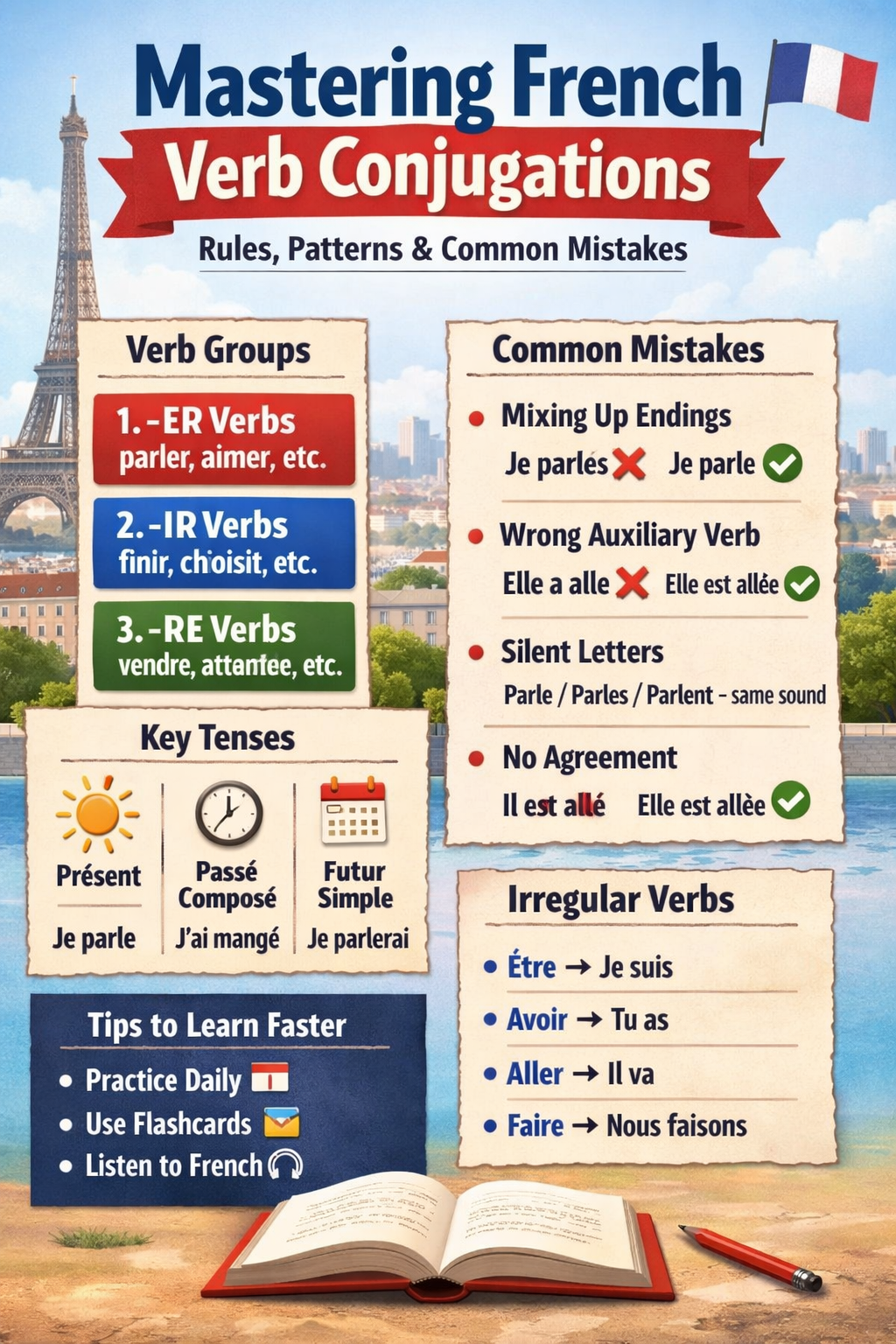
The Three Main Groups of French Verbs
French verbs are divided into three main categories:
1. Regular -ER Verbs (First Group)
These are the most common and easiest verbs to learn. About 80% of French verbs fall into this category.
Example: parler (to speak)
Conjugation:
Je parle
Tu parles
Il/Elle parle
Nous parlons
Vous parlez
Ils/Elles parlent
Rule:
Remove “-er” and add endings:
e
es
e
ons
ez
ent
More Examples:
aimer (to love)
travailler (to work)
regarder (to watch)
- 2. Regular -IR Verbs (Second Group)
These verbs follow a consistent pattern but are slightly different from -ER verbs.
Example: finir (to finish)
Conjugation:
Je finis
Tu finis
Il finit
Nous finissons
Vous finissez
Ils finissent
Rule:
Remove “-ir” and add:
is
is
it
issons
issez
issent
- 3. Regular -RE Verbs (Third Group)
These are less common but still important.
Example: vendre (to sell)
Conjugation:
Je vends
Tu vends
Il vend
Nous vendons
Vous vendez
Ils vendent
Rule:
Remove “-re” and add:
s
s
(no ending)
ons
ez
ent
- Understanding Verb Stems
The stem is the base of the verb after removing its ending.
Examples:
parler → parl-
finir → fin-
vendre → vend-
All conjugations are formed using the stem + appropriate endings.
French Verb Tenses Explained
To master French verbs, you need to understand key tenses:
1. Present Tense (Présent)
Used for:
Actions happening now
General truths
Examples:
Je mange (I eat)
Nous étudions (We study)
- 2. Passé Composé (Past Tense)
Used for completed actions.
Structure:
Auxiliary verb (avoir/être) + past participle
Examples:
J’ai mangé (I ate)
Elle est allée (She went)
- 3. Imparfait (Imperfect Tense)
Used for:
Habitual actions in the past
Descriptions
Examples:
Je lisais (I was reading)
Nous étions heureux (We were happy)
- 4. Futur Simple (Future Tense)
Used for future actions.
Examples:
Je parlerai (I will speak)
Nous finirons (We will finish)
- 5. Near Future (Futur Proche)
Structure:
aller + infinitive
Example:
Je vais manger (I am going to eat)
- Irregular Verbs in French
Irregular verbs do not follow standard patterns and must be memorized.
Être (to be)
Je suis
Tu es
Il est
Nous sommes
Vous êtes
Ils sont
- Avoir (to have)
J’ai
Tu as
Il a
Nous avons
Vous avez
Ils ont
- Aller (to go)
Je vais
Tu vas
Il va
Nous allons
Vous allez
Ils vont
- Faire (to do/make)
Je fais
Tu fais
Il fait
Nous faisons
Vous faites
Ils font
- Common Patterns to Simplify Learning
1. Memorize Endings, Not Entire Verbs
Once you know endings, you can apply them to many verbs.
2. Learn High-Frequency Verbs First
Focus on verbs used daily:
être
avoir
aller
faire
- 3. Practice Verb Groups Together
Grouping similar verbs improves memory and speed.
Most Common Mistakes in French Verb Conjugations
1. Incorrect Endings
❌ Je parles
✅ Je parle
2. Silent Letters Confusion
Many endings are not pronounced:
parle / parles / parlent → same sound
- 3. Using Wrong Auxiliary Verb
❌ Elle a allé
✅ Elle est allée
4. Ignoring Agreement Rules
With être verbs:
Elle est allée
Ils sont allés
- 5. Direct Translation from English
❌ I am agree
✅ Je suis d’accord
6. Mixing Tenses Incorrectly
❌ Je mange hier
✅ J’ai mangé hier
Practical Tips to Master French Verb Conjugation
1. Daily Practice
Consistency is key. Practice every day, even for a short time.
2. Use Flashcards
Great for memorizing:
Verb endings
Irregular verbs
- 3. Write Your Own Sentences
Instead of memorizing, apply verbs in context.
4. Listen to French Content
Watch:
French movies
YouTube videos
Podcasts
- 5. Speak Regularly
Practice speaking—even if you make mistakes.
Advanced Strategies for Faster Learning
1. Learn Verb Families
Recognize patterns in similar verbs.
2. Practice with Real-Life Situations
Example:
Ordering food
Asking directions
- 3. Read French Content Daily
Books, blogs, and articles improve understanding.
4. Think in French
Train your brain to process directly in French.
Practice Examples
Present Tense
Je parle français
Nous mangeons ensemble
- Past Tense
J’ai fini mon travail
Ils sont arrivés
- Future Tense
Je voyagerai demain
Nous étudierons ensemble- Conclusion:
Mastering French verb conjugations may seem challenging at first, but it becomes easier with practice and the right approach. By understanding verb groups, learning patterns, and practicing regularly, you can quickly improve your skills.
Focus on consistency, avoid common mistakes, and build a strong foundation. Over time, conjugation will become second nature, allowing you to speak French confidently and fluently.