Introduction
In today’s rapidly evolving digital world, one question is being asked more than ever:
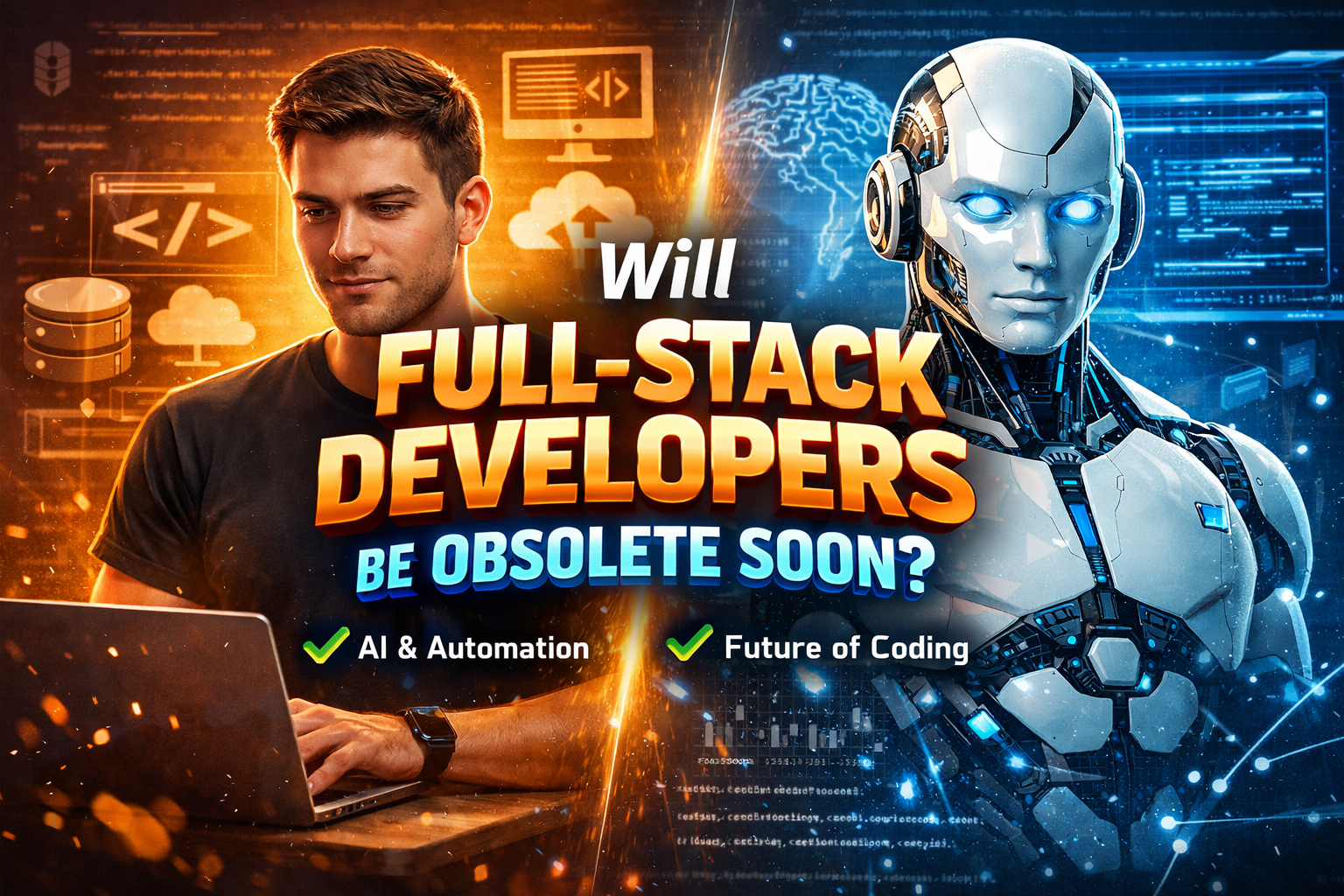
Will full-stack developers become obsolete soon?
With the rise of Artificial Intelligence (AI), automation tools, and no-code platforms, many aspiring developers and even experienced professionals are beginning to worry about their future. AI tools can now generate code, design interfaces, fix bugs, and even build entire applications with minimal human input.
This has led to widespread fear:
👉 Is coding dying?
👉 Will AI replace developers?
👉 Is full-stack development still a good career in 2026 and beyond?
The short answer is no—full-stack developers are not becoming obsolete.
But the long answer is far more interesting and important.
In reality, the role of full-stack developers is not disappearing—it is evolving at an unprecedented pace. Developers who adapt will thrive, while those who resist change may struggle.
In this in-depth, SEO-optimized blog, we will explore:
The impact of AI on full-stack development
The truth behind automation and no-code tools
Why full-stack developers are still in high demand
The future of web development careers
Skills you must learn to stay relevant
Let’s dive deep into the future of full-stack development.
What Is a Full-Stack Developer?
A full-stack developer is a professional who can work on both the frontend and backend of a web application.
Frontend Development
This includes everything users see and interact with:
HTML, CSS, JavaScript
Frameworks like React, Angular, Vue
UI/UX design principles
Backend Development
This involves the server-side logic:
Programming languages like Node.js, Python, Java
Databases like MongoDB, MySQL
APIs and server management
Additional Responsibilities
Modern full-stack developers often also handle:
Cloud deployment (AWS, Azure, GCP)
DevOps practices
Security and performance optimization
Because of this versatility, full-stack developers are often seen as complete problem solvers who can build applications from start to finish.
The Rise of AI in Software Development
Artificial Intelligence is transforming every industry, and software development is no exception.
1. AI-Powered Coding Tools
Tools like:
ChatGPT
GitHub Copilot
CodeWhisperer
are helping developers write code faster than ever before.
These tools can:
Generate code snippets instantly
Suggest improvements
Detect and fix bugs
Write documentation
Impact on Developers
AI significantly improves productivity by:
Reducing repetitive work
Speeding up development
Minimizing manual errors
However, AI is not perfect. It often:
Produces incorrect or inefficient code
Lacks context awareness
Requires human validation
2. Automation of Repetitive Tasks
AI is excellent at automating:
Boilerplate code
Testing scripts
Debugging suggestions
UI layout generation
This means developers spend less time on repetitive tasks and more time on creative and strategic work.
3. Growth of No-Code and Low-Code Platforms
Platforms like:
Webflow
Bubble
Wix
allow users to build applications without coding.
What This Means
Non-developers can create simple websites
Startups can launch products faster
Basic development tasks are becoming automated
But there’s a catch.
No-code tools are limited when it comes to:
Complex applications
Custom features
Scalability
Security
This is where full-stack developers still dominate.
The Myth: AI Will Replace Full-Stack Developers
The biggest misconception today is:
👉 “AI will replace developers completely.”
This idea comes from seeing AI generate code instantly. But it ignores a crucial fact:
Software development is not just about writing code.
It involves:
Understanding business requirements
Designing system architecture
Solving complex problems
Ensuring security and scalability
AI cannot fully replicate these human abilities.
The Reality: Full-Stack Developers Are Evolving
Instead of replacing developers, AI is changing how they work.
Old Role:
Writing code manually
Handling repetitive tasks
New Role:
Using AI tools efficiently
Designing complex systems
Managing integrations
Solving real-world problems
👉 Developers are becoming strategic thinkers instead of just coders.
Why Full-Stack Developers Are Still in High Demand
1. AI Cannot Understand Context Fully
AI lacks deep understanding of:
Business goals
User behavior
Real-world constraints
Developers bridge the gap between:
👉 Technology and business needs
2. Integration Is Complex
Building an application is not just about coding—it’s about connecting multiple systems.
For example:
Frontend + Backend
Database + APIs
Payment gateways + authentication systems
These integrations require:
Experience
Problem-solving skills
System-level thinking
AI struggles with this level of complexity.
3. Security Still Requires Human Expertise
AI-generated code often has:
Security vulnerabilities
Inefficient logic
Poor optimization
Full-stack developers ensure:
Secure authentication systems
Data protection
Scalable infrastructure
4. Complex Applications Need Experts
AI can build simple apps, but not:
Enterprise-level systems
Real-time platforms
Large-scale distributed systems
Examples include:
E-commerce platforms
Social media apps
Banking systems
These require experienced developers.
5. Businesses Still Need Developers
Companies are not just hiring coders—they are hiring problem solvers.
Full-stack developers:
Reduce team size
Increase efficiency
Handle multiple roles
👉 This makes them extremely valuable.
The Future of Full-Stack Development
1. AI-Augmented Development
Developers will increasingly:
Use AI as a coding assistant
Automate routine tasks
Focus on high-level decision-making
2. Rise of Hybrid Roles
The future belongs to developers who understand:
Full-stack development
AI and machine learning
Cloud computing
These hybrid professionals will dominate the job market.
3. Faster Development Cycles
With AI:
Products will launch faster
Teams will become smaller
Productivity will increase
4. Increased Competition
AI lowers the barrier to entry, meaning:
More people can build apps
Competition increases
👉 But skilled developers will always stand out.
Skills You Need to Stay Relevant
To succeed in the future, full-stack developers must upgrade their skills.
1. AI Integration
Learn how to:
Use AI tools effectively
Integrate APIs
Build AI-powered applications
2. System Design
Focus on:
Scalable architecture
Microservices
Distributed systems
3. Cloud Computing
Master platforms like:
AWS
Azure
Google Cloud
4. Problem-Solving
This is the most important skill:
Logical thinking
Debugging
Optimization
5. Communication Skills
Developers must:
Understand client needs
Explain technical concepts
Collaborate with teams
Advantages of Being a Full-Stack Developer in 2026
High demand in job market
Flexibility to work on multiple technologies
Better salary opportunities
Ability to build complete products
Strong career growth
Challenges in the Future
Need for continuous learning
Adapting to new technologies
Increased competition
Pressure to learn AI tools
Is Full-Stack Development Still a Good Career?
Absolutely yes.
Full-stack development remains one of the:
Most in-demand careers
Most versatile skill sets
Most future-proof roles
However, success depends on:
👉 Your ability to adapt and evolve
Final Verdict
❌ Myth:
Full-stack developers will become obsolete.
✅ Truth:
Full-stack developers will become more powerful with AI.
Conclusion
The fear of AI replacing full-stack developers is understandable—but it is largely exaggerated.
AI is not here to replace developers.
It is here to enhance their capabilities.
Developers who:
Learn AI
Adapt to new tools
Focus on problem-solving
will not just survive—they will thrive.
On the other hand, those who rely only on traditional coding skills without evolving may find it difficult to stay competitive.