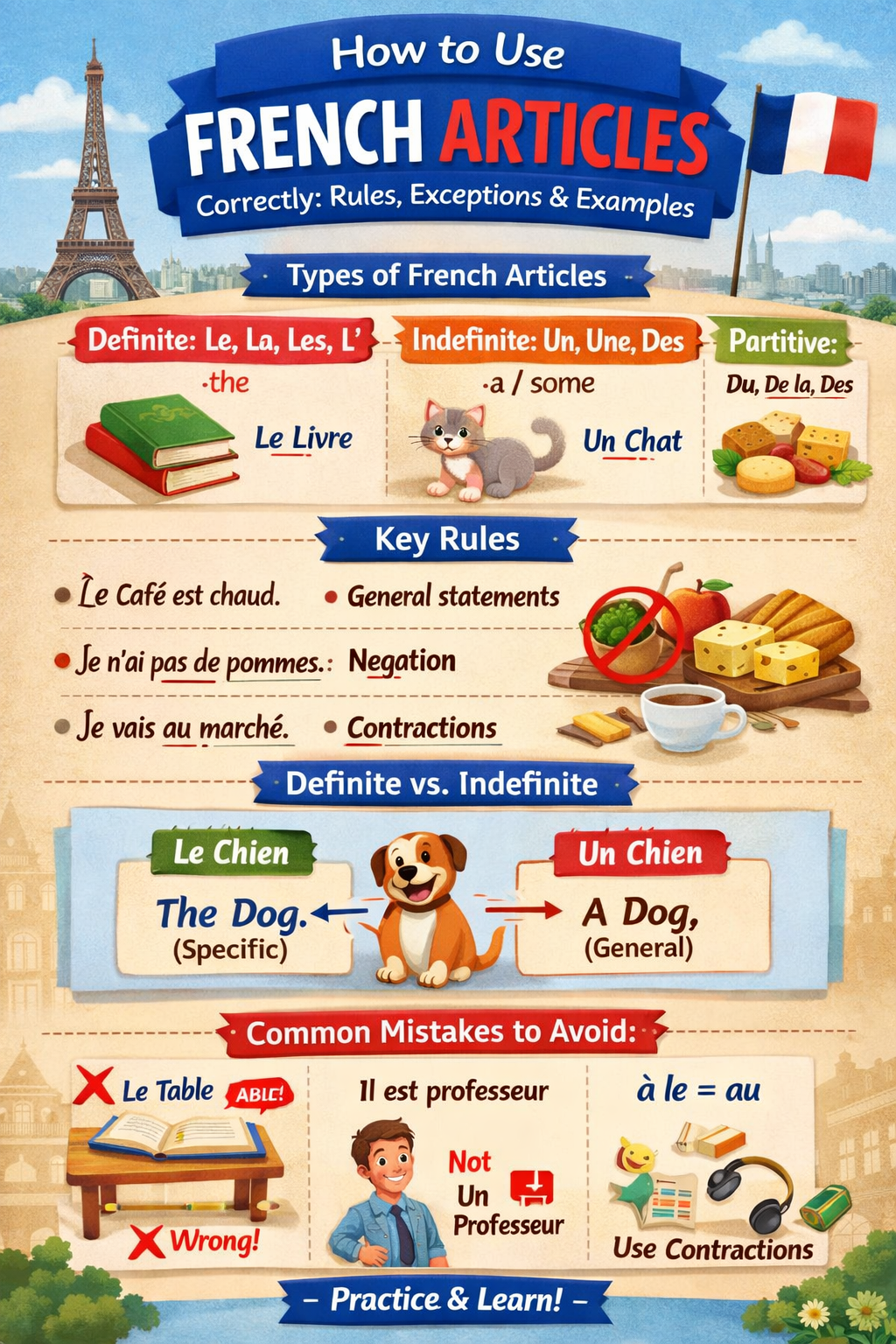
Introduction:
French is one of the most beautiful and widely spoken
languages in the world—but for many learners, mastering its grammar can feel
overwhelming. One of the biggest challenges? French articles.
Articles may seem like small words, but they play a huge
role in sentence meaning and accuracy. Whether you’re talking about a
book, the car, or some water, using the correct article in
French is essential.
Unlike English, French articles change based on:
- Gender
(masculine or feminine) - Number
(singular or plural) - Context
(specific vs general)
This is why many learners struggle—because there’s no
“one-size-fits-all” rule.
Why learners struggle with French articles
- English
uses fewer article variations - French
nouns have gender - Special
rules and exceptions can be confusing - Articles
change in negative sentences and contractions
What you’ll learn in this guide
In this complete guide, you’ll discover:
- Types
of French articles - Clear
rules with examples - Key
differences between article types - Important
exceptions and tricky cases - Common
mistakes to avoid - Practical
tips to master them faster
What Are French Articles?
Definition of Articles in French
Articles are small words placed before nouns to define
whether the noun is:
- Specific
or general - Known
or unknown - Countable
or uncountable
Comparison with English Articles
In English, we use:
- A / An →
Indefinite - The →
Definite
In French, there are more variations because nouns have
gender and number.
Types of French Articles
There are three main types:
1. Definite Articles
Used for specific or known nouns
→ the
2. Indefinite Articles
Used for non-specific nouns
→ a / an / some
3. Partitive Articles (brief)
Used for quantities of uncountable nouns
→ some (food, drinks, etc.)
Examples:
- Du
pain (some bread) - De
l’eau (some water)
Definite Articles in French (Le, La, Les, L’):
3.1 What Are Definite Articles?
Definite articles are used when referring to something specific,
known, or already mentioned.
They correspond to “the” in English.
3.2 Forms of Definite Articles
Article | Usage |
Le | Masculine singular |
La | Feminine singular |
Les | Plural |
L’ | Before vowel or silent “h” |
3.3 Rules for Usage
✅ 1. Talking About Something Specific
Use definite articles when referring to something known.
- Le
livre est sur la table.
(The book is on the table)
✅ 2. General Statements
In French, definite articles are used for general ideas.
- J’aime
le café
(I like coffee)
👉 In English, no article is used—but French requires
one.
✅ 3. With Countries, Languages, and Body Parts
- Je
parle le français - La
France est belle - Il a
mal à la tête
3.4 Examples
- Le
livre → The book - La
table → The table - Les
enfants → The children - L’homme → The
man
Indefinite Articles in French (Un, Une, Des):
4.1 What Are Indefinite Articles?
Indefinite articles refer to something non-specific or
unknown.
They correspond to:
- A / An
/ Some
4.2 Forms of Indefinite Articles
Article | Usage |
Un | Masculine singular |
Une | Feminine singular |
Des | Plural |
4.3 Rules for Usage
✅ 1. Introducing Something for the First Time
- J’ai
vu un chien
(I saw a dog)
✅ 2. Talking About “One” or “Some”
- Elle a
une voiture - J’ai
acheté des pommes
✅ 3. “Des” Becomes “De” in Negative Sentences
This is a very important rule:
- J’ai
des pommes → I have some apples - Je
n’ai pas de pommes → I don’t have any apples
4.4 Examples
- Un
chat → A cat - Une
voiture → A car - Des
pommes → Some apples
Key Differences: Definite vs Indefinite Articles:
Understanding the difference is crucial.
Feature | Definite | Indefinite |
Meaning | Specific | General |
English Equivalent | The | A / An / Some |
Example | Le livre | Un livre |
Example Comparison
- Le
livre → The book (specific) - Un
livre → A book (any book)
Important Exceptions & Special Cases:
French articles come with several exceptions you must know.
6.1 Articles with Negation
Indefinite articles change:
- Des →
De - Un /
Une → De (sometimes)
Examples:
- Je
n’ai pas de pain - Il n’a
pas de voiture
6.2 Articles with Quantity Expressions
After expressions like:
- Beaucoup
de (a lot of) - Un peu
de (a little) - Trop
de (too much)
👉 Use “de” instead of des
Example:
- Beaucoup
de livres
6.3 Omission of Articles
✅ Professions
- Il est
médecin (NOT un médecin)
✅ After “Il est” vs “C’est”
- Il est
professeur - C’est un
professeur
6.4 Contractions with Prepositions
French combines articles with prepositions:
Combination | Result |
À + le | au |
À + les | aux |
De + le | du |
De + les | des |
Examples:
- Je
vais au marché - Je
viens du bureau
7. Common Mistakes to Avoid
❌ 1. Using “un/une” instead of “le/la”
- Wrong:
Un soleil brille - Correct:
Le soleil brille
❌ 2. Forgetting Gender Agreement
- Wrong:
Le table - Correct:
La table
❌ 3. Misusing “des” in Negative Sentences
- Wrong:
Je n’ai pas des amis - Correct:
Je n’ai pas d’amis
❌ 4. Ignoring Contractions
- Wrong:
à le - Correct:
au
8. Practical Tips to Master French Articles
✅ 1. Learn Nouns with Their Gender
Always memorize:
- Le
livre - La
maison
✅ 2. Practice with Real-Life Sentences
Create your own examples daily.
✅ 3. Read and Listen to French Content
- Books
- Podcasts
- Movies
✅ 4. Use Flashcards
Include:
- Word +
gender + article
✅ 5. Practice Speaking
Use articles in everyday conversation.
9. Practice Exercises
Exercise 1: Fill in the blanks
1. ___ livre
est intéressant
2. J’ai ___
chien
3. Elle mange
___ pommes
Exercise 2: Choose the correct article
1. (Le / Un)
soleil
2. (Des / De)
livres après négation
Exercise 3: Correct the sentence
- Je
n’ai pas des amis → ________
Conclusion:
French articles may seem complicated at first, but with
consistent practice, they become natural.
Key Takeaways
- Definite
articles = specific nouns - Indefinite
articles = general nouns - Articles
change with gender and number - Watch
out for negation and contractions