Introduction
When learning French, one of the most important grammar concepts beginners encounter is negation. Just like in English where we say “I do not like coffee” or “She does not understand,” French also has a specific structure to express negative sentences.
One of the most common and essential French negation forms is “ne…pas.” If you are learning French A1 grammar, mastering this structure will help you communicate basic ideas such as saying no, not, or don’t in everyday conversations.
Many beginners initially find French negation rules confusing because, unlike English where “not” usually appears after the verb, French uses two parts to create a negative sentence. However, once you understand how “ne” and “pas” work together, forming negative sentences becomes much easier.
In this complete beginner guide, you will learn:
What French negation means
How “ne…pas” works in French grammar
Where to place ne and pas in sentences
How to form negative questions and commands
Common examples and mistakes to avoid
By the end of this article, you will have a strong understanding of how to use “ne…pas” correctly in French sentences.
What Is French Negation?
In grammar, negation simply means making a sentence negative. It expresses denial, refusal, or contradiction.
For example in English:
I like pizza.
I do not like pizza.
The second sentence is negative because it denies the action.
In French, negation works slightly differently. Instead of adding a single word like not, French usually uses two words surrounding the verb.
The most common structure is:
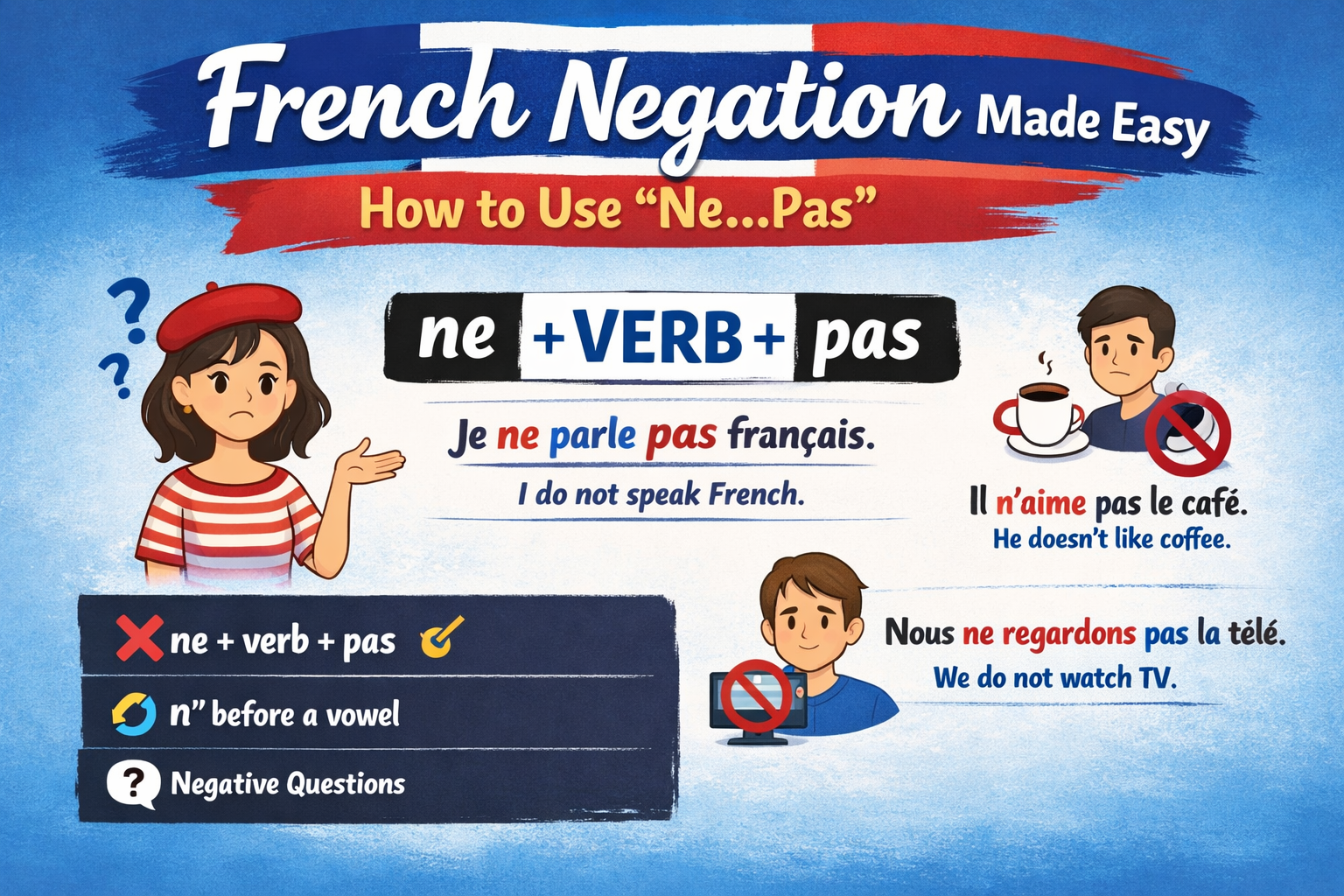
ne + verb + pas
Example:
Je mange.
(I eat.)
Je ne mange pas.
(I do not eat.)
Here:
ne appears before the verb
pas appears after the verb
Together they create the negative meaning.
This structure is the foundation of French A1 grammar and is used in almost every conversation.
Understanding the Structure of “Ne…Pas”
The ne…pas structure surrounds the verb in a sentence.
Basic Formula
Subject + ne + verb + pas
Example:
Je ne parle pas français.
I do not speak French.
Let’s break it down:
| Word | Meaning |
|---|---|
| Je | I |
| ne | negative particle |
| parle | speak |
| pas | not |
| français | French |
The meaning becomes “I do not speak French.”
Examples of “Ne…Pas” in Simple Sentences
Here are some examples of French negative sentences using the ne…pas structure.
Example 1
Je ne comprends pas.
I do not understand.
Example 2
Elle ne travaille pas aujourd’hui.
She does not work today.
Example 3
Nous ne regardons pas la télévision.
We do not watch television.
Example 4
Ils ne jouent pas au football.
They do not play football.
These examples show how ne and pas surround the verb to make the sentence negative.
How “Ne” Changes Before a Vowel (Elision)
In French grammar, ne changes to “n’” before a vowel or silent h.
This is called elision, a common rule in French pronunciation and writing.
Example
Je n’aime pas le café.
I do not like coffee.
Here:
ne → n’
because aime starts with a vowel.
More examples:
Il n’habite pas ici.
He does not live here.
Nous n’avons pas de voiture.
We do not have a car.
Learning this rule is essential when studying French grammar for beginners.
Using “Ne…Pas” with Different Subjects
The ne…pas structure works with all subject pronouns.
Je (I)
Je ne parle pas anglais.
I do not speak English.
Tu (You informal)
Tu ne comprends pas la question.
You do not understand the question.
Il / Elle (He / She)
Elle ne travaille pas ici.
She does not work here.
Nous (We)
Nous ne mangeons pas maintenant.
We are not eating now.
Vous (You formal / plural)
Vous ne regardez pas la télévision.
You do not watch television.
Ils / Elles (They)
Ils ne jouent pas au tennis.
They do not play tennis.
Using “Ne…Pas” with the Verb Être
The verb être (to be) is one of the most important verbs in French.
Negation follows the same structure.
Example:
Je ne suis pas fatigué.
I am not tired.
More examples:
Elle n’est pas prête.
She is not ready.
Nous ne sommes pas en retard.
We are not late.
Ils ne sont pas ici.
They are not here.
Using “Ne…Pas” with the Verb Avoir
Another essential French verb is avoir (to have).
Examples:
Je n’ai pas de voiture.
I do not have a car.
Elle n’a pas de frère.
She does not have a brother.
Nous n’avons pas de temps.
We do not have time.
Notice that “de” replaces “un/une/des” in negative sentences.
Example:
J’ai une voiture.
Je n’ai pas de voiture.
This rule is extremely common in French A1 grammar.
Negative Questions in French
You can also create negative questions using the same structure.
Example:
Tu ne comprends pas ?
Don’t you understand?
Il ne vient pas ?
Isn’t he coming?
These questions are common in spoken French.
Using “Ne…Pas” in the Present Tense
Most beginners learn ne…pas with the present tense first.
Examples:
Je ne travaille pas aujourd’hui.
I do not work today.
Nous ne sortons pas ce soir.
We are not going out tonight.
Elle ne lit pas ce livre.
She does not read this book.
Practicing these sentences will help you understand French sentence structure more easily.
Common Mistakes Beginners Make
Learning French negation rules takes practice. Here are some common mistakes to avoid.
1. Forgetting “ne”
Incorrect:
Je parle pas français.
Correct:
Je ne parle pas français.
Although spoken French sometimes drops ne, beginners should always include it.
2. Putting “pas” in the Wrong Place
Incorrect:
Je ne pas mange.
Correct:
Je ne mange pas.
Remember the structure:
ne + verb + pas
3. Forgetting Elision
Incorrect:
Je ne aime pas.
Correct:
Je n’aime pas.
Always use n’ before vowels.
Other French Negation Words (Advanced Preview)
Although ne…pas is the most common negation, French also uses other negative expressions.
Here are some examples:
| Expression | Meaning |
|---|---|
| ne…jamais | never |
| ne…plus | no longer |
| ne…rien | nothing |
| ne…personne | nobody |
Examples:
Je ne mange jamais de viande.
I never eat meat.
Elle ne voit personne.
She sees nobody.
These forms are typically learned after mastering ne…pas.
Practice Sentences for Beginners
Try converting these sentences into negative form.
Positive
Je parle français.
Negative
Je ne parle pas français.
Positive
Elle travaille ici.
Negative
Elle ne travaille pas ici.
Positive
Nous aimons ce film.
Negative
Nous n’aimons pas ce film.
Practicing these transformations helps reinforce French grammar rules.
Tips to Master French Negation Faster
Here are some practical tips to improve your French grammar skills.
Practice Daily Sentences
Write 5 positive sentences and convert them to negative.
Example:
Je mange → Je ne mange pas
Listen to Native Speakers
Watching French movies or listening to podcasts helps you hear negation naturally.
Learn with Flashcards
Create flashcards with positive and negative forms of verbs.
Speak Out Loud
Practice saying sentences aloud to improve fluency.
Why “Ne…Pas” Is Important in French Conversations
The ne…pas structure is used constantly in daily French conversations.
You need it to:
Refuse something
Express disagreement
Answer questions negatively
Describe what you do not like
Example conversation:
Tu aimes le café ?
Do you like coffee?
Non, je n’aime pas le café.
No, I do not like coffee.
Without understanding French negation, communication becomes very difficult.
Conclusion
Learning French negation with “ne…pas” is one of the most important steps for beginners studying French grammar. Although it may seem unusual at first because it uses two words instead of one, the structure becomes simple once you understand the pattern.
Remember the basic formula:
Subject + ne + verb + pas
Practice forming negative sentences regularly, and soon you will be able to express ideas like not liking, not having, or not doing something with confidence.
As you continue your journey in French A1 grammar, mastering ne…pas will help you build stronger sentences and communicate more naturally in French.
With consistent practice, you will quickly move from basic negative sentences to more advanced French grammar structure.