Introduction: Choosing a Career Today Is More Complicated Than Ever
“Choosing a career today is more complicated than ever.”
This statement perfectly describes the reality of students and young professionals in 2026. Gone are the days when career options were limited to engineering, medicine, law, or government jobs. Today, we live in a digital-first, AI-powered, skill-driven world where career possibilities are endless — from Artificial Intelligence, Data Science, Cybersecurity, Digital Marketing, UI/UX Design, FinTech, Blockchain, Content Creation, Product Management, to Remote Freelancing and Entrepreneurship.
While this explosion of opportunities is exciting, it has also created a growing problem: career confusion.
Students feel overwhelmed. Parents are unsure. Young professionals struggle with dissatisfaction and frequent job switching. Social media showcases glamorous success stories, adding to unrealistic expectations and fear of missing out (FOMO).
In this chaotic environment, professional career counselling emerges as a powerful solution — offering clarity, direction, and confidence.
This blog explores:
What is career confusion?
What is career counselling?
Key differences between career confusion and career counselling
Why professional guidance matters more than ever in 2026
Benefits of career counselling
Real-life case study
When and how to seek career counselling
How to choose the right career counsellor
Let’s dive deep into this essential topic.
What is Career Confusion?
Definition and Meaning
Career confusion refers to a state of uncertainty, anxiety, and indecisiveness regarding career choices. It occurs when individuals are unable to clearly identify:
Their interests
Their strengths
Their career goals
The best professional path for their future
In simple terms, career confusion is not knowing what to do next and feeling overwhelmed by choices.
Common Signs of Career Confusion
Career confusion shows up in many forms. Some of the most common signs include:
1. Frequently Changing Career Goals
One day you want to become a data scientist, the next day a digital marketer, and then suddenly an entrepreneur. Constantly shifting goals indicate lack of clarity.
2. Following Friends or Parents Blindly
Choosing a career just because friends are doing it or parents suggest it — without considering your own interest and aptitude — often leads to dissatisfaction.
3. Fear of Missing Out (FOMO Careers)
Social media promotes trending careers like AI, YouTube, Influencing, Crypto, and Startups. Many students chase trends without understanding whether they suit them.
4. Lack of Awareness About Personal Strengths
Many students are unaware of their own abilities, talents, and natural inclinations, leading to poor decision-making.
5. Overthinking and Anxiety
Constant overthinking, stress, and fear of making the wrong choice is a major symptom of career confusion.
Statistics and Trends About Student Indecision
Over 75% of students globally report feeling confused about their career choices.
Nearly 60% of graduates regret their degree choice within the first two years.
More than 45% of professionals switch careers due to dissatisfaction.
These figures highlight a serious problem: most people are making career decisions without clarity or guidance.
Impact of Social Media & Peer Pressure
Social media plays a powerful role in shaping career perceptions. Influencers show luxury lifestyles, fast success, and financial freedom, creating unrealistic expectations.
This leads to:
Trend-based decisions instead of skill-based planning
Increased anxiety and self-doubt
Constant comparison
Pressure to succeed quickly
As a result, students feel trapped between dreams, reality, expectations, and fear — the perfect recipe for career confusion.
What is Career Counselling?
Definition and Purpose
Career counselling is a structured, professional process that helps individuals understand their interests, strengths, abilities, and personality traits to make informed career decisions.
It aims to:
Identify the right career path
Provide clarity and direction
Reduce confusion and stress
Create a personalized career roadmap
Role of Certified Career Counsellors
Certified career counsellors are trained professionals who:
Conduct scientific assessments
Interpret aptitude and personality test results
Provide unbiased guidance
Suggest suitable career paths
Assist in academic and career planning
Their role is not to impose decisions but to empower individuals to make smart choices.
Difference Between Advice and Professional Guidance
| Advice | Professional Career Guidance |
|---|---|
| Based on personal opinions | Based on scientific assessment |
| Influenced by emotions | Data-driven decision-making |
| General suggestions | Personalized career roadmap |
| No long-term planning | Structured long-term planning |
In short, career counselling replaces guesswork with clarity.
Tools Used in Career Counselling
Professional counselling uses scientific tools, such as:
1. Aptitude Tests
Measure logical, numerical, verbal, and analytical abilities.
2. Personality Assessments
Identify personality traits using tools like MBTI, Big Five, etc.
3. Interest Profiling
Analyze areas of natural interest and motivation.
4. Skill Gap Analysis
Identifies skills required for desired careers and current gaps.
These tools ensure accurate, personalized, and data-backed career planning.
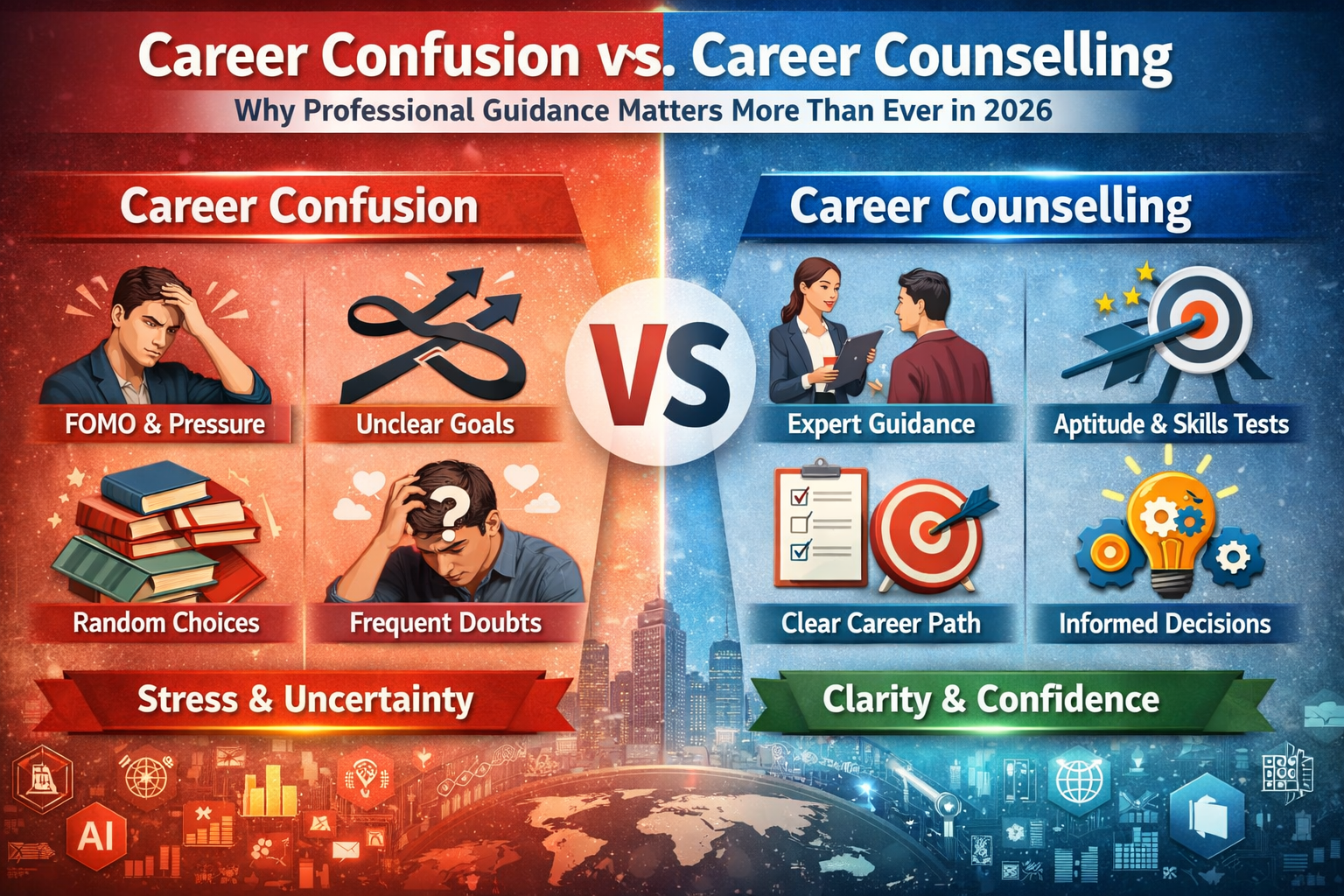
Career Counselling vs. Career Confusion: Key Differences
| Career Confusion | Career Counselling |
|---|---|
| Based on emotions & pressure | Based on data & assessment |
| Short-term thinking | Long-term career planning |
| Random course selection | Structured career roadmap |
| Influenced by trends | Based on strengths & skills |
| High risk of career change | Informed decision-making |
Career confusion creates chaos, while career counselling creates clarity.
Why Professional Guidance Matters More Than Ever in 2026
✔ Explosion of Career Options
The career landscape in 2026 includes emerging fields such as:
Artificial Intelligence (AI)
Automation & Robotics
Cybersecurity
Data Science & Analytics
Digital Marketing
FinTech & Blockchain
Cloud Computing
UX/UI Design
Virtual Reality (VR) & Metaverse
While this diversity is exciting, it also makes decision-making extremely complex. Without expert guidance, students often feel lost.
✔ Rapidly Changing Job Market
Skills become outdated quickly. Careers that were booming five years ago may no longer be relevant today.
This makes:
Continuous upskilling
Strategic planning
Long-term career vision
absolutely necessary — something professional career counselling supports effectively.
✔ Highly Competitive Environment
With globalization and remote work, students now compete globally. Success requires:
Specialization
Strong skill development
Smart academic and career planning
Career counselling helps individuals stand out instead of blending in.
✔ Mental Health & Career Stress
Career confusion leads to:
Anxiety
Depression
Low confidence
Self-doubt
Professional counselling not only provides career clarity but also improves mental well-being, confidence, and emotional stability.
Benefits of Career Counselling
1. Clear Career Direction
Students gain clarity about what suits them best, eliminating confusion.
2. Better Decision-Making Skills
Counselling trains individuals to think logically and strategically.
3. Increased Confidence
Clear goals build confidence, motivation, and self-belief.
4. Reduced Risk of Wrong Career Choices
Scientific assessments minimize trial-and-error decisions.
5. Personalized Career Roadmap
Students receive step-by-step plans including:
Subject selection
Course guidance
Skill development
Internships
Certifications
Career timelines
6. Improved Academic and Professional Performance
Clear vision leads to higher focus, discipline, and success.
Real-Life Example: From Career Confusion to Career Clarity
Case Study: Rahul’s Career Transformation
Rahul, a bright Class 12 student, chose engineering due to parental pressure and peer influence. After two years, he realized he had no interest in coding or technical subjects. His grades dropped, confidence suffered, and stress increased.
He then opted for professional career counselling.
Through aptitude testing, interest profiling, and personality assessment, it was discovered that Rahul had:
Strong communication skills
Creative thinking
High emotional intelligence
He was guided toward Digital Marketing & Brand Management.
Within three years:
Rahul became a certified digital marketer
Secured a high-paying role in a multinational company
Started freelance consulting
Achieved career satisfaction
This transformation highlights the life-changing impact of career counselling.
When Should You Seek Career Counselling?
After 10th Grade
To select the right stream: Science, Commerce, Arts, or vocational pathways.
After 12th Grade
To choose appropriate graduation courses and professional programs.
Before Choosing Graduation
To align degree selection with career goals.
During Career Switch
To plan smooth career transitions.
When Feeling Stuck or Dissatisfied
To rediscover purpose, motivation, and direction.
How to Choose the Right Career Counsellor
1. Check Certifications
Ensure counsellors are certified and professionally trained.
2. Experience in Industry Trends
They should be updated with modern career opportunities.
3. Use of Scientific Assessment Tools
Avoid counsellors offering only motivational advice.
4. Transparent Process
They should explain assessment methods and counselling steps clearly.
5. Follow-Up Support
Post-counselling mentoring and career planning support is crucial.
Conclusion: From Confusion to Clarity
Career confusion is natural — but staying confused is a choice.
In a fast-changing, highly competitive, and digitally driven world, professional career counselling is no longer a luxury — it is a necessity.
It transforms:
Uncertainty into clarity
Fear into confidence
Pressure into purpose
Chaos into structured planning
Investing in career counselling is truly investing in your future success, happiness, and fulfillment.
Choose clarity. Choose confidence. Choose career counselling.