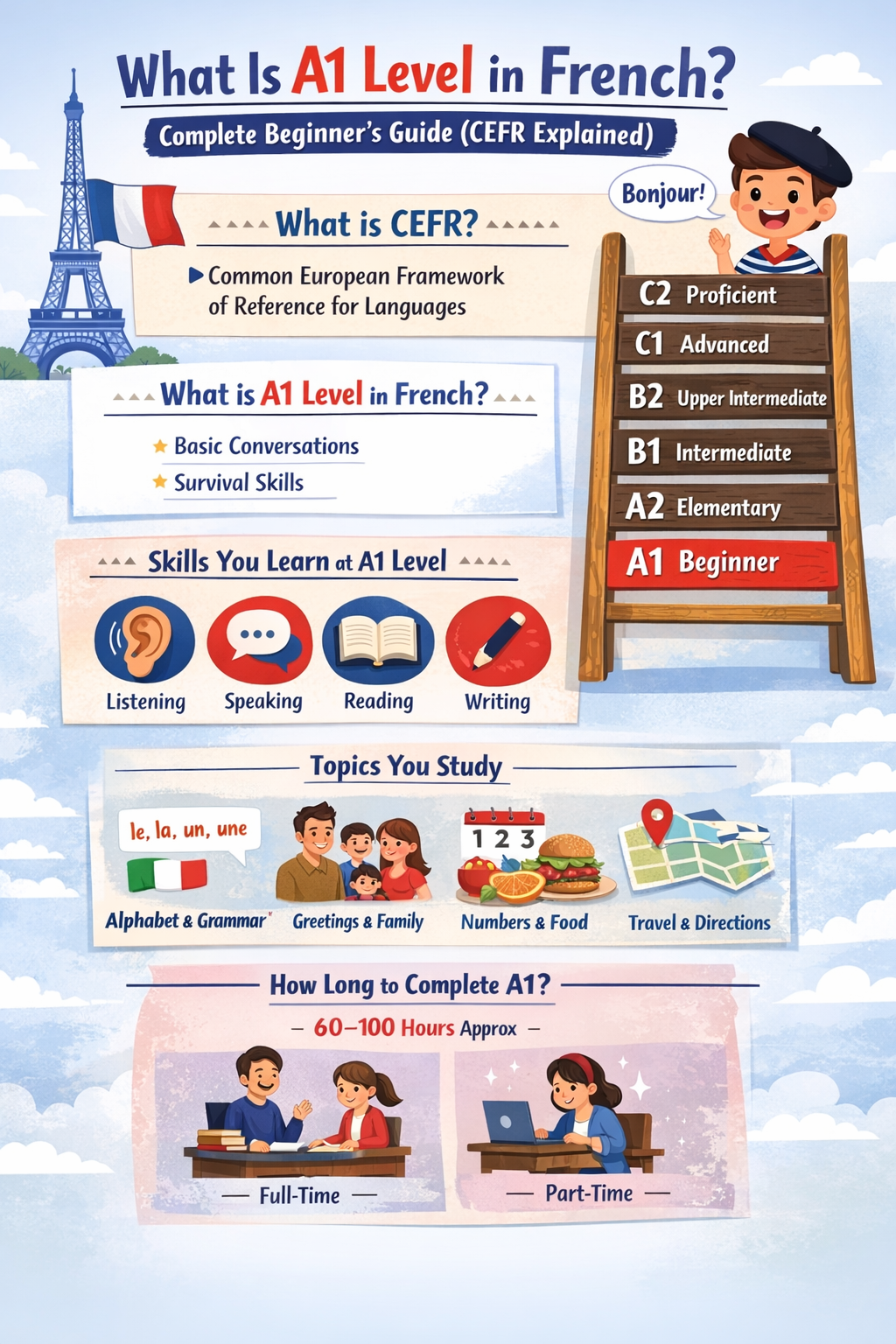
Learning French is a dream for many people, but beginners often feel confused about where to start. If you have ever searched “What is A1 level in French?” or “Is A1 good for beginners?”, you are not alone.
With structured learning frameworks like CEFR (Common European Framework of Reference for Languages), language learning has become clearer, more organized, and easier to track. Among these levels, A1 is the very first step — designed specially for complete beginners.
In this complete beginner’s guide, you will learn:
What A1 level in French really means
What CEFR is and why it matters
Skills you develop at A1
Grammar and vocabulary covered
Time required to complete A1
Who should take A1 French
What comes after A1
Let’s start your French learning journey with clarity and confidence.
1️⃣ Introduction: What Is A1 Level in French?
“Thinking of learning French but confused about A1 level?”
Many beginners hear terms like A1, A2, B1, B2 and feel overwhelmed. The truth is — A1 is simply the starting point of learning French.
The A1 level represents the absolute beginner stage, where learners start from scratch and slowly build their foundation in listening, speaking, reading, and writing.
The A1 level is part of an international system called CEFR — Common European Framework of Reference for Languages, which standardizes language learning levels across the world.
By the end of this article, you will understand:
What A1 level truly includes
How good your French will be after A1
Whether A1 is difficult
How long it takes
Who should enroll
If you're planning to learn French for studies, career, travel, or relocation, this guide will give you complete clarity.
2️⃣ What Is CEFR? (Understanding the Framework First)
Before understanding A1, it's important to understand CEFR.
What Is the Full Form of CEFR?
CEFR = Common European Framework of Reference for Languages
Why Was CEFR Created?
CEFR was developed by the Council of Europe to:
Standardize language proficiency levels
Make learning, teaching, and assessment uniform worldwide
Allow students, teachers, universities, and employers to understand language ability clearly
Who Uses CEFR?
CEFR is used by:
Schools & universities
Language institutes
Embassies & immigration offices
Employers
International exam boards (DELF, DALF, IELTS, TOEFL, Goethe, etc.)
The 6 CEFR Levels Explained Briefly
CEFR divides language learning into 6 levels:
| Level | Description |
|---|---|
| A1 | Beginner (Breakthrough) |
| A2 | Elementary |
| B1 | Intermediate |
| B2 | Upper Intermediate |
| C1 | Advanced |
| C2 | Mastery / Proficiency |
👉 A1 is the foundation level, where your language journey begins.
3️⃣ What Exactly Is A1 Level in French?
Definition of A1 Level
A1 is the beginner or breakthrough level of French, designed for learners with no prior knowledge of the language.
At A1:
You learn basic words, sentences, and expressions
You understand slow and simple French
You can communicate in everyday situations
Who Is A1 Designed For?
Absolute beginners
Students starting French for the first time
Travelers
School students
Professionals entering international roles
Real-Life Description of A1 Level
After completing A1:
“You can survive basic conversations in French.”
You may not speak fluently, but you can:
Introduce yourself
Ask simple questions
Understand basic replies
Handle everyday situations
4️⃣ Skills You Learn at A1 Level in French
A1 focuses on developing four core language skills:
🔹 Listening Skills
At A1, you learn to:
Understand slow and clear speech
Recognize common daily expressions
Identify familiar words
Understand simple instructions
Example:
“Bonjour, comment tu t’appelles ?”
(Hello, what is your name?)
🔹 Speaking Skills
You learn to:
Introduce yourself
Ask basic questions
Answer simple queries
Talk about family, city, job, hobbies
Examples:
Je m'appelle Rahul. (My name is Rahul.)
J'habite à Lucknow. (I live in Lucknow.)
J’ai 15 ans. (I am 15 years old.)
🔹 Reading Skills
You will understand:
Short sentences
Simple paragraphs
Menus
Signboards
Short emails and messages
🔹 Writing Skills
You will learn to:
Write simple sentences
Fill forms
Write short self-introductions
Compose basic messages
5️⃣ French A1 Grammar Topics Covered
Grammar is the backbone of language learning. At A1 level, you build your basic grammar foundation.
Key Grammar Topics:
French alphabet & pronunciation
Articles: le, la, les, un, une
Gender of nouns (masculine & feminine)
Present tense of être (to be)
Present tense of avoir (to have)
Regular verb conjugations (-er, -ir, -re verbs)
Sentence structure
Question formation
Negation (ne...pas)
Example:
Je suis étudiant. (I am a student.)
J’ai un frère. (I have a brother.)
6️⃣ Vocabulary Themes at A1 Level
A1 vocabulary focuses on daily life situations.
Common Vocabulary Topics:
Greetings & introductions
Numbers & dates
Family
Professions
Daily routine
Food & shopping
Directions & travel
Time & weather
This vocabulary allows you to communicate in everyday situations confidently.
7️⃣ How Long Does It Take to Complete A1 Level in French?
Average Learning Time
60–100 study hours on average
Time Breakdown:
| Learning Mode | Approx Duration |
|---|---|
| Full-time course | 3–4 weeks |
| Part-time classes | 6–10 weeks |
| Self-study | 2–3 months |
Factors Affecting Duration:
Learning consistency
Teaching method
Practice frequency
Student motivation
8️⃣ Is French A1 Difficult for Beginners?
Why French Feels Challenging Initially
Pronunciation
Silent letters
Gender rules
Verb conjugations
Common Beginner Challenges:
Understanding accents
Remembering gender
Listening comprehension
Why A1 Is Still Manageable
Structured syllabus
Step-by-step progression
Basic vocabulary
Simple grammar
👉 With proper guidance, A1 is easy, enjoyable, and motivating.
9️⃣ Can You Speak French After A1? (Realistic Expectations)
What You CAN Do After A1
Introduce yourself
Order food
Ask directions
Book hotels
Handle basic conversations
What You CANNOT Do Yet
Deep conversations
Business discussions
Advanced grammar
Professional writing
Mini A1 Conversation Example:
A: Bonjour, tu t’appelles comment ?
B: Je m’appelle Aman. Et toi ?
A: Je m’appelle Riya. Tu viens d’où ?
B: Je viens de l’Inde.
(Translation: Hello, what’s your name? My name is Aman. And you? My name is Riya. Where are you from? I am from India.)
🔟 Who Should Take French A1?
1. Students
School curriculum
Study abroad plans
Language certifications
2. Working Professionals
Career growth
International projects
Multinational companies
3. Travel Enthusiasts
Confident travel communication
Cultural connection
4. People Planning to Move Abroad
Immigration requirements
Daily life communication
Social integration
1️⃣1️⃣ What Comes After A1?
After completing A1, learners move to A2 level.
What Is A2 Level?
A2 is the elementary level, where:
Sentence formation improves
Vocabulary expands
Communication becomes smoother
When Should You Move to A2?
When you can comfortably handle A1 topics
After completing 60–100 hours
When you pass A1 assessments
Importance of Continuous Practice
Consistency is key. Daily listening, speaking, reading, and writing practice leads to faster fluency.
1️⃣2️⃣ Conclusion: Why A1 Is the Perfect Starting Point
The A1 level in French is the foundation of your entire language journey. It builds confidence, removes fear, and prepares you for advanced learning.
Join a structured French course today and begin your journey toward fluency with expert guidance and systematic learning.