Introduction
In the modern business world, human resource management (HRM) plays a vital role in organizational success. One of the most important responsibilities of HR professionals is recruitment and selection, and this process begins with two fundamental concepts — Job Description and Job Specification.
Many students, job seekers, HR professionals, and business owners often confuse job description vs job specification. Although both are closely related and used in the recruitment process, their meanings, objectives, and content are quite different.
Understanding the difference between job description and job specification helps organizations hire the right talent, improves employee productivity, and ensures clarity in roles and responsibilities. For job seekers, it helps in choosing the right job according to their skills, qualifications, and career goals.
In this complete SEO-optimized guide, we will cover:
Meaning of Job Description
Meaning of Job Specification
Differences between Job Description and Job Specification
Examples of Job Description and Job Specification
Importance, advantages, limitations
Practical applications in recruitment
What is Job Description? (Meaning & Definition)
Job Description Meaning
A Job Description is a formal written document that provides complete information about a job role. It explains what a job involves, the responsibilities, duties, tasks, authority, reporting relationships, working conditions, and location of work.
In simple words, a job description tells “what is to be done” in a job.
Definition of Job Description
Job Description is a detailed statement that defines the nature of a job, including duties, responsibilities, working conditions, and reporting relationships.
Key Features of Job Description
Written document
Focuses on job role, not the person
Explains tasks, duties, responsibilities
Used in recruitment, training, performance appraisal
Contents of a Job Description
A standard job description usually includes the following elements:
1. Job Title
Clearly defines the designation of the employee.
Example: Web Developer, HR Manager, Sales Executive
2. Department
Indicates the department in which the job exists.
Example: IT Department, HR Department, Marketing Department
3. Job Location
Specifies where the job will be performed.
Example: Lucknow, Delhi, Mumbai, Remote
4. Job Summary
A brief overview of the role and its purpose.
5. Duties and Responsibilities
Detailed explanation of daily tasks and responsibilities.
6. Reporting Authority
Shows whom the employee will report to.
7. Working Conditions
Includes working hours, shifts, physical environment, etc.
Example of Job Description
Job Title: Digital Marketing Executive
Department: Marketing
Location: Lucknow
Job Summary:
The Digital Marketing Executive will manage online marketing campaigns, social media platforms, and website promotions to increase brand awareness and generate leads.
Key Responsibilities:
Manage social media accounts
Plan and execute marketing campaigns
Optimize website content for SEO
Analyze performance reports
Coordinate with content and design teams
Reporting To: Marketing Manager
Working Conditions: Full-time, office-based
What is Job Specification? (Meaning & Definition)
Job Specification Meaning
A Job Specification is a statement that describes the minimum qualifications, skills, experience, abilities, and personal traits required to perform a job successfully.
In simple words, job specification tells “who is fit to do the job.”
Definition of Job Specification
Job Specification is a document that states the educational qualifications, experience, skills, knowledge, and personal attributes required for a specific job.
Key Features of Job Specification
Focuses on human qualities, not tasks
Helps in candidate screening
Guides selection and recruitment
Sets minimum eligibility criteria
Contents of Job Specification
1. Educational Qualification
Minimum academic requirements.
Example: Bachelor’s degree, MBA, Diploma, etc.
2. Experience
Required work experience.
Example: 1–3 years, 5+ years, freshers
3. Skills
Technical and soft skills needed.
Example: Communication, coding, marketing, leadership
4. Knowledge
Domain knowledge or subject expertise.
5. Physical & Mental Abilities
Stamina, concentration, adaptability, problem-solving ability.
6. Personal Traits
Attitude, teamwork, confidence, integrity, creativity.
Example of Job Specification
Educational Qualification: Bachelor’s degree in Marketing / Business Administration
Experience: Minimum 1 year in digital marketing
Skills Required:
SEO & SEM knowledge
Social media marketing
Content writing
Data analysis
Personal Traits:
Good communication
Creative mindset
Team player
Positive attitude
Job Description vs Job Specification: Key Differences
| Basis | Job Description | Job Specification |
|---|---|---|
| Meaning | Describes job duties and responsibilities | Describes required qualifications and skills |
| Focus | Job-centered | Person-centered |
| Question Answered | What is to be done? | Who can do it? |
| Purpose | Clarifies job role | Helps in selection of candidates |
| Content | Tasks, duties, reporting, working conditions | Skills, experience, education, traits |
| Used For | Recruitment, training, evaluation | Screening, hiring, promotion |
| Nature | Descriptive | Analytical |
| Prepared By | HR managers & supervisors | HR managers & recruitment experts |
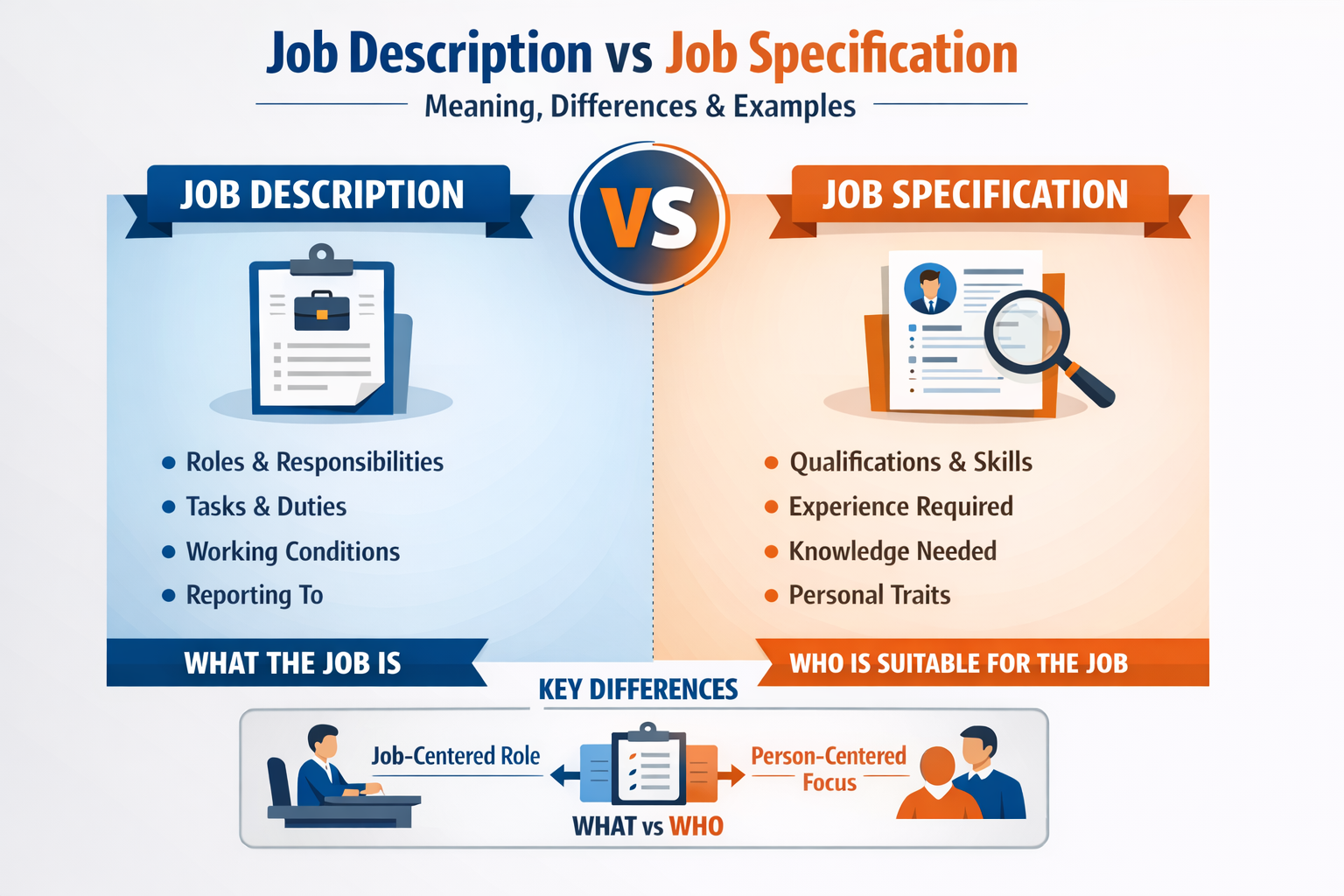
Difference Between Job Description and Job Specification (In Simple Words)
The difference between job description and job specification lies in their focus and purpose.
Job Description explains the job role, responsibilities, and tasks.
Job Specification explains the qualifications, skills, and traits required to perform that job.
In short:
👉 Job Description = What the job is
👉 Job Specification = Who is suitable for the job
Relationship Between Job Description and Job Specification
Both concepts are closely linked and together form the foundation of job analysis.
Job Description defines what work is to be done.
Job Specification defines who is capable of doing that work.
Without job description, job specification becomes meaningless. Similarly, without job specification, job description cannot lead to proper hiring.
Importance of Job Description
1. Clarifies Job Roles
Helps employees understand their responsibilities.
2. Improves Recruitment
Attracts suitable candidates.
3. Performance Evaluation
Helps in assessing employee performance.
4. Training & Development
Identifies skill gaps and training needs.
5. Legal Protection
Provides written proof of job expectations.
Importance of Job Specification
1. Helps in Candidate Screening
Filters unsuitable applicants.
2. Improves Hiring Quality
Ensures skilled employees are hired.
3. Reduces Employee Turnover
Right hiring reduces job dissatisfaction.
4. Supports Training Planning
Identifies skill development areas.
5. Enhances Productivity
Right candidate improves organizational output.
Advantages of Job Description
Clear understanding of duties
Improves coordination
Reduces confusion
Supports HR planning
Enhances accountability
Advantages of Job Specification
Better recruitment decisions
Accurate candidate matching
Improved workforce quality
Supports career planning
Increases efficiency
Limitations of Job Description
May become outdated
Rigid structure
Time-consuming to prepare
Needs frequent updating
Limitations of Job Specification
Over-specification can limit talent
Difficult to define soft skills
May discourage capable freshers
Changing job roles affect accuracy
Role of Job Description & Job Specification in Recruitment Process
Both are essential steps in the staffing function of management:
Job Analysis
Job Description
Job Specification
Recruitment
Selection
Training
They ensure systematic, objective, and effective hiring.
Real-Life Practical Example
Job Role: Web Developer
Job Description Includes:
Develop website layouts
Write HTML, CSS, JavaScript code
Debug software errors
Maintain website security
Coordinate with designers
Job Specification Includes:
B.Tech / BCA in Computer Science
1+ years of experience
Knowledge of HTML, CSS, JavaScript
Problem-solving skills
Creative thinking
Job Description vs Job Specification in HR Management
In Human Resource Management (HRM), these two concepts help:
Workforce planning
Recruitment & selection
Performance management
Training & development
Career growth planning
They act as strategic HR tools for organizational success.
SEO Benefits of Using Job Description & Job Specification Content
This topic has high search demand in:
Education blogs
HR management websites
Career portals
Business studies platforms
Keywords like:
job description vs job specification, difference between job description and job specification, job description meaning, job specification examples
have high SEO value and ranking potential.
Frequently Asked Questions (FAQ)
1. What is the main difference between job description and job specification?
Job description focuses on job tasks, while job specification focuses on candidate requirements.
2. Which comes first — job description or job specification?
Job description comes first, followed by job specification.
3. Are job description and job specification part of job analysis?
Yes, both are important components of job analysis.
4. Can recruitment happen without job specification?
Technically yes, but it leads to poor hiring decisions.
5. Is job specification more important than job description?
Both are equally important and complementary.
Conclusion
Understanding Job Description vs Job Specification is essential for effective recruitment, workforce planning, and organizational growth.
Job Description explains the nature of work, duties, and responsibilities.
Job Specification defines the qualifications, skills, and traits needed to perform that work effectively.
Together, they form the backbone of successful HR management and recruitment strategy. Whether you are a student, job seeker, HR professional, or business owner, mastering these concepts will help you make better career and business decisions.