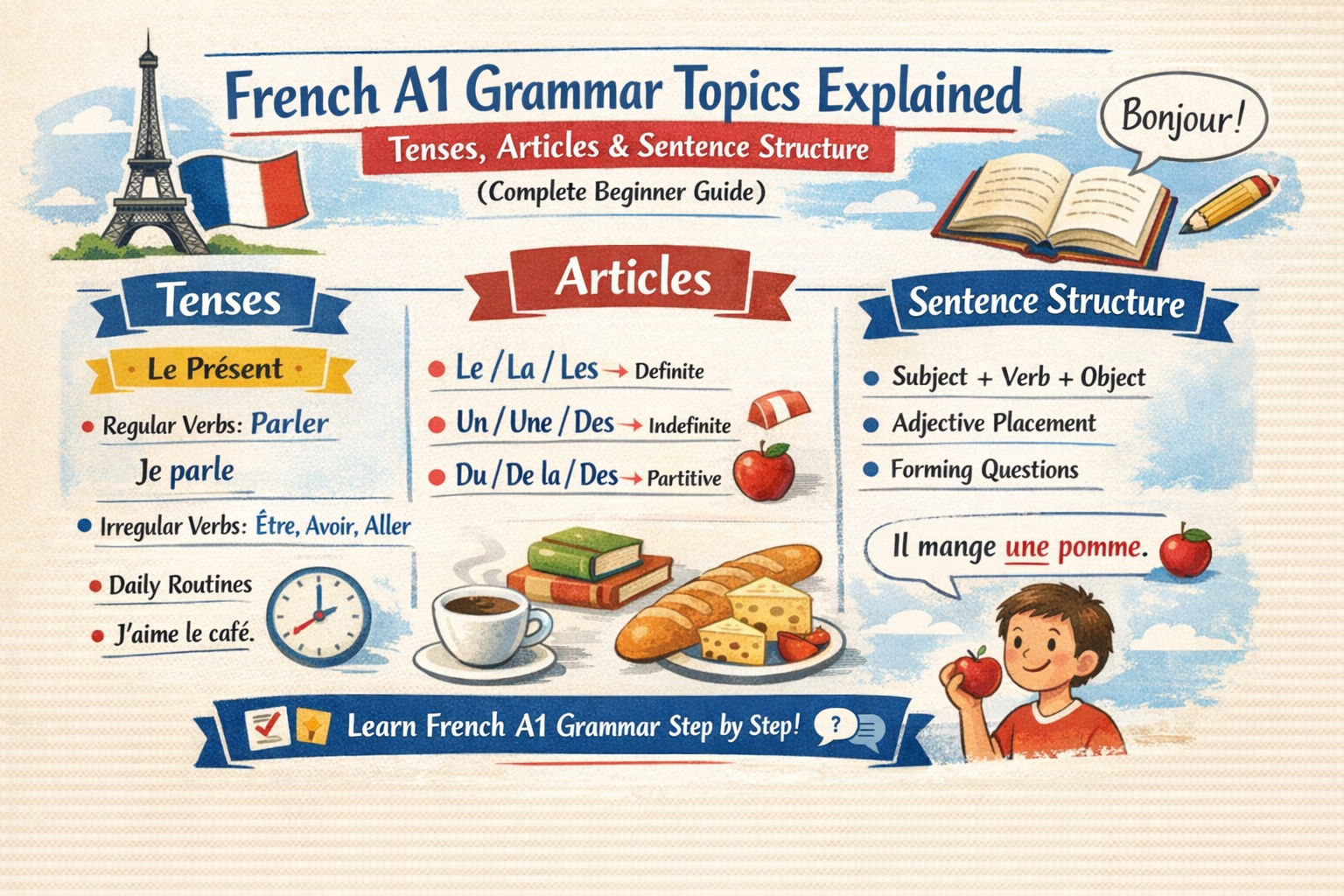
Introduction
Learning French starts with understanding its grammar fundamentals. If you are a beginner, the French A1 level is the perfect place to begin your language journey. At this stage, learners focus on mastering essential grammar topics that allow them to communicate in basic everyday situations, understand simple conversations, and form meaningful sentences.
What is French A1 Level?
The A1 level is the first and most basic stage of the CEFR (Common European Framework of Reference for Languages). At this level, students can understand and use simple expressions, introduce themselves, ask and answer basic questions, and interact in everyday contexts if the other person speaks slowly and clearly.
Why Grammar is Important at the Beginner Stage?
Grammar is the foundation of language learning. Without strong grammar basics, learners may know vocabulary but struggle to build correct sentences. French grammar at the A1 level helps students:
Build correct sentence structures
Use proper verb forms
Apply correct articles
Understand gender and agreement
Avoid common beginner mistakes
Strong grammar skills ensure clarity, accuracy, and confidence in speaking, reading, and writing French.
What Will You Learn in This Guide?
In this complete guide, you will master:
French A1 tenses (present tense)
Definite, indefinite, and partitive articles
Basic French sentence structure
Question formation and negation
Gender and agreement rules
Common grammar mistakes and practice exercises
This guide is ideal for students, self-learners, teachers, and French language institutes.
Overview of French A1 Grammar
CEFR A1 Level Explanation
The CEFR framework divides language learning into six levels:
A1 – Beginner
A2 – Elementary
B1 – Intermediate
B2 – Upper Intermediate
C1 – Advanced
C2 – Mastery
At the A1 level, learners can:
Introduce themselves
Ask basic questions
Talk about daily routines
Express likes and dislikes
Describe simple objects and people
What Grammar Knowledge is Expected at A1?
At this level, students are expected to know:
Present tense conjugation
Basic verb forms
Articles and noun genders
Simple sentence structures
Question and negation forms
Adjective placement and agreement
How A1 Grammar Builds the Foundation for A2?
Strong A1 grammar skills help learners move smoothly to A2, where they will learn:
Past tense
Future tense
Complex sentences
Prepositions
Advanced question structures
Without mastering A1 grammar, students often struggle at higher levels.
Part 1: Tenses in French A1
3. Present Tense (Le Présent) – The Core of A1 Grammar
The present tense is the most important tense at the A1 level. It is used to talk about:
Daily routines
Current activities
Facts
Habits
Preferences
3.1 Regular Verbs (-ER Verbs)
Most French verbs belong to the -er verb group, making them easy to learn.
Conjugation Pattern
To conjugate -er verbs:
Remove -er from the infinitive.
Add endings:
| Subject | Ending |
|---|---|
| Je | -e |
| Tu | -es |
| Il / Elle / On | -e |
| Nous | -ons |
| Vous | -ez |
| Ils / Elles | -ent |
Example: Parler (to speak)
| Subject | Verb |
|---|---|
| Je | parle |
| Tu | parles |
| Il / Elle | parle |
| Nous | parlons |
| Vous | parlez |
| Ils / Elles | parlent |
Common Regular -ER Verbs
aimer (to like)
manger (to eat)
travailler (to work)
regarder (to watch)
écouter (to listen)
étudier (to study)
3.2 Irregular Verbs (Essential A1 Verbs)
Some verbs are irregular and must be memorized.
Être (to be)
| Subject | Verb |
|---|---|
| Je | suis |
| Tu | es |
| Il / Elle | est |
| Nous | sommes |
| Vous | êtes |
| Ils / Elles | sont |
Example:
Je suis étudiant. (I am a student.)
Avoir (to have)
| Subject | Verb |
|---|---|
| J’ | ai |
| Tu | as |
| Il / Elle | a |
| Nous | avons |
| Vous | avez |
| Ils / Elles | ont |
Example:
J’ai un livre. (I have a book.)
Aller (to go)
| Subject | Verb |
|---|---|
| Je | vais |
| Tu | vas |
| Il / Elle | va |
| Nous | allons |
| Vous | allez |
| Ils / Elles | vont |
Example:
Je vais à l’école. (I go to school.)
Faire (to do / make)
| Subject | Verb |
|---|---|
| Je | fais |
| Tu | fais |
| Il / Elle | fait |
| Nous | faisons |
| Vous | faites |
| Ils / Elles | font |
3.3 Using Present Tense in Daily Situations
Talking About Routine
Je me lève à 7 heures. (I wake up at 7.)
Je travaille dans un bureau. (I work in an office.)
Introducing Yourself
Je m’appelle Marie. (My name is Marie.)
Je suis étudiant. (I am a student.)
Expressing Likes & Dislikes
J’aime le café. (I like coffee.)
Je n’aime pas le thé. (I do not like tea.)
Part 2: Articles in French
Articles are extremely important in French. Unlike English, every noun must have an article.
4. Definite Articles (Le, La, Les)
Used to refer to specific or known nouns.
| Gender | Singular | Plural |
|---|---|---|
| Masculine | le | les |
| Feminine | la | les |
Before vowels: l’
Examples:
le livre (the book)
la table (the table)
les enfants (the children)
l’homme (the man)
When to Use Definite Articles?
When talking about specific things
When referring to general concepts
Example:
J’aime le chocolat. (I like chocolate.)
5. Indefinite Articles (Un, Une, Des)
Used to refer to unspecified or unknown objects.
| Gender | Singular | Plural |
|---|---|---|
| Masculine | un | des |
| Feminine | une | des |
Examples:
un garçon (a boy)
une fille (a girl)
des livres (some books)
6. Partitive Articles (Du, De la, De l’, Des)
Used for food, drink, and uncountable quantities.
| Form | Usage |
|---|---|
| du | masculine |
| de la | feminine |
| de l’ | before vowels |
| des | plural |
Examples:
du pain (some bread)
de la soupe (some soup)
de l’eau (some water)
des fruits (some fruits)
Common Beginner Mistakes
❌ Je mange pain
✅ Je mange du pain
Part 3: Sentence Structure in French
7. Basic Sentence Structure (Subject + Verb + Object)
French follows SVO order, just like English.
Structure:
Subject + Verb + Object
Example:
Je mange une pomme. (I eat an apple.)
8. Adjective Placement
In French, most adjectives come after nouns.
Examples:
une voiture rouge (a red car)
un livre intéressant (an interesting book)
Common A1 Adjectives
grand (big)
petit (small)
beau (beautiful)
bon (good)
mauvais (bad)
Gender & Number Agreement
un garçon intelligent
une fille intelligente
9. Forming Questions in French
1. Intonation Method
Statement → Raise tone at end
Tu parles français. → Tu parles français ?
2. Est-ce que Structure
Est-ce que tu parles français ?
3. Basic Inversion (Optional)
Parles-tu français ?
10. Negation in French
Ne… pas Structure
Structure:
Subject + ne + verb + pas
Examples:
Je ne mange pas.
Il n’aime pas le café.
11. Gender & Agreement Rules
Masculine vs Feminine Nouns
Masculine: le garçon
Feminine: la fille
Plural Formation
Add -s
livre → livres
table → tables
Adjective Agreement
un homme intelligent
une femme intelligente
12. Common Grammar Mistakes at A1 Level
1. Forgetting Gender
❌ le table
✅ la table
2. Wrong Verb Endings
❌ je parles
✅ je parle
3. Article Confusion
❌ je mange pain
✅ je mange du pain
4. Direct Translation from English
❌ je suis 15 ans
✅ j’ai 15 ans
13. Practice Examples & Mini Exercises
Fill in the Blanks
Je ___ étudiant. (suis / es)
Elle mange ___ pomme. (une / un)
Nous ___ au marché. (allons / allez)
Correct the Sentence
Je ne aime pas café.
Il sont étudiants.
Translation Practice
I like chocolate.
We go to school.
14. Conclusion
Mastering French A1 grammar is the key to building a strong foundation in the French language. By understanding present tense, articles, sentence structure, and agreement rules, learners gain the confidence to speak, write, and understand basic French.
Consistent practice, structured learning, and regular revision will help students move smoothly toward A2 level fluency. Whether you are a student, teacher, or self-learner, mastering these A1 grammar topics ensures long-term success in French language learning.