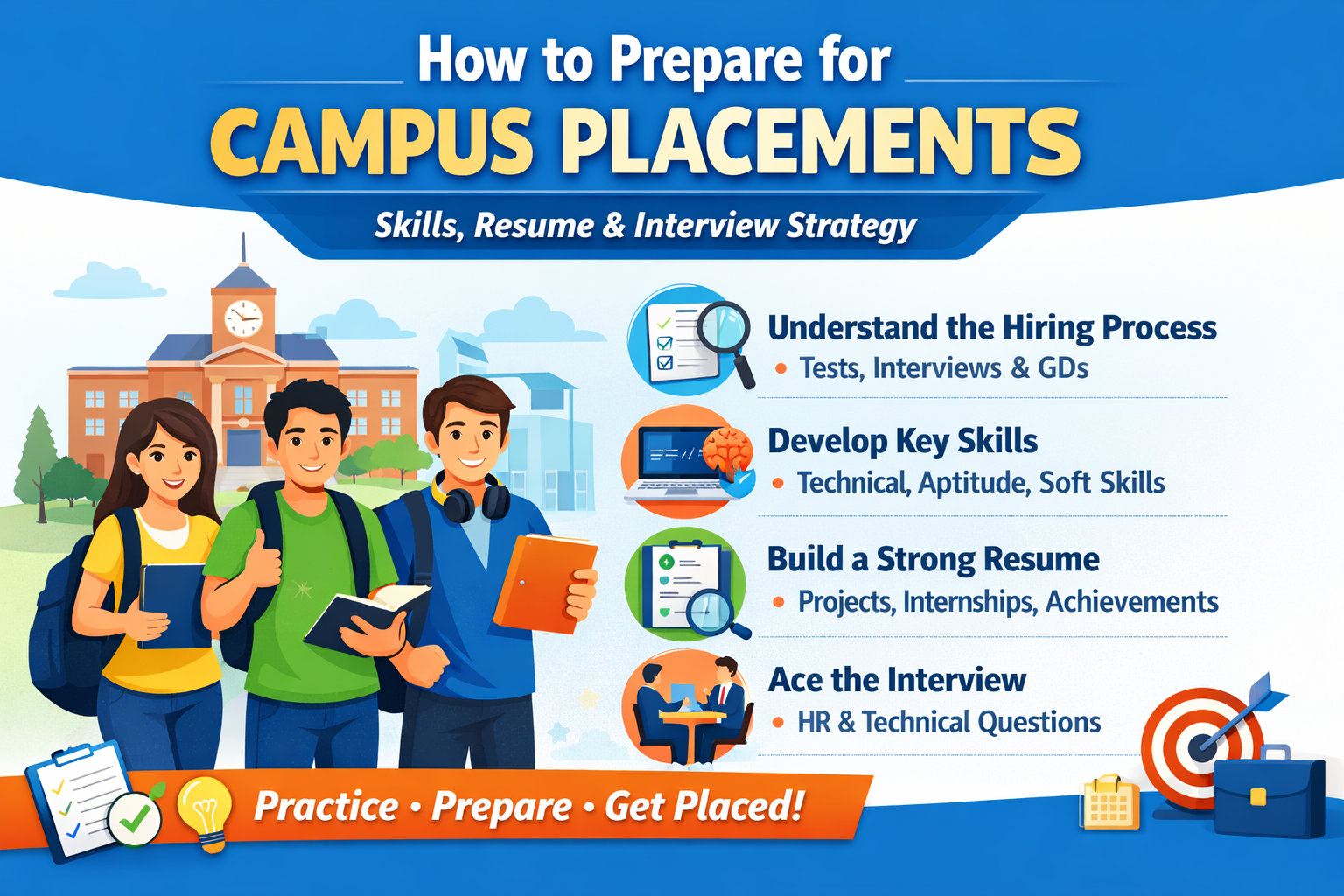
Campus placements are one of the most important milestones in a student’s academic journey. For many, it is the first step into the professional world. With increasing competition, rapid technological change, and high expectations from recruiters, smart and early preparation for campus placements is no longer optional — it is essential.
This complete guide on how to prepare for campus placements will walk you through every crucial step, including skills development, resume building, interview strategy, and final preparation tips. Whether you are in your first year or final year, this roadmap will help you stay focused, confident, and job-ready.
1. Introduction: Why Campus Placements Matter
Why Campus Placements Are a Major Career Milestone
Campus placements provide students with a structured entry into the corporate world. They offer:
Job security at an early stage
Exposure to industry standards
Financial independence
Career growth opportunities
For fresh graduates, campus recruitment is often the best platform to start a professional career.
High Competition: Why Preparation Must Start Early
Every year, thousands of students compete for a limited number of job roles. Recruiters look for multi-skilled candidates who are technically sound, confident, and adaptable. Last-minute preparation rarely leads to success.
Starting early allows students to:
Build strong technical foundations
Improve aptitude and reasoning skills
Gain internship and project experience
Develop communication and confidence
What This Guide Covers
This blog will help you understand:
The campus recruitment process
Essential technical, aptitude, and soft skills
How to create a powerful placement resume
Proven interview preparation strategies
Common mistakes to avoid
2. Understand the Campus Recruitment Process
Understanding how the campus recruitment process works helps students prepare strategically.
2.1 Pre-Placement Talk (PPT)
During PPT sessions, companies share:
Company overview
Job roles and responsibilities
Growth opportunities
Selection process
Students should attend PPTs seriously because:
They provide insight into company expectations
They help in interview preparation
They clarify role-specific skills
2.2 Eligibility & Shortlisting
Most companies shortlist candidates based on:
CGPA Criteria
Many companies set a minimum CGPA requirement (e.g., 6.5, 7.0, or 8.0). Maintaining good academic performance increases your opportunities.
Resume-Based Shortlisting
Your resume plays a key role in clearing the first filter. A well-structured resume can significantly increase your chances.
Importance of Internships & Projects
Practical experience through internships and academic projects shows your real-world problem-solving ability.
2.3 Selection Rounds
The campus recruitment process generally includes:
Aptitude Test
Tests numerical ability, logical reasoning, and verbal skills.
Technical Interview
Evaluates subject knowledge, coding skills, and project understanding.
HR Interview
Focuses on personality, communication skills, attitude, and cultural fit.
Group Discussion (If Applicable)
Assesses leadership, teamwork, and communication abilities.
3. Skills You Must Develop Before Placements
3.1 Technical Skills (Role-Specific)
Your technical skills depend on your career domain.
Core Subject Knowledge
Engineering students should revise subjects like:
Data Structures
Operating Systems
DBMS
Computer Networks
Management students should focus on:
Marketing
Finance
HR concepts
Business analytics
Programming Skills (For Tech Roles)
Learn at least one programming language such as:
Python
Java
C++
JavaScript
Practice coding daily to improve logic and speed.
Tools & Software Knowledge (For Non-Tech Roles)
Tools like:
MS Excel
Power BI
Tableau
CRM software
add strong value to your resume.
Certifications
Relevant certifications help validate your skills and improve employability.
3.2 Aptitude & Logical Reasoning
Aptitude tests eliminate a large number of candidates, so preparation is critical.
Key areas:
Quantitative aptitude
Logical reasoning
Verbal ability
Recommended platforms:
IndiaBix
HackerRank
PrepInsta
Testbook
3.3 Soft Skills (Highly Underrated but Critical)
Soft skills often decide final selection.
Communication Skills
Clear and confident communication reflects professionalism.
Confidence & Body Language
Your posture, eye contact, and gestures convey self-belief.
Problem-Solving Ability
Companies prefer candidates who can analyze and solve real-world problems.
Teamwork & Leadership
Group projects, clubs, and events help develop these qualities.
Time Management
Balancing academics, skill-building, and internships reflects discipline.
4. Building a Strong Placement Resume
4.1 Resume Format & Structure
Keep it 1 page only
Use clear headings
Follow a professional layout
Maintain clean formatting
4.2 What to Include in Resume
Academic details
Technical skills
Internships
Projects with measurable results
Certifications
Achievements
Extracurricular activities
4.3 What to Avoid
Irrelevant personal details
Spelling or grammar mistakes
Fake experience
Long paragraphs
Casual fonts
4.4 Tailoring Resume for Different Roles
Customize your resume for:
Technical roles
Marketing roles
Data analyst roles
HR roles
Highlight role-specific keywords and relevant achievements.
5. Interview Preparation Strategy
5.1 Research the Company
Before interviews, research:
Company background
Products and services
Market position
Recent achievements
5.2 Common Interview Questions
Prepare structured answers for:
Tell me about yourself
Strengths and weaknesses
Why should we hire you?
Career goals
5.3 Technical Interview Preparation
Revise fundamentals
Practice coding
Be ready to explain projects
Practice problem-solving
5.4 HR Interview Strategy
Be honest and confident
Show positive attitude
Explain salary expectations realistically
Demonstrate cultural fit
5.5 Group Discussion Tips
Start confidently
Enter discussion politely
Stay structured
Avoid dominating
Respect others' opinions
6. Mock Practice & Final Preparation
6.1 Take Mock Tests
Simulate real placement exams to build speed and accuracy.
6.2 Conduct Mock Interviews
Practice interviews with:
Friends
Seniors
Mentors
Record yourself to identify areas of improvement.
6.3 Prepare Documents in Advance
Keep ready:
Multiple resume copies
Academic certificates
ID proof
Passport-size photos
7. Common Mistakes to Avoid
Starting preparation too late
Ignoring aptitude
Memorizing answers
Poor grooming
Late arrival
Lack of confidence
8. Conclusion: Consistency Beats Last-Minute Preparation
Campus placements require consistent preparation, not last-minute stress. Focus on:
Skill development
Resume building
Interview readiness
Confidence building
Students should ideally start placement preparation from 2nd or 3rd year. Remember, placements are important — but learning, growth, and long-term career success matter even more.