Introduction:
In today’s digital world, coding is no longer just a skill for computer science students—it’s a career opportunity for anyone willing to learn. Whether you are a school student, college graduate, working professional, or someone switching careers, coding can open doors to high-paying and future-proof jobs.
But for absolute beginners, the biggest question is:
“Where do I start?”
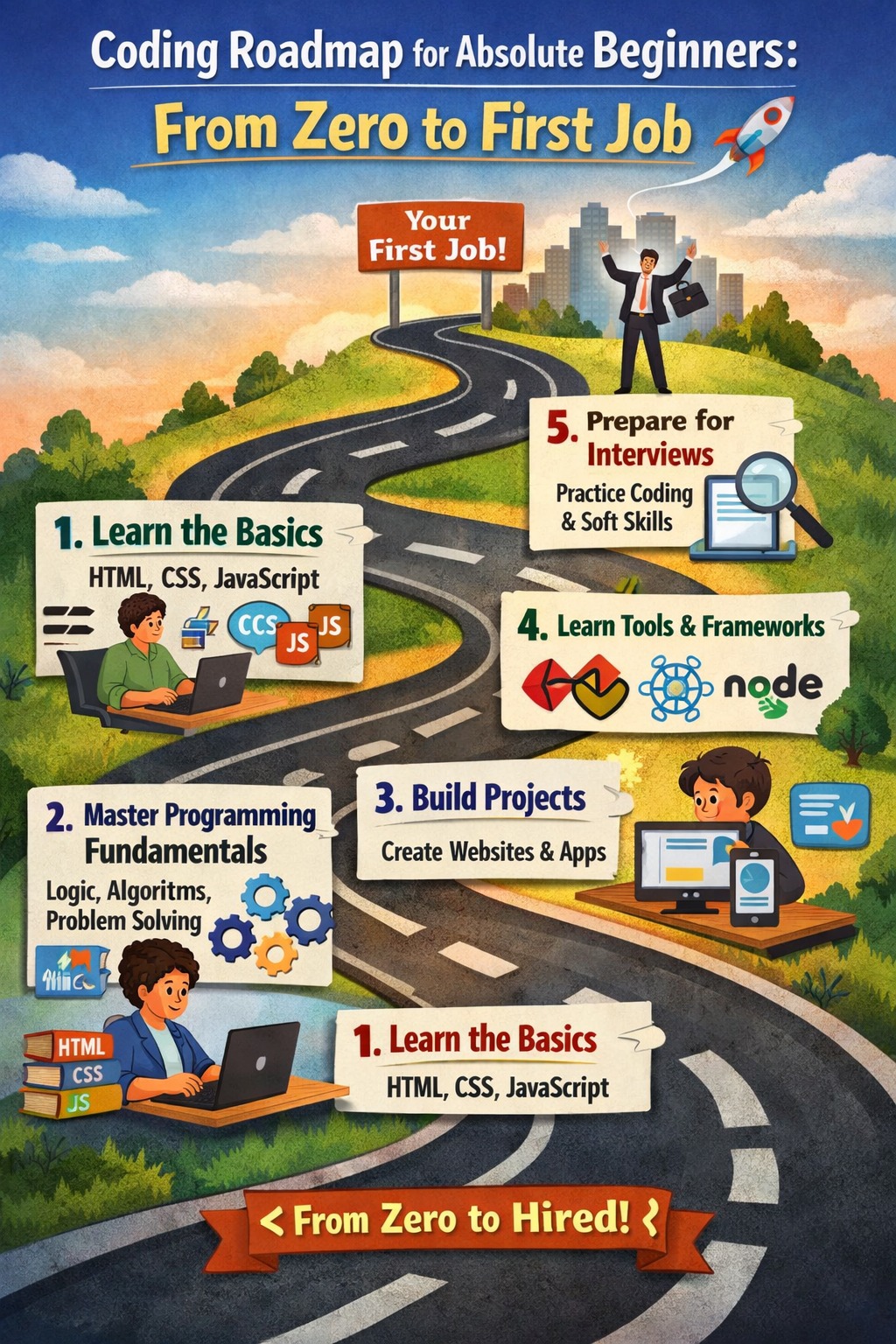
This Coding Roadmap for Absolute Beginners is designed to take you from zero knowledge to your first coding job, step by step. No confusion. No unnecessary technologies. Just a clear, practical path.
Why Learn Coding as a Beginner?
Before starting the roadmap, let’s understand why coding is worth learning:
High demand for skilled developers worldwide
Remote and freelance job opportunities
Good salary growth even at entry level
Skills applicable across industries (IT, finance, healthcare, education, startups)
Builds logical thinking and problem-solving skills
Coding is not about memorizing syntax—it’s about thinking logically and building solutions.
Step 1: Understand the Basics of Coding:
What Is Coding?
Coding is the process of giving instructions to a computer using a programming language. These instructions help build websites, apps, software, and systems.
Key Concepts Every Beginner Must Learn
Before choosing any language, understand these fundamentals:
What is a program?
What is a programming language?
Variables and data types
Conditional statements (if/else)
Loops
Functions
Errors and debugging
👉 Tip: Don’t rush. Strong basics make advanced learning easier.
Step 2: Choose the Right Programming Language:
Choosing the first programming language is critical for beginners.
Best Coding Languages for Absolute Beginners
Python
Easy syntax
Used in web development, AI, data science
Beginner-friendly and powerful
JavaScript
Essential for web development
Runs in the browser
High job demand
HTML & CSS (Not programming languages but essential)
HTML for structure
CSS for design
Must-learn for web developers
👉 Recommended Path for Beginners:
Start with HTML → CSS → JavaScript or Python first, depending on your goal.
Step 3: Learn Computer & Internet Basics:
Many beginners skip this step, but it’s extremely important.
Learn about:
How the internet works
What is a browser?
What is a server?
How websites are hosted
Basic command line usage
File and folder structure
This knowledge helps you understand how your code actually works in the real world.
Step 4: Practice Coding Daily (Very Important):
Coding is a skill, not theory.
How to Practice as a Beginner
Write small programs daily
Solve beginner coding problems
Modify existing code
Break code and fix errors
Practice Platforms
Coding practice websites
Simple projects
Online code editors
👉 Consistency matters more than speed.
Even 1 hour daily is enough if done properly.
Step 5: Learn Version Control (Git & GitHub):
To get a job, you must work like a professional developer.
What Is Git?
Git is a version control system that tracks code changes.
What Is GitHub?
GitHub is a platform to store, share, and showcase your code.
Learn:
Creating repositories
Committing code
Pushing projects to GitHub
Reading other developers’ code
👉 Recruiters often check GitHub profiles before hiring.
Step 6: Choose a Career Path in Coding:
Once basics are clear, choose one career direction:
Popular Coding Career Paths
Web Development
Frontend Developer
Backend Developer
Full Stack Developer
Software Development
Desktop applications
Enterprise software
Data Science & AI
Python, machine learning
Data analysis
Mobile App Development
Android or iOS apps
👉 Don’t try everything. Pick ONE path and go deep.
Step 7: Learn Job-Oriented Skills:
For your chosen path, learn industry-required technologies.
Example: Web Developer Skills
HTML, CSS, JavaScript
Responsive design
Basic frameworks
APIs
Debugging tools
Example: Python Developer Skills
Python libraries
Object-oriented programming
Data handling
Basic automation
👉 Focus on skills companies actually hire for, not just theory.
Step 8: Build Real Projects:
Projects are more important than certificates.
Beginner Project Ideas
Personal portfolio website
To-do list app
Calculator
Blog website
Simple login system
Why Projects Matter
Show practical skills
Improve confidence
Strengthen problem-solving
Increase hiring chances
👉 Aim for 5–8 solid projects before applying for jobs.
Step 9: Create a Strong Portfolio & Resume:
Your portfolio is your digital identity.
Portfolio Must Include:
About section
Skills
Projects with live links
GitHub profile
Contact information
Resume Tips for Beginners
Keep it simple
Highlight skills and projects
Mention tools and technologies
Avoid unnecessary personal details
Step 10: Apply for Internships & Entry-Level Jobs:
Start small. Growth will follow.
Where Beginners Can Apply
Internships
Trainee developer roles
Junior developer positions
Freelance projects
Job Application Tips
Customize resume for each job
Apply consistently
Don’t fear rejection
Keep improving skills while applying
👉 Your first job may not be perfect, but it’s your entry point.
Common Mistakes Beginners Should Avoid:
Trying to learn too many languages at once
Watching tutorials without practicing
Skipping basics
Comparing yourself to others
Giving up too early
Remember: Every expert was once a beginner.
How Long Does It Take to Get a Coding Job?
On average:
Basics: 1–2 months
Skill building: 3–6 months
Projects + job preparation: 2–3 months
👉 With consistency, 6–9 months is realistic for beginners.
Conclusion:
Learning coding from scratch may feel overwhelming, but with the right roadmap, it becomes achievable. This Coding Roadmap for Absolute Beginners is your guide from zero to your first job.
Focus on:
Strong fundamentals
Daily practice
Real projects
Job-oriented skills
Stay patient. Stay consistent. Your coding journey starts today 🚀