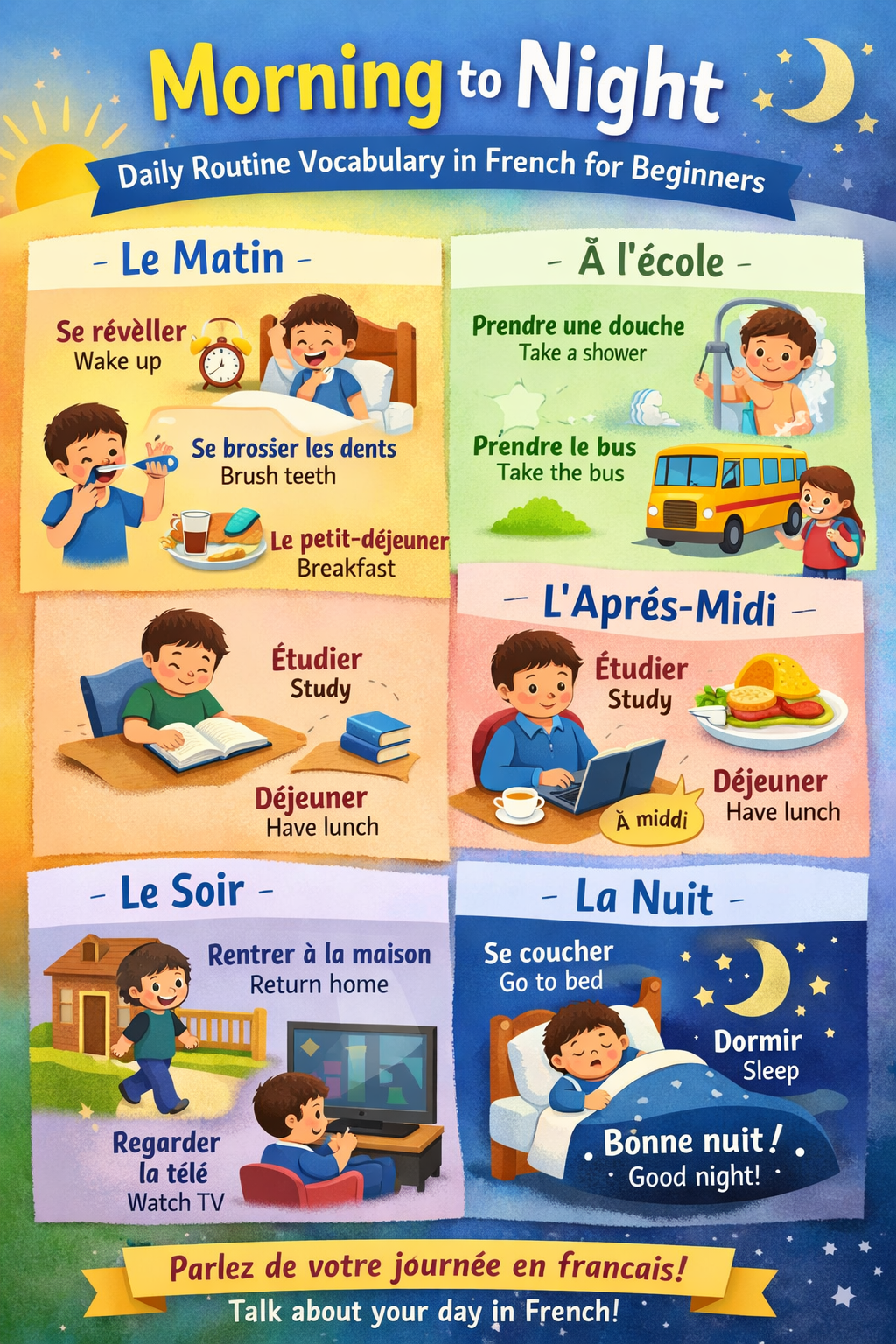
Learning a new language becomes much easier when you start with words you use every single day. One of the best beginner topics in French is daily routine vocabulary—from waking up in the morning to going to bed at night. This topic helps you build confidence, improve sentence formation, and speak French naturally in real-life situations.
In this blog, you will learn French daily routine vocabulary from morning to night, with easy verbs, nouns, example sentences, common mistakes, and quick practice exercises designed especially for beginners.
1. Introduction
Why learning daily routine vocabulary is important
Daily routine vocabulary is essential because it allows you to talk about your everyday life, which is the foundation of communication in any language. Whether you are introducing yourself, practicing speaking, or writing simple paragraphs in French, routine words are used everywhere.
How this topic helps beginners speak French confidently
By learning routine vocabulary, beginners can:
Form simple and meaningful sentences
Practice common reflexive verbs
Speak about time, habits, and actions
Build fluency step by step without memorizing complex grammar
What readers will learn in this article
In this blog, you will learn:
Morning to night French vocabulary
Common French verbs and nouns
Simple example sentences
A full daily routine paragraph in French
Practice exercises
Common beginner mistakes and tips to avoid them
2. Morning Routine Vocabulary (Le Matin)
Morning is the first part of our day, and French has specific verbs and nouns commonly used in the morning.
Common Morning Verbs
Se réveiller – to wake up
Se lever – to get up
Se brosser les dents – to brush teeth
These are reflexive verbs, which are very important in French daily routine vocabulary.
Morning Nouns
Le réveil – alarm clock
Le petit-déjeuner – breakfast
Simple Example Sentences
Je me réveille à 6 heures.
(I wake up at 6 o’clock.)
Je me brosse les dents le matin.
(I brush my teeth in the morning.)
Je prends le petit-déjeuner.
(I have breakfast.)
3. Getting Ready & Going to School/College
After waking up, we get ready and go to school, college, or work.
Daily Action Words
Prendre une douche – to take a shower
S’habiller – to get dressed
Travel-Related Vocabulary
Aller à l’école – to go to school
Prendre le bus – to take the bus
Example Sentences
Je prends une douche.
(I take a shower.)
Je m’habille rapidement.
(I get dressed quickly.)
Je vais à l’école en bus.
(I go to school by bus.)
4. Afternoon Routine Vocabulary (L’Après-Midi)
The afternoon is usually related to study, work, and meals.
Study and Work-Related Words
Étudier – to study
Déjeuner – to have lunch
Common Time Expressions
À midi – at noon
L’après-midi – afternoon
Example Sentences
J’étudie l’après-midi.
(I study in the afternoon.)
Je déjeune à midi.
(I have lunch at noon.)
5. Evening Routine Vocabulary (Le Soir)
Evening is the time to relax after a long day.
Evening Activities
Rentrer à la maison – to return home
Dîner – to have dinner
Relaxation Words
Regarder la télévision – to watch TV
Lire un livre – to read a book
Example Sentences
Je rentre à la maison le soir.
(I return home in the evening.)
Je regarde la télévision.
(I watch television.)
6. Night Routine Vocabulary (La Nuit)
Night-time vocabulary focuses on rest and sleep.
Night-Time Actions
Se coucher – to go to bed
Dormir – to sleep
Useful Phrases
Bonne nuit – good night
Example Sentences
Je me couche à 10 heures.
(I go to bed at 10 o’clock.)
Je dors bien la nuit.
(I sleep well at night.)
7. Full Daily Routine Example in French
French Paragraph
Je me réveille à 6 heures le matin. Je me lève et je me brosse les dents. Je prends une douche et je m’habille. Je prends le petit-déjeuner, puis je vais à l’école en bus. À midi, je déjeune. L’après-midi, j’étudie. Le soir, je rentre à la maison et je dîne. Je regarde la télévision ou je lis un livre. La nuit, je me couche et je dors. Bonne nuit.
Line-by-Line English Meaning
I wake up at 6 in the morning.
I get up and brush my teeth.
I take a shower and get dressed.
I have breakfast, then I go to school by bus.
At noon, I have lunch.
In the afternoon, I study.
In the evening, I return home and have dinner.
I watch TV or read a book.
At night, I go to bed and sleep. Good night.
8. Quick Practice for Beginners
Match the Word with Meaning
Se coucher – ___
Déjeuner – ___
Le réveil – ___
Fill in the Blanks
Je ___ à 7 heures. (wake up)
Je ___ le bus. (take)
Speak-Out-Loud Practice Tip
Read your daily routine out loud every day. Speaking helps you remember verbs faster and improves pronunciation.
9. Common Mistakes Beginners Make
Verb Conjugation Errors
Many beginners forget to conjugate verbs according to the subject:
❌ Je réveiller
✅ Je me réveille
Forgetting Reflexive Verbs
French daily routine uses many reflexive verbs:
se réveiller
se lever
se coucher
Always use me / te / se / nous / vous correctly.
10. Conclusion
Key Vocabulary Recap
You learned:
Morning to night French routine vocabulary
Common verbs, nouns, and phrases
A complete daily routine paragraph
Practice exercises and common mistakes
Encouragement to Practice Daily Routine Sentences
Practice your routine every day in French—even simple sentences make a big difference. Try describing your real day using these words.
Next Learning Step Suggestion
Next, learn:
French time expressions
Present tense verb conjugation
Asking and answering daily routine questions in French