Introduction:
Recruitment and selection are two of the most crucial functions in Human Resource Management (HRM). While recruitment focuses on attracting potential candidates, selection is about choosing the most suitable individual for a job. At the heart of this process lies the selection decision—a critical stage that determines who ultimately joins the organization.
A selection decision directly impacts organizational performance, culture, and long-term success. A well-informed decision leads to hiring the right talent, whereas a poor decision can result in high employee turnover, low productivity, and increased hiring costs. This blog explores what a selection decision is, its meaning, step-by-step process, importance, challenges, and best practices in HR management, helping HR professionals make better and more ethical hiring choices.
What Is a Selection Decision?
Definition of Selection Decision in HRM
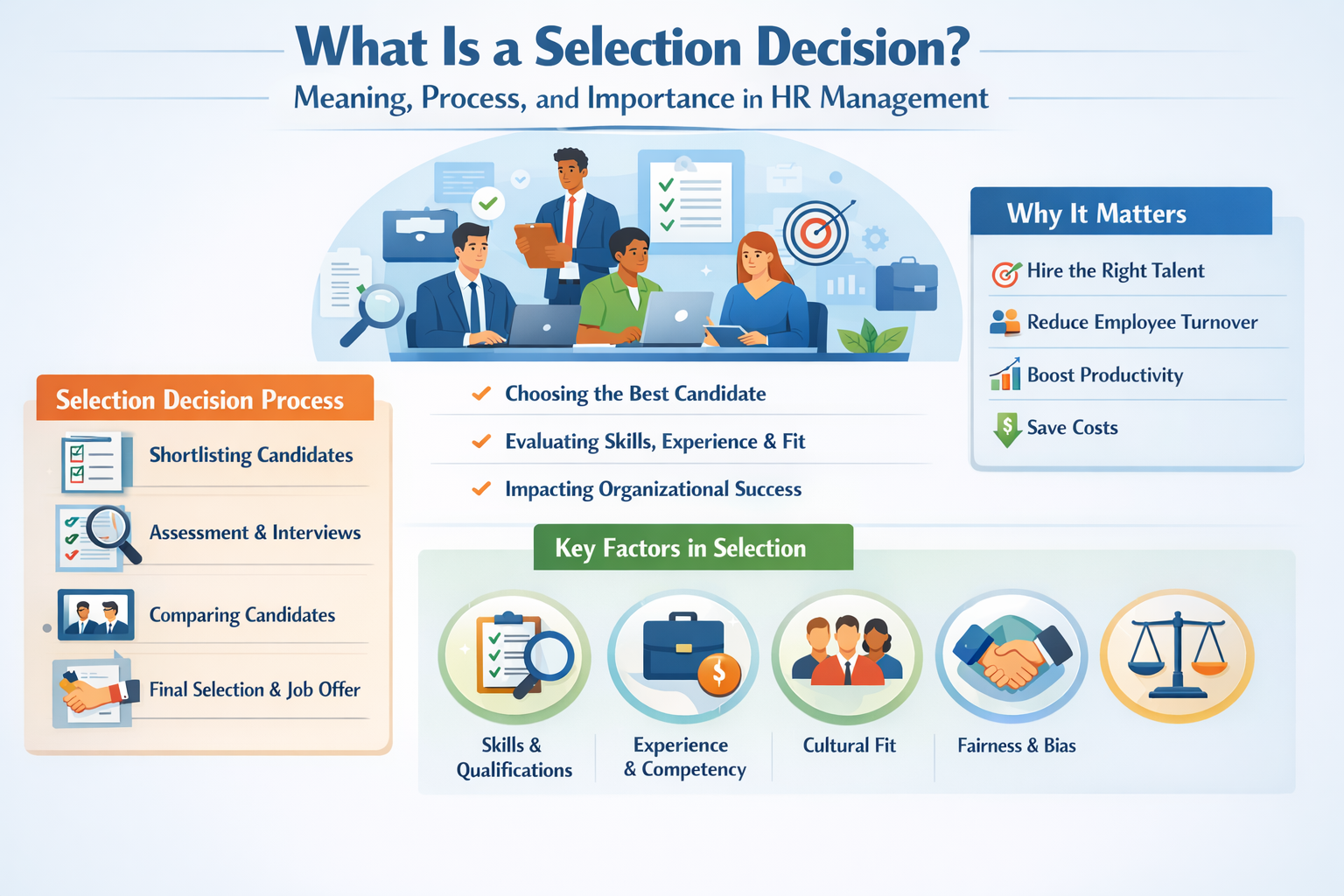
A selection decision in HR Management refers to the final judgment made by HR professionals and hiring managers to choose the most suitable candidate from a pool of applicants after evaluating their skills, qualifications, experience, and cultural fit.
In simple words, it is the decision that answers the question:
“Which candidate should be hired for this role?”
Role of Selection Decision in the Recruitment Process
The selection decision comes after recruitment, screening, and assessment stages. It acts as a bridge between evaluating candidates and offering employment. This decision ensures that the chosen candidate aligns with both job requirements and organizational goals.
Who Is Involved in Making Selection Decisions?
Selection decisions are usually made collaboratively and may involve:
HR professionals – manage the process and ensure policy compliance
Hiring managers – assess technical and role-specific fit
Department heads or leadership – approve final hiring decisions for critical roles
Meaning of Selection Decision in HR Management:
Selection Decision Explained in Simple Terms
The selection decision is the final step where HR chooses the best candidate based on evidence collected during interviews, tests, and evaluations.
Difference Between Selection and Selection Decision
| Selection | Selection Decision |
|---|---|
| Overall process of choosing candidates | Final choice of one candidate |
| Includes tests, interviews, screening | Comes after all evaluations |
| Ongoing activity | One-time final judgment |
Real-World Example of a Selection Decision
Imagine a company hiring a Digital Marketing Executive. After interviews and skill tests, three candidates remain. HR compares their experience, performance scores, and cultural fit. The candidate who best meets the job requirements and company values is selected. This final choice is the selection decision.
Selection Decision Process: Step-by-Step:
4.1 Shortlisting of Candidates
The selection decision process begins with shortlisting:
Screening resumes and applications
Checking eligibility, qualifications, and experience
Removing unsuitable profiles
This step narrows down the candidate pool for further evaluation.
4.2 Assessment and Evaluation:
Candidates are evaluated using multiple methods:
Interviews – HR interviews, technical interviews, and behavioral interviews
Tests – aptitude tests, skill-based tests, and psychometric assessments
Background verification – checking employment history and references
These tools help HR gather objective data for decision-making.
4.3 Comparison of Candidates:
At this stage:
Candidate profiles are matched with job requirements
Scoring matrices and evaluation forms are used
Strengths and weaknesses of each candidate are compared
This structured comparison supports fair and data-driven selection decisions.
4.4 Final Selection Decision:
This is the most crucial stage:
HR and department heads discuss evaluation results
Final approval is taken from management
Legal and compliance documentation is completed
HR ensures that the selection decision follows organizational policies and employment laws.
4.5 Job Offer and Appointment:
Once the selection decision is finalized:
Offer letters are issued
Salary negotiations may take place
Candidate acceptance is confirmed
After acceptance, the candidate officially becomes an employee.
Importance of Selection Decision in HR Management:
1. Ensures Hiring of the Right Talent
A well-planned selection decision helps organizations hire employees with the right skills, attitude, and potential.
2. Reduces Employee Turnover
Selecting the right candidate minimizes early resignations and job mismatches.
3. Improves Productivity and Performance
Employees selected through effective decision-making perform better and contribute more to business goals.
4. Saves Recruitment and Training Costs
Wrong hiring decisions increase rehiring and retraining costs. Accurate selection decisions reduce these expenses.
5. Supports Long-Term Organizational Goals
Strategic selection decisions align human capital with long-term growth and competitiveness.
Factors Affecting Selection Decisions:
Several factors influence selection decisions in HR management:
Skills and qualifications – technical and professional competence
Experience and competency – job-related expertise
Cultural fit and attitude – alignment with company values
Organizational policies – internal hiring guidelines
Bias and fairness considerations – ensuring equal opportunity
Challenges in Making Effective Selection Decisions:
Despite best efforts, HR professionals face challenges such as:
1. Unconscious Bias
Personal preferences or stereotypes may affect decision-making.
2. Time Pressure in Hiring
Urgent hiring needs can lead to rushed decisions.
3. Incomplete Candidate Information
Limited or inaccurate data may result in poor evaluations.
4. Balancing Skills vs Cultural Fit
Choosing between technical expertise and cultural alignment is often difficult.
Best Practices for Effective Selection Decisions:
To improve selection decision quality, HR should follow these best practices:
Use structured interviews with standardized questions
Rely on data-driven assessments and analytics
Involve multiple decision-makers to reduce bias
Maintain transparent documentation for accountability
Ensure fairness, diversity, and inclusion
Selection Decision in Modern HR:
Modern HR practices have transformed selection decisions through technology:
Use of AI and HR Analytics
AI tools analyze resumes, predict performance, and reduce bias.
Role of Applicant Tracking Systems (ATS)
ATS helps manage candidate data and supports efficient decision-making.
Remote Hiring and Virtual Interviews
Digital interviews and online assessments have become common in global hiring.
Conclusion:
The selection decision is a cornerstone of effective HR management. It determines who joins the organization and shapes its future performance, culture, and success. By understanding the meaning, process, importance, challenges, and best practices of selection decisions, HR professionals can make informed, ethical, and strategic hiring choices.
A strong selection decision not only ensures the right talent is hired but also strengthens organizational effectiveness and long-term growth. In today’s competitive and technology-driven environment, making smart and unbiased selection decisions is more important than ever.