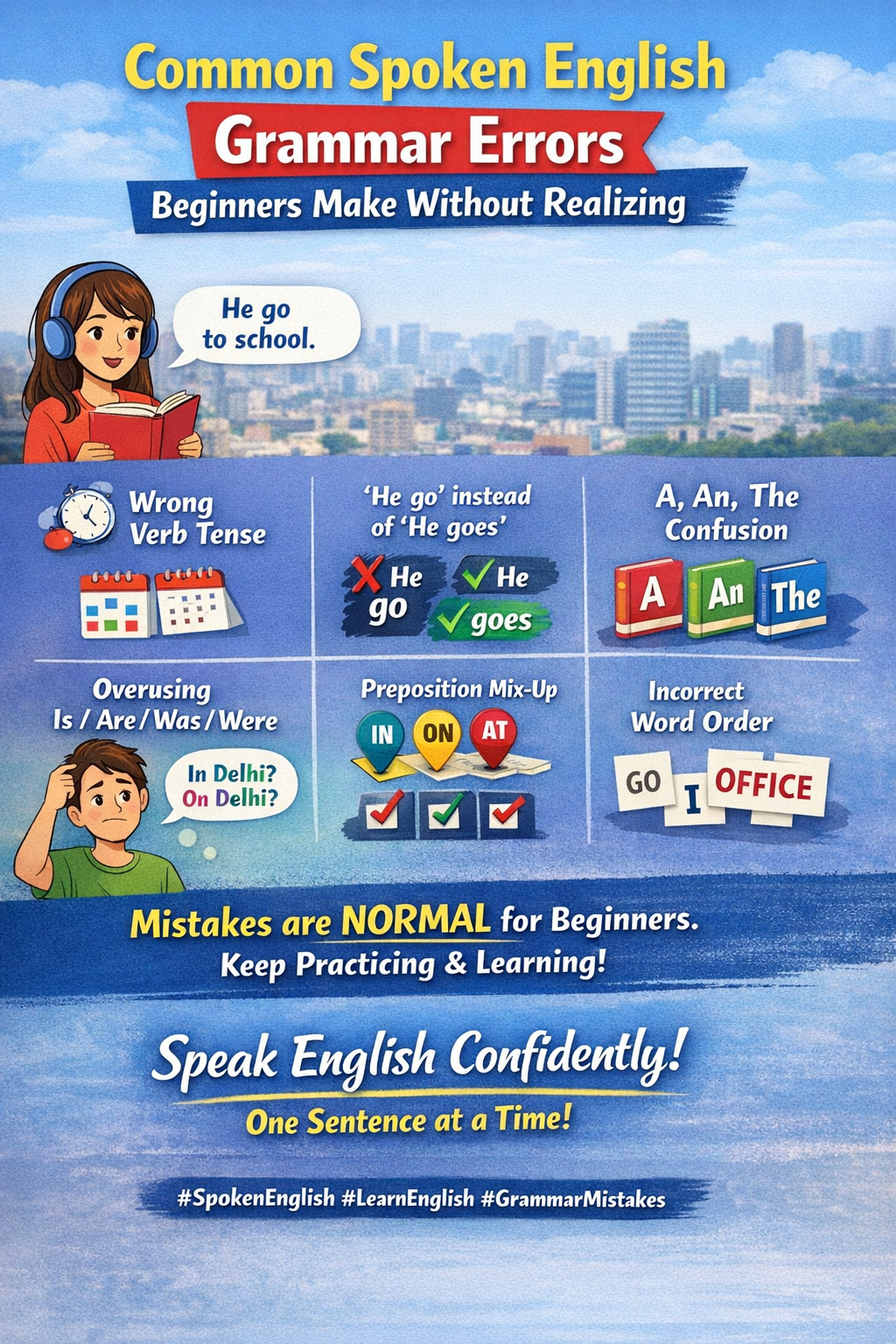
Learning spoken English is an exciting journey, but beginners often make grammar mistakes without even noticing them. These errors may seem small, yet they can affect confidence, clarity, and fluency while speaking. The good news is that most spoken English grammar errors are common and easy to fix once you become aware of them.
In this blog, we will explore the most common spoken English grammar mistakes beginners make, understand why they happen, see real-life examples, and learn simple tips to correct them. This guide is ideal for students, job seekers, and anyone who wants to speak English confidently.
1. Why Spoken English Grammar Matters
Spoken English grammar matters because it helps you express your thoughts clearly and confidently. Even if your vocabulary is good, incorrect grammar can confuse the listener or change the meaning of your sentence.
Difference Between Written and Spoken English
Written English is usually more formal and structured, while spoken English is natural and conversational. However, basic grammar rules still apply in spoken English, especially in professional or social situations.
How Small Grammar Mistakes Affect Confidence
Repeated grammar mistakes can make speakers feel nervous or hesitant. When you speak with correct grammar, you feel more confident and people understand you better.
2. Using Wrong Verb Tense While Speaking
One of the most common spoken English grammar errors is using the wrong verb tense.
Mixing Past, Present, and Future Tenses
Beginners often mix tenses while speaking, especially in fast conversations.
Common mistakes:
❌ Yesterday I go to market
❌ I am doing this work last year
Correct usage:
✅ Yesterday I went to the market
✅ I did this work last year
Simple Tips to Remember Correct Tense
Think about time words (yesterday, today, tomorrow)
Practice speaking in one tense at a time
Use simple tenses first before moving to complex ones
3. Subject–Verb Agreement Errors
What Subject–Verb Agreement Means
The verb must match the subject in number and person.
Common Spoken Mistakes
❌ He go to office daily
❌ They was happy
Correct forms:
✅ He goes to the office daily
✅ They were happy
Easy Rules to Avoid This Mistake
Singular subject → singular verb
Plural subject → plural verb
Remember: He/She/It always takes “s” in present tense
4. Incorrect Use of Articles (A, An, The)
Articles are confusing for beginners, especially those whose native language doesn’t use them.
Why Articles Confuse Beginners
English articles depend on pronunciation, specificity, and context.
When to Use or Skip Articles
A / An – for general things
The – for specific things
No article – for general plural or uncountable nouns
Examples:
❌ I bought pen
✅ I bought a pen
❌ She is best teacher
✅ She is the best teacher
5. Overusing “Is / Are / Was / Were”
Why Beginners Rely Too Much on Helping Verbs
Beginners feel safe using “is” and “are” because sentences seem easier to form.
Examples:
❌ I am doing job in company
❌ She is having a car
How It Affects Sentence Flow
Overuse makes speech sound unnatural and less fluent.
Natural Spoken Alternatives
✅ I work in a company
✅ She has a car
6. Confusing Prepositions in Daily Conversation
Prepositions like in, on, at, to, for, with are a major challenge in spoken English.
Commonly Confused Prepositions
In / On / At (time & place)
To / For (direction vs purpose)
Examples:
❌ I live on Delhi
✅ I live in Delhi
❌ This gift is to you
✅ This gift is for you
Quick Tricks
In – big places or long time
On – surface or days
At – exact point or time
7. Incorrect Word Order in Sentences
Influence of Mother Tongue
Many beginners translate sentences directly from their native language, leading to wrong word order.
Examples:
❌ I daily go office
❌ She very well sings
Correct Patterns:
✅ I go to the office daily
✅ She sings very well
Basic English Sentence Order
Subject + Verb + Object + Time/Place
8. Using Wrong Pronouns While Speaking
Mixing He / She / They / It
Beginners often confuse gender or number.
Examples:
❌ My friend is coming. He is my sister
✅ My friend is coming. She is my sister
Possessive Pronoun Mistakes
❌ This is me book
✅ This is my book
Speaking Practice Tip
Practice describing people and objects daily using correct pronouns.
9. Missing or Adding “-s / -es” Incorrectly
Third-Person Singular Mistakes
❌ He play cricket
✅ He plays cricket
Plural vs Singular Confusion
❌ Two child are playing
✅ Two children are playing
Easy Tips
Add -s / -es with he, she, it
Listen carefully to pronunciation
10. Translating Directly from Native Language to English
Why Direct Translation Causes Errors
Grammar structures differ from language to language.
Examples:
❌ I am having fever
✅ I have a fever
How to Think in English
Learn phrases, not word-by-word translation
Practice speaking simple sentences
Listen to English conversations daily
11. How to Identify and Correct These Mistakes
Listen to Native Speakers
Watch English movies, podcasts, and interviews.
Record and Review Your Speech
Recording helps you notice repeated grammar mistakes.
Daily Speaking Practice Techniques
Speak in front of a mirror
Practice with a partner
Join spoken English classes or online groups
12. Conclusion
Making grammar mistakes in spoken English is completely normal for beginners. Every fluent speaker once made the same errors. The key is not perfection, but progress.
Focus on communication first and accuracy later. With regular practice, listening, and awareness, your spoken English grammar will improve naturally. Keep speaking, keep learning, and most importantly, don’t be afraid to make mistakes—that’s how fluency is built.