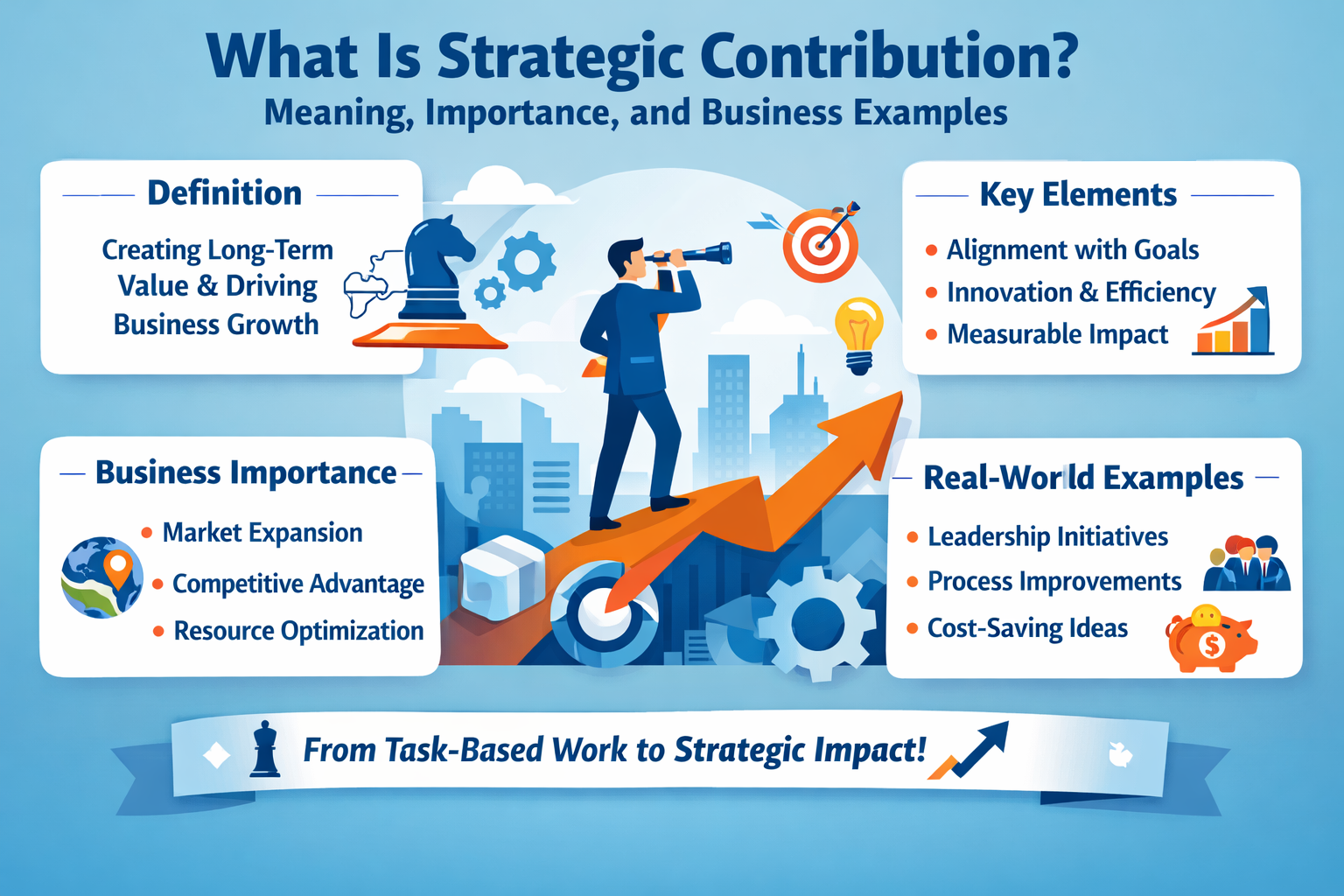
In today’s fast-changing and highly competitive
business environment, organizations no longer succeed only by completing tasks
efficiently. Success now depends on how much value those tasks create.
This is where the concept of strategic contribution becomes critically
important.
Businesses are shifting from task-based work
to value-driven impact, where every role—whether leadership, management,
or entry-level—contributes to long-term business goals. This article explains
the meaning of strategic contribution, why it matters, how it differs
from tactical work, and real-world business examples to help you understand its
true impact.
By the end of this blog, you will clearly
understand:
- What
strategic contribution means - Why
it is important for businesses and employees - How
to identify and measure strategic contribution - How
individuals and organizations can develop strategic contribution skills
What Is Strategic Contribution? (Meaning
& Definition):
Definition of Strategic Contribution
Strategic contribution
refers to any action, decision, or initiative that directly supports an
organization’s long-term goals, growth, and competitive advantage. It
goes beyond daily tasks and focuses on creating sustainable business impact.
In simple words:
Strategic contribution is work that moves the business
forward, not just work that keeps it running.
Strategic Contribution vs Operational
Work
- Operational
work focuses on routine activities such as
reporting, execution, and maintenance. - Strategic
contribution focuses on planning, improvement,
innovation, and alignment with business objectives.
Both are important, but strategic contribution
determines direction and future success.
Levels of Strategic Contribution
- Individual
level: Suggesting improvements, saving
costs, improving customer experience - Team
level: Process optimization, performance
improvement initiatives - Organizational
level: Market expansion, digital
transformation, restructuring
Key Elements of Strategic Contribution:
A true strategic contribution includes the following
key elements:
Alignment with Organizational Goals
Every strategic contribution directly supports the
company’s vision, mission, and objectives.
Long-Term Value Creation
Strategic contributions focus on sustainable
results, not just quick wins.
Impact on Growth or Competitive
Advantage
It improves revenue, efficiency, customer
satisfaction, or market position.
Ownership and Decision-Making Mindset
Strategic contributors think like business owners,
not task executors.
Measurable Outcomes
Strategic impact can be measured using KPIs,
OKRs, and performance metrics.
Why Strategic Contribution Is Important
for Businesses:
3.1 Business Growth and Sustainability
Strategic contribution drives:
- Innovation
and new product development - Market
expansion and customer retention - Organizational
resilience during economic uncertainty
Companies that focus on strategic contribution adapt
faster and survive longer.
3.2 Competitive Advantage
Organizations gain an edge by:
- Making
smarter, data-driven decisions - Responding
faster to market changes - Differentiating
through strategy, not just price
3.3 Better Resource Utilization
Strategic contribution ensures optimal use of:
- Time
- Talent
- Capital
It reduces waste, inefficiencies, and unnecessary
effort.
Importance of Strategic Contribution for
Employees:
Strategic contribution is not only beneficial for
organizations but also for employees.
Career Growth and Leadership Readiness
Employees who contribute strategically are seen as future
leaders.
Visibility and Recognition
Strategic contributors gain management attention and
career opportunities.
Higher Job Satisfaction and Engagement
When employees see their work creating impact,
motivation increases.
Becoming a Value Creator
Instead of just following instructions, employees
become problem solvers and innovators.
Strategic Contribution vs Tactical
Contribution
Strategic Contribution | Tactical Contribution |
Long-term focus | Short-term focus |
Drives direction | Supports execution |
Creates business impact | Completes tasks |
Linked to goals | Linked to activities |
Both are necessary, but strategy sets the path
and tactics follow it.
Real-World Business Examples of
Strategic Contribution:
6.1 Leadership-Level Example
A CEO identifies a new market opportunity and leads
a digital transformation strategy, resulting in global expansion and
increased revenue.
6.2 Manager-Level Example
An operations manager redesigns workflows, reducing
turnaround time by 30% and improving team productivity.
6.3 Employee-Level Example
A junior employee suggests automating a manual
reporting process, saving hundreds of work hours annually and reducing errors.
6.4 Startup or SME Example
A small business pivots to an online sales model,
adopts digital marketing, and expands its customer base nationwide.
How to Identify Strategic Contribution
in an Organization:
Ask these key questions:
- Does
this work support long-term business goals? - Does
it create measurable impact? - Does
it improve growth, efficiency, or customer value?
Organizations should:
- Identify
high-impact roles - Connect
individual performance to business strategy - Encourage
initiative and innovation
How to Develop Strategic Contribution
Skills:
Strategic Thinking and Problem-Solving
Learn to see the bigger picture and anticipate
future challenges.
Business Awareness
Understand financials, market trends, and customer
behavior.
Data-Driven Decision Making
Use insights, metrics, and analysis to guide
actions.
Collaboration and Cross-Functional
Exposure
Working across teams improves strategic
understanding.
Continuous Learning and Upskilling
Strategic contributors invest in learning,
leadership, and digital skills.
Measuring Strategic Contribution:
Organizations measure strategic contribution using:
Key Performance Indicators (KPIs)
Metrics linked to growth, efficiency, and outcomes.
OKRs (Objectives and Key Results)
Clear alignment between individual goals and company
strategy.
Balanced Scorecards
Combining financial and non-financial performance
indicators.
Qualitative vs Quantitative Impact
Both measurable results and behavioral impact
matter.
Role of Leadership and HR in Encouraging
Strategic Contribution:
Leadership and HR play a vital role by:
- Creating
a strategy-aligned culture - Empowering
employees to think strategically - Linking
performance management to business impact - Offering
leadership development and strategic training
Common Mistakes and Misconceptions:
Confusing Busyness with Impact:
Being busy does not mean being strategic.
Over-Focus on Short-Term Results:
Ignoring long-term goals weakens sustainability.
Poor Alignment with Strategy:
Unclear goals lead to wasted effort.
Weak Communication:
Employees cannot contribute strategically if they
don’t understand the strategy.
Strategic Contribution in the Future of
Work:
With AI, automation, and digital transformation,
routine tasks will decline, while strategic thinking skills will be in high
demand.
Remote and hybrid work models further increase the
need for:
- Ownership
- Accountability
- Strategic
decision-making
Future-ready professionals will be strategic
contributors, not just executors.
Frequently Asked Questions (FAQs):
What is an example of strategic
contribution?
Introducing a cost-saving process or improving customer experience.
Can junior employees make strategic
contributions?
Yes. Strategic contribution depends on mindset, not designation.
How is strategic contribution measured?
Through KPIs, OKRs, business outcomes, and impact analysis.
Why do organizations value strategic
contributors?
Because they drive growth, innovation, and long-term success.
Conclusion:
Strategic contribution is the bridge between strategy
and action. It transforms everyday work into meaningful business impact.
In a competitive world, organizations and
professionals who focus on strategic thinking, alignment, and value creation
will always stay ahead.
Final takeaway:
👉 Execution
keeps the business running, but strategic contribution helps it grow.
Start thinking beyond tasks. Start contributing
strategically.