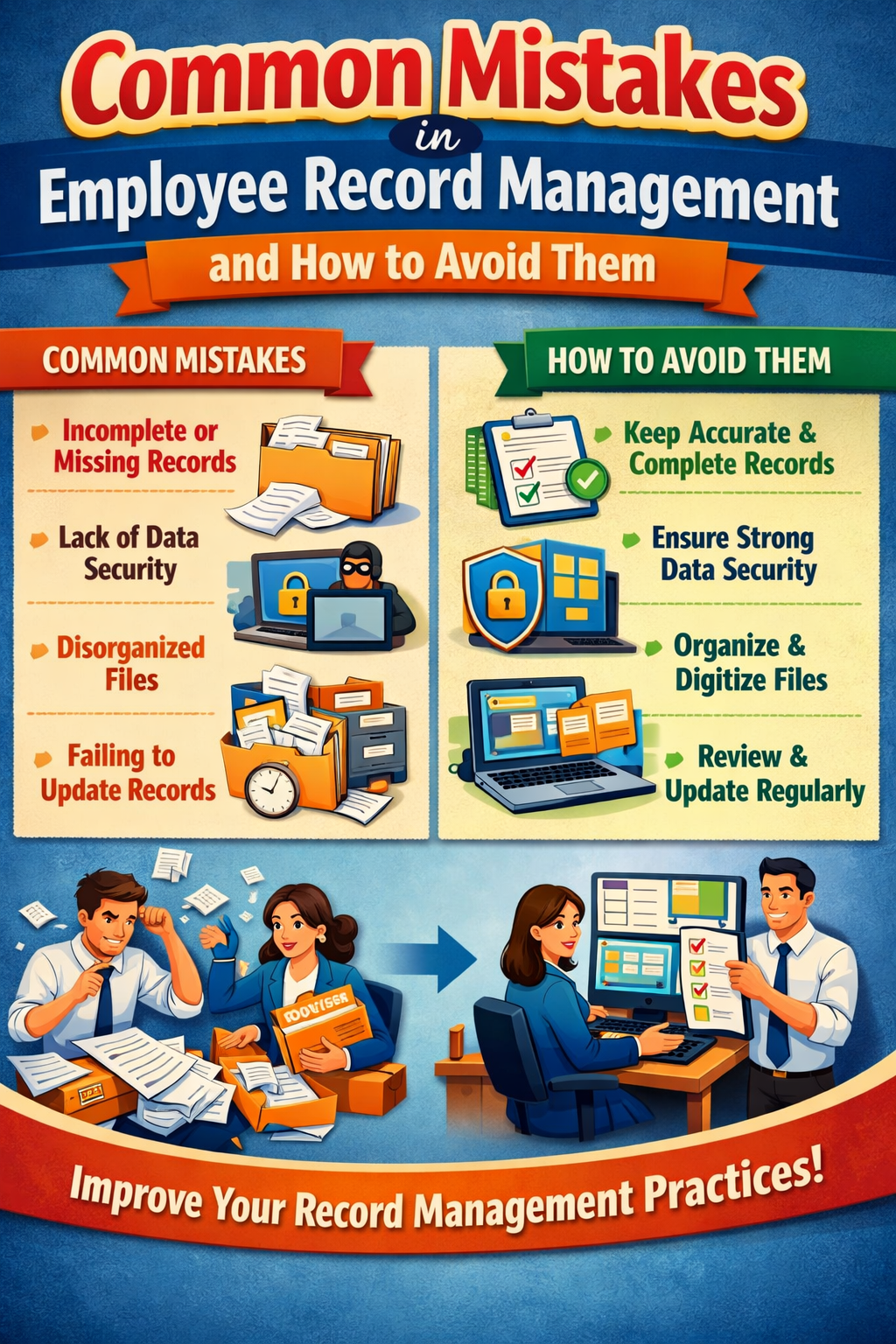
Introduction:
Employee record
management is one of the most critical responsibilities of any HR department.
Accurate and well-maintained employee records form the backbone of smooth HR
operations, legal compliance, payroll processing, and employee trust. From
personal details and employment contracts to payroll data and performance
reviews, every record plays a vital role in organizational efficiency.
Poor employee record
management can lead to serious consequences such as compliance penalties,
payroll errors, data breaches, and employee dissatisfaction. In many cases,
organizations underestimate the importance of structured and secure
record-keeping until an audit, dispute, or legal issue arises.
The purpose of this
article is to highlight the most common mistakes in employee record
management and provide practical solutions and best practices to
help HR teams and businesses avoid these pitfalls while improving accuracy,
compliance, and efficiency.
What Is
Employee Record Management?
Definition and Scope:
Employee record
management refers to the systematic process of collecting, storing,
maintaining, updating, and securing employee-related information throughout the
employee lifecycle—from hiring to exit.
Types of Employee
Records:
Employee records
typically include:
- Personal records: Name, address, contact details,
identity proofs - Payroll records: Salary, tax details, bank
information, payslips - Performance records: Appraisals, feedback, promotions
- Compliance records: Attendance, leave, statutory
forms, contracts, disciplinary actions
Who Is Responsible for
Managing Records?
HR professionals are
primarily responsible for employee record management, often in coordination
with payroll teams, compliance officers, and IT departments to ensure data
accuracy, security, and legal adherence.
Why Employee Record
Accuracy Matters:
Legal and Statutory
Compliance:
Accurate employee
records help organizations comply with labor laws, tax regulations, and
statutory requirements. Incorrect or missing records can result in penalties,
audits, and legal disputes.
Smooth HR Operations
and Audits:
Well-organized records
ensure smooth onboarding, payroll processing, internal audits, and external
inspections, saving time and reducing stress.
Employee Satisfaction
and Dispute Prevention:
Employees trust
organizations that manage their data responsibly. Accurate records prevent
salary disputes, leave miscalculations, and miscommunication.
Data-Driven HR
Decision-Making:
Reliable employee data
enables informed HR decisions related to workforce planning, promotions,
training, and performance management.
Common Mistake #1: Incomplete
Employee Records:
Missing Documents and
Information:
Incomplete records
often include missing identity proofs, signed contracts, tax declarations, or
emergency contact details.
Risks of Incomplete
Records:
- Compliance violations
- Payroll delays or errors
- Legal exposure during disputes
How to Avoid This
Mistake:
- Use standardized onboarding
checklists - Verify documents before employee
confirmation - Conduct regular record completeness
audits
Common Mistake #2: Manual and
Paper-Based Record Keeping:
Limitations of Physical
Files and Spreadsheets:
Paper files and
spreadsheets are time-consuming, prone to errors, and difficult to scale as the
organization grows.
Risks of Data Loss and
Errors:
- Misplaced files
- Data duplication
- Lack of real-time updates
Transitioning to
Digital HR Systems:
Adopting an HRMS
(Human Resource Management System) allows centralized, searchable, and
secure storage of employee records.
Common Mistake #3: Poor Data
Security and Access Control:
Unauthorized Access
Issues:
Without proper access
controls, sensitive employee data may be accessed by unauthorized personnel.
Data Breaches and
Confidentiality Risks:
Data breaches can
damage company reputation and lead to legal consequences.
Best Practices for Data
Protection:
- Role-based access controls
- Data encryption
- Secure login authentication
- Regular security audits
Common Mistake #4: Failure to Update Employee
Records Regularly:
Outdated Personal and
Employment Details:
Employee information
such as address, bank details, job role, or salary often changes but remains
unupdated.
Impact on Payroll,
Compliance, and Communication:
Outdated data can
result in incorrect payments, compliance issues, and communication gaps.
Setting Update
Schedules and Reminders:
- Schedule quarterly or annual record
updates - Use automated reminders
- Enable employee self-service
updates
Common Mistake #5: Lack of Standardized Record
Management Processes:
Inconsistent Data
Formats and Storage:
Different departments
may follow different formats, leading to confusion and inconsistency.
Problems During Audits
and Reporting:
Inconsistent records
make audits, reporting, and analysis difficult and error-prone.
Creating Standard HR
Documentation Procedures:
- Define standard templates
- Maintain uniform naming conventions
- Document clear SOPs for record
management
Common Mistake #6: Non-Compliance with Legal
Retention Requirements:
Ignoring Statutory
Record Retention Periods:
Many organizations fail
to retain employee records for the legally required duration.
Risks of Penalties and
Legal Disputes:
Non-compliance can
result in fines, legal action, and loss of credibility.
Understanding Labor
Laws and Compliance Timelines:
HR teams must stay
updated with labor laws and define clear record retention and disposal
policies.
Common Mistake #7: No Backup or
Disaster Recovery Plan:
Data Loss Due to System
Failure or Accidents:
Without backups, system
crashes, cyberattacks, or natural disasters can wipe out critical data.
Importance of Regular
Backups:
Regular backups ensure
business continuity and data recovery.
Secure Backup and
Recovery Strategies:
- Cloud-based backups
- Automated backup schedules
- Periodic recovery testing
Best Practices for Effective
Employee Record Management:
Use of HRMS / Digital
Record Systems:
Digital HR systems
streamline data storage, retrieval, and updates while improving accuracy.
Regular Audits and Data
Verification:
Conduct periodic audits
to identify errors, gaps, or compliance risks.
Employee Self-Service
Portals:
Allow employees to view
and update their information, reducing HR workload and improving accuracy.
Training HR Staff on
Compliance and Data Handling:
Continuous training
ensures HR teams understand legal requirements and best data-handling
practices.
Role of Automation in
Employee Record Management:
Automated Data Entry
and Updates:
Automation reduces
manual errors and ensures real-time data accuracy.
Integration with
Payroll and Attendance Systems:
Integrated systems
eliminate duplication and ensure seamless payroll processing.
Error Reduction Through
Automation:
Automated validations
and workflows significantly reduce human errors and compliance risks.
Conclusion:
Employee record
management is not just an administrative task—it is a strategic HR function
that directly impacts compliance, payroll accuracy, operational efficiency, and
employee trust. Common mistakes such as incomplete records, manual processes,
poor security, and non-compliance can expose organizations to serious risks.
By adopting digital HR
systems, standardizing processes, ensuring regular updates, and leveraging
automation, businesses can build a reliable and compliant employee record
management system.
Final Recommendation:
HR teams and businesses should prioritize structured, secure, and automated
employee record management practices to ensure long-term organizational
success, legal compliance, and a positive employee experience.