Introduction:
Full stack development
refers to building both the front-end and back-end of a web application. A full
stack web developer work with user interfaces, server-side logic, databases and
deployment environments.
The Front-end is what users see and interact
with- HTML, CSS, and JavaScript- while the back-end manages data, authentication
and business logic using server-side technologies. Choosing the right
technology stack is critical because it directly affects performance,
scalability, security, and maintainability. One of the most reliable and widely
used stacks is the LAMP STACK.
What is the
LAMP Stack?
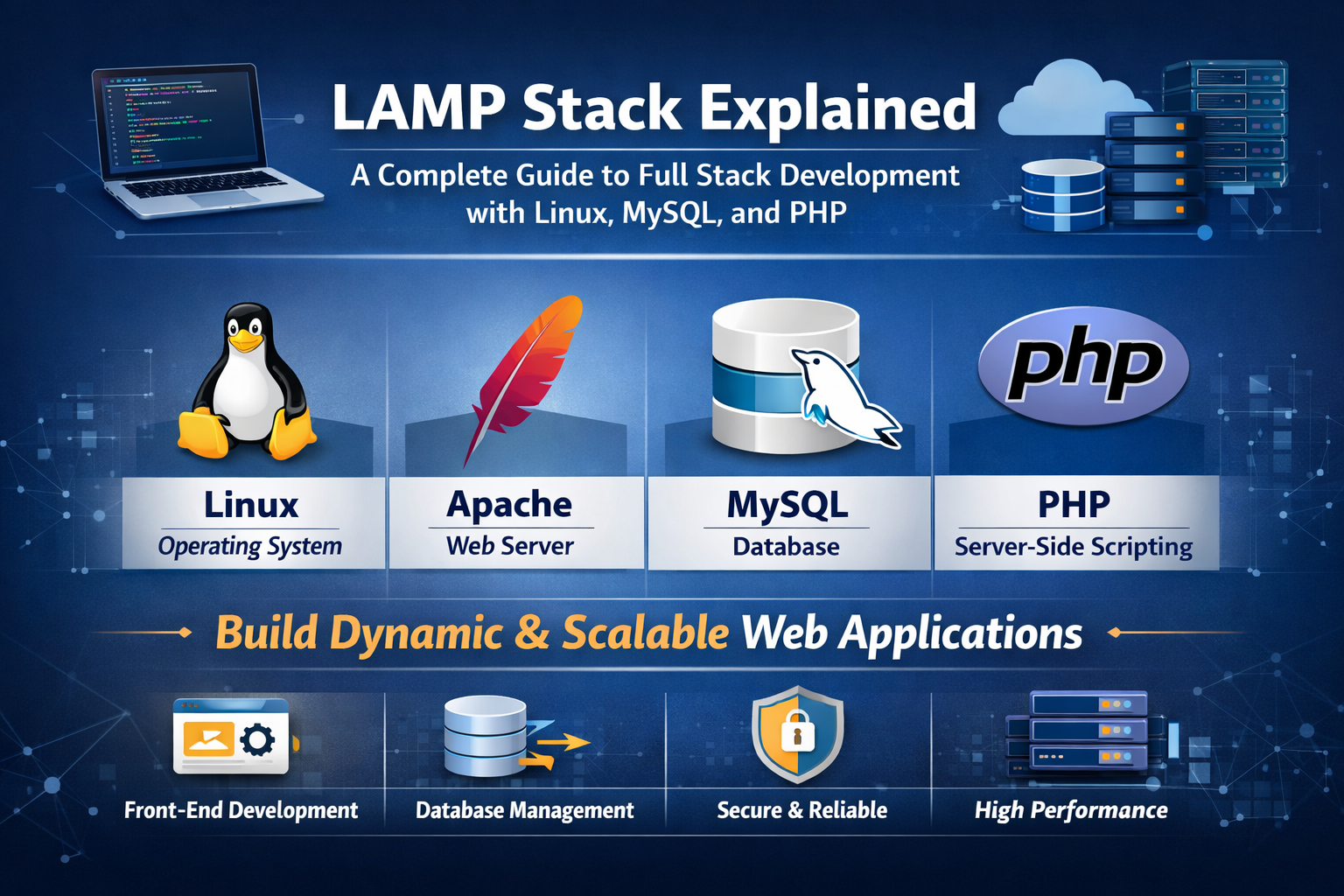
The LAMP Stack is a
popular open-source technology stack used for full stack web development. LAMP
stands for:
·
Linux – Operating System
·
Apache – Web Server
·
MySQL – Database
·
PHP – Server-side scripting language
Originally introduced
in the late 1990s, the LAMP stack quickly became the backbone of dynamic
websites. Its stability, flexibility, cost-effectiveness, and large community
support make it a preferred choice even today.
Components of the
LAMP Stack:
Linux- The operating system:
Linux serves as the
foundation of the LAMP stack.
Why Linux is used in web serves:
·
Open-source and free
·
Highly secure and stable
·
Excellent server performance
Common Linux distributions for LAMP:
- Ubuntu
- CentOS
- Debian
Linux offers strong
permission control, process management, and scalability, making it ideal
for both startups and enterprises.
Apache- the web server:
Apache HTTP Server handles incoming HTTP requests from users’
browsers.
Key roles of Apache:
- Serves static files (HTML, CSS,
images) - Processes dynamic PHP content
- Manages virtual hosting and modules
Apache is known for its
flexibility, module-based architecture, and reliability, making it one
of the most widely used web servers globally.
MySQL – The Database:
MySQL is a relational database management system used to
store and manage structured data.
Purpose of MySQL in
LAMP:
- Stores application data securely
- Supports fast data retrieval
- Works seamlessly with PHP
Basic concepts include:
- Tables
- Queries (SELECT, INSERT, UPDATE)
- Relationships
MySQL is ideal for
applications that require speed, consistency, and scalability.
PHP – The Server-Side
Language:
PHP (Hypertext
Preprocessor) is the scripting
language that powers the back-end logic.
What PHP does:
- Handles form submissions
- Interacts with MySQL databases
- Generates dynamic web pages
PHP works closely with
Apache and MySQL and supports powerful frameworks like:
- Laravel
- CodeIgniter
These frameworks help
developers build secure, scalable, and maintainable applications faster.
How the LAMP stack works
together:
In a LAMP application:
1. A user sends a request via a browser
2. Apache receives the request
3. PHP processes the logic
4. MySQL fetches or stores data
5. The response is sent back to the browser
This smooth request–response
flow enables dynamic, data-driven websites.
Front-end development in LAMP Applications:
The front-end uses:
- HTML for structure
- CSS for styling
- JavaScript for interactivity
These technologies
integrate with PHP to display dynamic data. Developers often use libraries like
Bootstrap, jQuery, and modern JS frameworks to improve UI and uSetting
Up a LAMP Development Environment
System requirements:
- Linux OS
- Minimum 2GB RAM
- Basic terminal knowledge
Installation steps:
- Install Linux
- Set up Apache
- Install MySQL
- Configure PHP
Local tools like XAMPP,
LAMP on Ubuntu, or Docker simplify development and testing.
Building a Simple LAMP Stack
Application:
A basic LAMP project
includes:
- Creating a MySQL database
- Connecting PHP to MySQL
- Writing PHP scripts for CRUD
operations - Displaying dynamic data on web
pages
This hands-on approach
helps beginners understand full stack application flow.
Security Best Practices
in LAMP Stack:
Security is crucial in
web development.
Best practices include:
- Securing Linux servers with
firewalls - Apache security configurations
- Preventing SQL injection using
prepared statements - Protecting against XSS attacks
- Limiting database access privileges
Performance Optimization
and Scalability:
To optimize LAMP
performance:
- Use caching (OPcache, Redis)
- Optimize MySQL queries
- Enable Apache and PHP performance
tuning
For scalability, LAMP
applications can be deployed with load balancers, cloud servers, and
containerization tools.
Advantages and Limitations of
the LAMP Stack:
Advantages
- Open-source and cost-effective
- Large community support
- Easy to learn and deploy
- Proven reliability
Limitations
- Not ideal for real-time
applications - Can require tuning for high traffic
LAMP is best suited for
content-driven, database-backed web applications.
Career Opportunities in LAMP Full Stack
Development:
Skills required:
- Linux server management
- PHP and MySQL
- Front-end technologies
Job roles include:
- Full Stack Developer
- PHP Developer
- Web Application Developer
With consistent demand,
LAMP offers a strong career path for beginners and professionals.
Conclusion:
The LAMP Stack
remains a powerful and relevant choice for full stack development. Its
open-source nature, scalability, and simplicity make it ideal for learning and
production use.
For beginners,
mastering LAMP builds a strong foundation in web development, databases, and
server-side programming. The next step is hands-on practice, real-world
projects, and continuous learning.