Introduction:
In today’s competitive
job market, understanding the HR salary
structure is essential for both employees and employers. Compensation is
not just about the monthly paycheck—it directly influences employee motivation,
job satisfaction, retention, and overall performance.
For HR professionals,
having clarity about fixed pay,
variable pay, and employee benefits is crucial because HR plays a dual
role: managing their own compensation expectations while also designing salary
structures for the entire organization.
A well-designed HR
salary structure ensures fairness, compliance with labor laws, and alignment
with business goals. This blog explains the complete HR salary structure,
including fixed pay, variable pay, statutory benefits, and future compensation
trends, in a clear and practical manner.
What Is an HR
Salary Structure?
An HR salary
structure refers to the organized breakdown of compensation paid to HR
professionals. It defines how much an employee earns, how it is paid, and what
additional benefits are included.
Components of Cost to
Company (CTC)
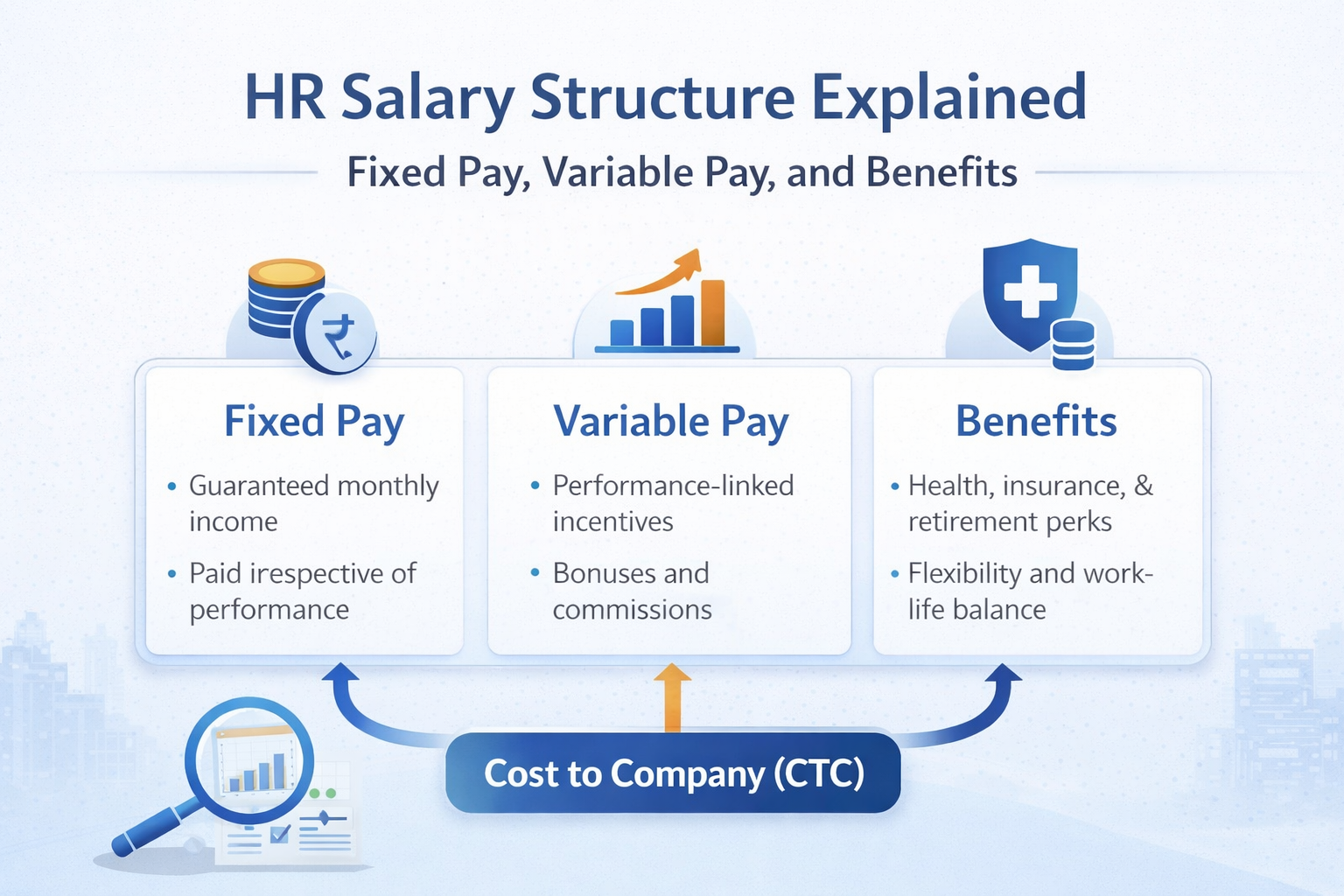
CTC (Cost to Company)
is the total amount an employer spends on an employee annually. It includes:
- Fixed pay
- Variable pay
- Statutory benefits
- Non-statutory benefits
Difference Between
Gross Salary, Net Salary, and CTC
- CTC: Total cost incurred by the
employer - Gross Salary: Salary before deductions like PF
and tax - Net Salary (Take-Home Pay): Amount received after deductions
Understanding these
differences helps HR professionals communicate compensation clearly and avoid
misunderstandings.
Fixed Pay: The Stable Component of HR
Compensation:
3.1 What Is Fixed Pay?
Fixed pay is the guaranteed portion of salary paid monthly,
regardless of performance. It provides income stability and forms the
foundation of the HR salary structure.
3.2 Common Components
of Fixed Pay
1. Basic Salary
o Core component of salary
o Basis for PF, gratuity, and other benefits
2. House Rent Allowance (HRA)
o Provided to meet rental expenses
o Tax benefits available under the Income Tax Act
3. Dearness Allowance (DA)
o Adjusts salary for inflation
o Common in government and PSU roles
4. Special Allowance
o Flexible component to balance salary structure
5. Conveyance Allowance
o Supports daily commuting expenses
3.3 Importance of Fixed
Pay in HR Roles
Fixed pay ensures:
- Financial stability
- Compliance with labor laws
- Predictable statutory deductions
- Employee trust and security
For HR professionals,
stable fixed pay is essential since their role involves long-term
organizational planning.
Variable Pay:
Performance-Linked Earnings:
4.1 What Is Variable
Pay?
Variable pay is linked to individual, team, or company
performance. It may be paid monthly, quarterly, or annually and is designed to
reward results.
4.2 Types of Variable
Pay in HR
1. Performance Bonus
o Based on annual or quarterly appraisals
2. Recruitment Incentives
o Linked to hiring targets and closures
3. Retention or Engagement Incentives
o Focused on reducing attrition
4. Profit-Sharing Bonuses
o Paid when the organization performs well
4.3 Advantages and
Challenges of Variable Pay
Advantages
- Boosts motivation
- Encourages productivity
- Aligns employee goals with business
objectives
Challenges
- Income uncertainty
- Difficult performance measurement
- Risk of bias if criteria are
unclear
A transparent variable
pay system is critical for its success.
Employee Benefits: Beyond Cash Compensation:
5.1 Statutory Benefits
These benefits are
legally mandated in India:
- Provident Fund (PF)
- Employee State Insurance (ESI)
- Gratuity
- Bonus (as per applicable laws)
Compliance with
statutory benefits protects both employer and employee.
5.2 Non-Statutory
Benefits
These benefits improve
employee experience:
- Health and life insurance
- Paid leave and holidays
- Learning and development programs
- Flexible work options and remote
work
Modern HR salary
structures focus heavily on these benefits to enhance retention.
Typical HR Salary Structure by
Role & Experience:
HR Fresher / Executive
- Higher fixed pay ratio
- Limited variable pay
- Focus on learning benefits
HR Generalist /
Recruiter
- Moderate variable pay
- Hiring-based incentives
- Performance-linked bonuses
HR Manager
- Balanced fixed and variable pay
- Leadership and retention incentives
- Enhanced benefits
Senior HR / HR Head
- Strategic variable pay
- Profit-sharing and long-term
incentives - Comprehensive benefits package
Factors Affecting HR
Salary Structure:
Several factors
influence HR compensation:
- Experience and qualifications
- Industry and company size
- Location (metro vs non-metro)
- Skills like HR analytics, HR tech,
labor law compliance
Professionals with
specialized HR skills often command higher salaries.
Designing a Balanced HR
Salary Structure:
An effective HR salary
structure should focus on:
- Internal equity: Fair pay across roles
- External equity: Market competitiveness
- Legal compliance: Adherence to labor laws
- Business alignment: Supporting company goals
Benchmarking and salary
surveys play a key role in achieving balance.
Common Mistakes in HR
Salary Structuring:
- Overloading fixed pay, reducing
flexibility - Unclear variable pay criteria
- Ignoring statutory compliance
- Lack of transparency in CTC
communication
Avoiding these mistakes
builds trust and reduces attrition.
Future Trends in
HR Compensation:
The future of HR salary
structures includes:
- Pay-for-performance models
- Skill-based and role-based pay
- AI-driven compensation planning
- Flexible benefits and total rewards
approach
HR professionals must
stay updated to remain relevant in 2026 and beyond.
Conclusion:
A well-designed HR
salary structure balances fixed pay, variable pay, and benefits
while ensuring fairness, transparency, and legal compliance.
For HR professionals
and employers, clarity in compensation builds trust, improves performance, and
supports long-term organizational growth. By adopting modern compensation
practices and focusing on total rewards, organizations can attract, retain, and
motivate top HR talent effectively.