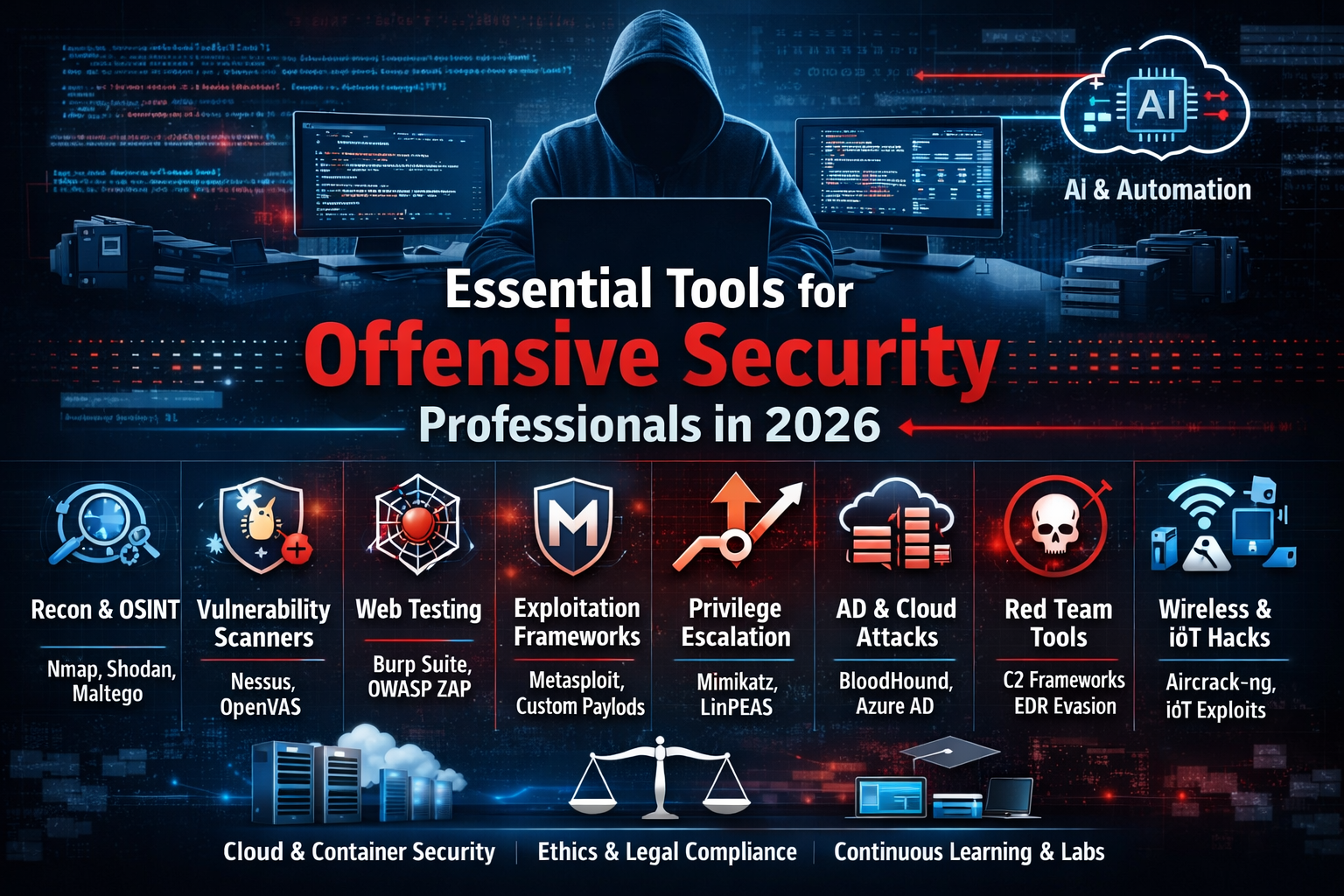
Introduction: why tools matter in offensive security
Offensive security has
evolved rapidly over the last decade, and by 2026, the landscape is more
complex, automated, and cloud-driven than ever before. Offensive security professionals—ethical
hackers, penetration testers, and red teamers—rely heavily on specialized tools
to identify vulnerabilities, simulate real-world attacks, and strengthen
organizational defenses.
Tools act as force
multipliers. They speed up reconnaissance, automate repetitive tasks, uncover
hidden attack paths, and help professionals think like adversaries. However,
tools alone are not enough. The true power lies in combining strong
foundational skills with the right tooling. In 2026, offensive security tools
are increasingly AI-assisted, cloud-native, and focused on stealth and realism,
making it essential for professionals to stay updated.
This blog explores the essential
tools for offensive security professionals in 2026, covering
reconnaissance, exploitation, red teaming, cloud security, automation, and
ethical considerations—while emphasizing mastery over blind tool usage.
The Modern Offensive Security
Toolkit in 2026
Evolution of Offensive
Security Tools
The modern offensive
security toolkit reflects current attack surfaces. Organizations now operate
across cloud platforms, APIs, containers, identity systems, mobile apps, and
IoT devices. As a result, tools in 2026 focus on:
- Automation and AI-assisted testing
- Cloud and identity-based attack
vectors - Stealth, evasion, and
living-off-the-land techniques - Integration and collaboration
Open-Source vs
Commercial Tools
Open-source tools like
Nmap, Metasploit, OWASP ZAP, and BloodHound remain foundational due to
transparency and flexibility. Commercial tools such as Burp Suite Pro, Nessus,
and enterprise C2 frameworks offer advanced features, scalability, and
professional support. A balanced toolkit usually includes both.
Legal and Ethical Disclaimer:
All tools discussed here must be used only with proper authorization.
Unauthorized usage is illegal and unethical. Offensive security exists to
improve security, not exploit it.
Reconnaissance &
Information Gathering Tools
Reconnaissance is the
backbone of any offensive operation. The better the recon, the higher the
success rate.
Network & Host
Discovery
Nmap
Nmap remains a cornerstone in 2026. Its advanced Nmap Scripting Engine (NSE)
allows automated service detection, vulnerability checks, and enumeration.
Skilled professionals customize NSE scripts to extract maximum intelligence.
Masscan
For large-scale environments, Masscan offers ultra-fast scanning
capabilities. It is especially useful for internet-wide scans or massive
enterprise networks when speed is critical.
OSINT & Passive
Recon Tools
Maltego
Maltego excels in visualizing relationships between domains, IPs, people, and
organizations. It is invaluable for OSINT-driven reconnaissance and social
engineering simulations.
Amass
Amass remains one of the best tools for subdomain enumeration,
especially useful for discovering shadow IT, forgotten assets, and cloud-hosted
services.
Shodan
Shodan acts as a search engine for exposed services. Offensive security
professionals use it to identify misconfigured servers, open ports, and
vulnerable technologies without active scanning.
Vulnerability Scanning
& Analysis Tools
Automated Vulnerability
Scanners
Nessus, OpenVAS, and
Nexpose
These scanners automate the detection of known vulnerabilities across systems
and applications. In 2026, they integrate threat intelligence and cloud
support, making them more accurate than ever.
Strengths and
Limitations
Automation saves time but often produces false positives and misses business
logic flaws. Skilled professionals validate findings manually and chain
vulnerabilities creatively.
Cloud & Container
Security Scanners
Cloud security is no
longer optional.
- Tools for AWS, Azure, and GCP
identify misconfigurations, overly permissive IAM roles, and exposed
storage. - Kubernetes and container image
scanners detect vulnerable
dependencies, insecure configurations, and secrets leakage.
Cloud-focused offensive
testing is one of the fastest-growing skill areas in 2026.
Web Application
Offensive Security Tools
Intercepting Proxies
Burp Suite (Community
& Pro)
Burp Suite remains the gold standard for web application testing. Features like
Repeater, Intruder, and Scanner (Pro) help identify complex vulnerabilities in
modern web apps and APIs.
OWASP ZAP
OWASP ZAP is a powerful open-source alternative, ideal for beginners and
automation pipelines.
Web Exploitation &
Fuzzing
Tools like ffuf,
Gobuster, and Dirsearch help discover hidden directories, endpoints, and
parameters.
API Security Testing Tools
With APIs dominating modern architectures, specialized tools help test
authentication, authorization, and input validation issues in REST and GraphQL
APIs.
Exploitation Frameworks
& Payload Development
Metasploit Framework
(2026 Use Cases)
Metasploit remains relevant for exploit development, payload delivery, and
post-exploitation automation. In 2026, it is often used in controlled
simulations and training labs.
Custom Exploit
Development
Advanced professionals develop custom exploits using Python, Go, and Rust,
allowing flexibility, speed, and evasion.
Payload Obfuscation
& Evasion Basics
Modern EDR solutions require payloads to be stealthy. Simple obfuscation
techniques and behavioral evasion are now core skills.
Post-Exploitation &
Privilege Escalation Tools
Mimikatz
Still widely discussed, Mimikatz demonstrates credential harvesting techniques.
In real-world environments, its concepts matter more than the tool itself.
LinPEAS & WinPEAS
These automated scripts help identify privilege escalation vectors on Linux and
Windows systems.
Living-Off-the-Land
Binaries (LOLBins)
Using native system tools to avoid detection is a major red team technique in
2026.
Active Directory &
Identity Attack Tools
BloodHound
BloodHound visualizes Active Directory attack paths, making it one of the most
powerful tools for enterprise environments.
Kerberoasting &
NTLM Relay Tools
These tools exploit weaknesses in authentication mechanisms when
misconfigurations exist.
Cloud Identity Attacks
Attacking Azure AD and IAM misconfigurations is now a standard part of
offensive assessments.
Red Teaming &
Evasion Tools
Command-and-Control
(C2) Frameworks
Modern C2 frameworks focus on stealth, encryption, and realism rather than
brute-force exploitation.
Bypassing EDR and AV
(High-Level)
In 2026, bypassing defenses requires understanding detection logic rather than
relying on single tools.
Adversary Simulation
Platforms
These platforms help organizations test defenses against realistic threat
scenarios.
Wireless, IoT &
Mobile Offensive Tools
Wi-Fi Tools
(Aircrack-ng Suite)
Wireless attacks remain relevant, especially in corporate and public networks.
IoT Firmware Analysis
Tools
Extracting and analyzing firmware reveals hardcoded credentials and insecure
services.
Mobile App Testing
Tools
Android and iOS testing tools help identify insecure storage, weak encryption,
and API flaws.
AI & Automation in Offensive
Security (2026 Trends)
AI plays a growing role
in:
- AI-assisted reconnaissance
- Automated vulnerability discovery
- Attack path optimization
However, ethical
safeguards are critical to prevent misuse and over-reliance on automation.
Collaboration, Reporting &
Documentation Tools
Professional offensive
security requires clear communication.
- Secure note-taking and evidence
collection - Automated report generation
- Collaboration tools for red team
coordination
Well-written reports
often matter more than the attack itself.
Choosing the Right Tools as an Offensive
Security Professional
- Beginners should focus on core tools like
Nmap, Burp Suite, and Metasploit. - Advanced professionals customize toolchains and write
their own tools. - Certification-aligned learning (OSCP, CRTO, PNPT) helps guide
tool selection. - Continuous practice in labs and
simulations is essential.
Legal, Ethical &
Compliance Considerations
Offensive security in
2026 demands strict adherence to:
- Defined scope and authorization
- Proper documentation
- Responsible disclosure
- Compliance with laws and standards
Ethics separate
professionals from attackers.
Conclusion: Mastery Over Tools, Not
Just Tools
Tools enable attacks,
but skills define success. The best offensive security professionals
understand systems deeply, think creatively, and use tools as extensions of
their knowledge. Continuous learning, hands-on labs, and real-world simulations
are the keys to staying relevant.
As offensive security evolves,
those who focus on mastery, ethics, and adaptability will shape the
future of cybersecurity in 2026 and beyond.