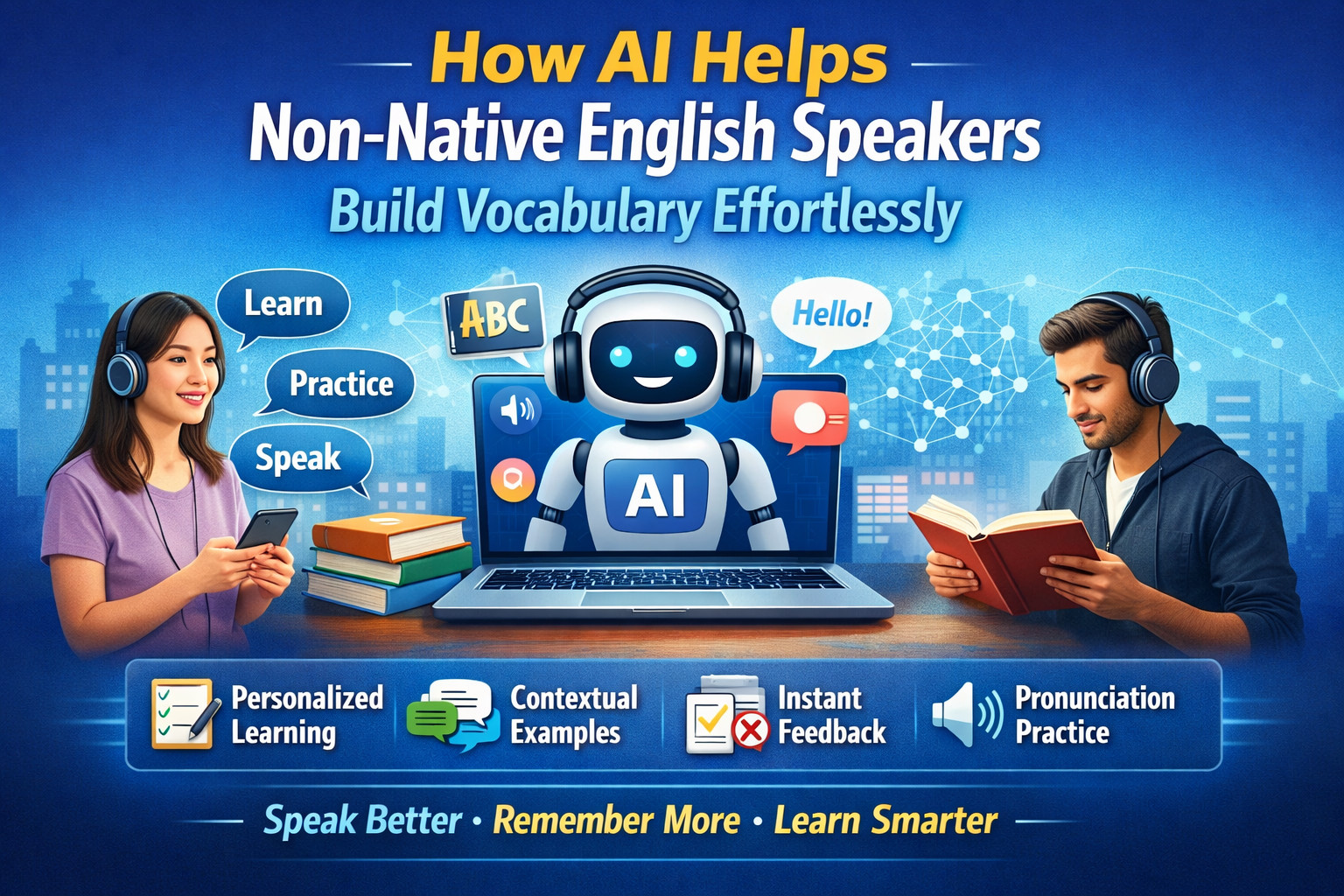
Learning English
vocabulary is one of the biggest challenges for non-native English speakers.
Even after years of study, many learners struggle to remember words, use them
correctly, or speak confidently. Traditional methods like rote memorization and
long word lists often fail to deliver real results.
Today, Artificial
Intelligence (AI) is transforming the way people learn languages. With
personalized learning, instant feedback, and real-life context, AI makes
vocabulary building easier, faster, and more effective than ever before.
In this article, we
will explore how AI helps non-native English speakers build vocabulary
effortlessly, the tools involved, best practices, and the future of
AI-powered language learning.
Introduction:
Challenges Non-Native
English Speakers Face in Vocabulary Building
Non-native learners
often face problems such as forgetting words quickly, misunderstanding
meanings, and lacking confidence while speaking. Vocabulary learning becomes
stressful instead of enjoyable.
Why Traditional
Memorization Methods Fail
Memorizing word lists
without context does not activate long-term memory. Learners may recognize
words in exams but fail to use them in conversations.
How AI Is Changing
Language Learning
AI introduces smart,
adaptive, and personalized learning methods that adjust according to the
learner’s needs, level, and goals.
What This Article
Covers
This blog explains why
vocabulary learning is difficult, how AI-powered vocabulary learning works, its
benefits, tools, best practices, and future trends.
Why Vocabulary Is
Difficult for Non-Native English Speakers
Limited Exposure to
Real-Life English Usage
Many learners study English
in classrooms but rarely hear or use it in daily life. This limits practical
vocabulary development.
Confusion Between
Similar Words and Meanings
Words like say/tell,
affect/effect, or big/large often confuse learners because
traditional methods don’t explain usage clearly.
Difficulty with
Pronunciation and Context
Knowing a word’s
meaning is not enough. Learners struggle with pronunciation, sentence
placement, and tone.
Forgetting New Words
Due to Lack of Practice
Without revision and
real usage, the brain quickly forgets new vocabulary.
What Is AI-Powered Vocabulary
Learning?
Simple Explanation of
AI in Language Learning
AI uses computer
systems that learn from user behavior and improve learning experiences
automatically.
Role of NLP (Natural
Language Processing)
NLP helps AI understand
human language, meaning, grammar, pronunciation, and context.
How Machine Learning
Personalizes Vocabulary Practice
AI analyzes learner
mistakes, strengths, and progress to suggest the right words at the right time.
AI-Based vs Rule-Based
Learning Apps
Traditional apps follow
fixed rules, while AI-powered apps adapt dynamically to individual learners.
Key Ways AI Helps Build Vocabulary
Effortlessly
4.1 Personalized
Vocabulary Learning
AI customizes learning
based on the learner’s level and goals.
- Adjusts word difficulty
automatically - Creates customized word lists for
spoken English, exams, or workplace communication - Allows beginners and advanced
learners to progress at their own pace
This personalization
removes pressure and makes learning comfortable.
4.2 Context-Based Word
Learning
AI focuses on learning
words in context, not isolation.
- Words are taught through sentences,
dialogues, and stories - Real-life usage replaces
dictionary-style definitions - AI generates examples based on
learner interest
This improves
understanding and recall.
4.3 Instant Feedback
and Error Correction
One of AI’s biggest
advantages is real-time feedback.
- Corrects spelling, grammar, and
word usage instantly - Suggests better words based on
context - Builds confidence by reducing fear
of mistakes
Immediate correction
accelerates learning.
4.4 Pronunciation and
Accent Support
AI-powered speech
recognition improves speaking skills.
- Learners practice pronunciation
with instant evaluation - Accent-neutralization guidance
improves clarity - Audio-visual models demonstrate
correct sounds
This is extremely
helpful for non-native speakers.
4.5 Spaced Repetition
and Smart Revision
AI uses memory science
to improve retention.
- Identifies when a learner is likely
to forget a word - Schedules smart revision cycles
- Ensures long-term vocabulary
retention
This removes the need
for manual revision planning.
AI Tools and Apps for Vocabulary
Building
Popular AI-Powered
Vocabulary Apps
Many modern language
apps use AI features such as adaptive learning, speech recognition, and smart
revision. (Examples can be explored without promotion.)
Features to Look for in
a Good AI Vocabulary App
- Personalized learning paths
- Context-based examples
- Pronunciation practice
- Progress tracking
Mobile vs Desktop
Learning Advantages
Mobile apps support
daily practice, while desktop platforms are better for detailed learning and
writing.
AI
for Different Learning Goals
Spoken English
Improvement
AI chatbots and
conversation simulators help learners practice real-life speaking.
Academic and Exam
Vocabulary (IELTS, TOEFL, GRE)
AI identifies
exam-focused vocabulary and provides targeted practice.
Workplace and
Professional Communication
AI suggests formal,
polite, and professional vocabulary for emails and meetings.
Daily Conversational
English
AI helps learners use
natural, everyday expressions instead of textbook English.
AI vs Traditional Vocabulary Learning
Methods
Flashcards vs AI-Driven
Learning
Flashcards are static,
while AI adapts content dynamically.
Classroom Learning vs
AI Practice
Classrooms offer
structure, but AI provides unlimited personalized practice.
Time Efficiency and
Effectiveness
AI reduces learning
time while improving retention and confidence.
Common Mistakes Learners Make While Using AI
Tools
- Over-reliance on apps without
real-life usage - Skipping speaking practice
- Ignoring AI feedback
- Using too many apps at once
Avoiding these mistakes
improves results significantly.
Best Practices to Maximize Vocabulary Growth
with AI
- Combine AI learning with real
conversations - Set daily vocabulary goals
- Actively review AI feedback
- Track progress weekly
Consistency is the key
to effortless vocabulary growth.
Future of AI in Vocabulary
Learning
AI-Powered Tutors and
Conversational Agents
AI tutors will offer
human-like conversations and guidance.
Emotion-Aware and
Voice-Based Learning
Future AI will adjust
teaching based on learner emotions and confidence levels.
Role of AI in Global
Language Education
AI will make quality
English education accessible worldwide.
Conclusion
AI has completely
transformed vocabulary learning for non-native English speakers. With
personalized lessons, context-based learning, pronunciation support, and smart
revision, AI makes vocabulary building effortless and effective.
By adopting AI-assisted
learning wisely and combining it with real-life practice, learners can gain
confidence, fluency, and long-term vocabulary mastery.
Final Takeaway:
AI doesn’t replace learning—it enhances it. Used correctly, AI is the
smartest companion for mastering English vocabulary naturally and confidently.