Learning a new language
is an exciting journey, and French is often one of the most popular choices
among learners worldwide. Known as the language of love, diplomacy,
fashion, and culture, French opens doors to global opportunities in education,
careers, and travel.
But one question almost
every learner asks before starting is:
How much time does it
really take to learn French?
The honest answer is: it
depends. Learning French is not a one-size-fits-all process. It varies
based on your goals, learning method, consistency, and background. In this
blog, we’ll provide a realistic, level-by-level breakdown of how long it
takes to learn French, along with practical tips to speed up your progress.
Why Learning French Is
Worth Your Time
Before discussing
timelines, let’s understand why French is such a valuable language to learn.
French is spoken by
more than 300 million people across over 29 countries, making it
one of the most widely used languages in the world. It is an official language
of international organizations such as the United Nations, European Union,
UNESCO, and the International Olympic Committee.
France and other
French-speaking countries offer excellent opportunities in education,
tourism, fashion, hospitality, aviation, diplomacy, and international business.
Learning French not only improves communication skills but also enhances
cultural understanding and global employability.
Whether you are
learning French for higher studies, career advancement, travel, or personal
growth, the time invested brings long-term rewards.
What Does “Learning
French” Actually Mean?
Many people believe
learning French means speaking like a native speaker. In reality, language
learning happens in clearly defined stages. Your learning duration
depends on the level you aim to achieve.
Language proficiency is
commonly measured using the CEFR (Common European Framework of Reference for
Languages), which includes the following levels:
- A1 – Beginner
- A2 – Elementary
- B1 – Intermediate
- B2 – Upper-Intermediate
- C1 – Advanced
- C2 – Near-Native
Each level represents a
different level of fluency and communication ability.
Beginner Level (A1): 2
to 3 Months:
At the A1 level,
learners become familiar with the basics of the French language.
What You Can Do at A1:
- Introduce yourself and others
- Use basic greetings and everyday
expressions - Ask and answer simple questions
- Understand short sentences and
familiar words
Time Required:
⏳ 60 to 100 hours of
study
With 30 to 45
minutes of daily practice, most learners can reach A1 within 2 to 3
months.
French is considered
relatively easy for English speakers because many words are similar, which
helps beginners build confidence quickly.
Elementary Level (A2):
4 to 6 Months Total:
At the A2 level,
learners start communicating more naturally in everyday situations.
What You Can Do at A2:
- Talk about daily routines, hobbies,
and family - Understand basic spoken French
- Read short texts and simple
articles - Handle basic conversations while
traveling
Time Required:
⏳ 150 to 200 total
hours
From absolute beginner
to A2, it usually takes 4 to 6 months with regular practice. This level
marks the transition from memorizing phrases to actually using the language.
Intermediate Level
(B1): 8 to 12 Months:
The B1 level is a major
milestone in learning French.
What You Can Do at B1:
- Participate in conversations with
confidence - Express opinions and explain
experiences - Understand movies and podcasts with
subtitles - Manage real-life situations
independently
Time Required:
⏳ 350 to 400 total
study hours
Most learners achieve
B1 within 8 to 12 months. At this stage, French becomes functional
rather than theoretical. Many universities and employers consider B1 as a
minimum working proficiency.
Upper-Intermediate
Level (B2): 1.5 to 2 Years:
At the B2 level,
learners can use French professionally and academically.
What You Can Do at B2:
- Speak fluently with fewer pauses
- Understand news, debates, and
documentaries - Write structured essays, reports,
and emails - Study or work in a French-speaking
environment
Time Required:
⏳ 500 to 650 total
hours
Reaching B2 usually
takes 18 to 24 months. This level is often required for studying abroad
in France or Canada and for many professional roles.
Advanced Level (C1 and
C2): 2.5 to 4 Years:
Advanced levels focus
on mastery and precision.
What You Can Do at
Advanced Levels:
- Understand complex and abstract
topics - Speak almost like a native speaker
- Use idiomatic expressions naturally
- Read academic and professional
materials
Time Required:
⏳ 800 to 1,000+
hours
These levels require
long-term dedication, immersion, and consistent exposure to French in real-life
contexts.
Factors That Affect How
Fast You Learn French:
Several factors
influence your learning speed:
- Native language background
- Quality of learning resources
- Consistency and daily practice
- Speaking and listening exposure
- Guidance from trained instructors
Learners who practice
speaking regularly progress much faster than those who only study grammar.
Can You Learn French
Faster?
Yes, with the right
approach.
Effective Strategies:
- Speak from the beginning
- Learn commonly used phrases
- Practice listening daily
- Combine all four skills: reading,
writing, listening, and speaking - Follow a structured learning plan
With focused effort,
learners can reach B1 in under 9 months.
Final Verdict: How Long
Does It Really Take to Learn French?
Here’s a realistic
summary:
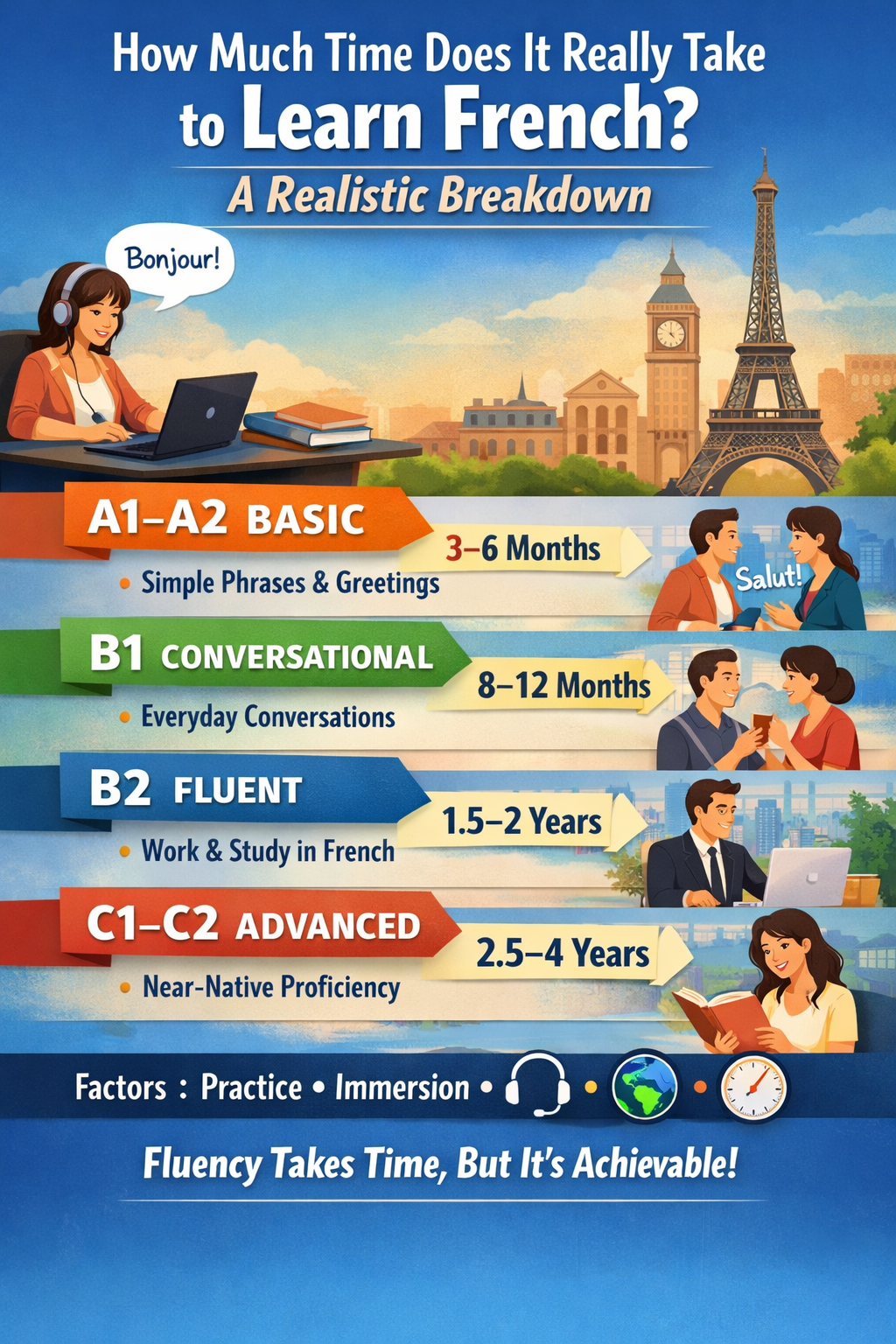
- Basic French (A1–A2): 3 to 6 months
- Conversational French (B1): 8 to 12 months
- Professional Fluency (B2): 1.5 to 2 years
- Advanced Mastery (C1–C2): 2.5 to 4 years
Learning French is a
gradual process, but with consistency and the right guidance, fluency is
achievable.
Start Your French
Learning Journey with Skill Excellent:
At Skill Excellent,
French learning is designed to be practical, structured, and result-oriented.
With expert mentors, interactive sessions, and real-world speaking practice,
learners can achieve their goals efficiently and confidently.
Your French journey
doesn’t start someday — it starts today.