Introduction:
English can said to be
the most used languages in the world, and if you have master in it then it
opens doors to global communication, education and career growth. However many
learners struggle because they clearly do not understand the difference between
spoken English and written English. Most of the people often assume that they
both are same which leads to confusion, mistakes and lack of confidence.
Understanding the
difference between spoken and written English matters because both serve
different purposes and follow different rules. Using written-style English
while speaking can make conversations sound robotic or unnatural. On the other
hand, writing exactly the way we speak can make emails, exams, or reports look
unprofessional.
This blog is specially
going to be useful for students, professionals, job seekers and English
learners who want to communicate effectively in real-life situations. By the
end of this blog, you will clearly understand how spoken English and written English
differ, when to use each, and how to improve both skills.
What is spoken
English?
Definition and purpose:
Spoken English refers
to the use of English in verbal communication. It is the form of English we use
while talking to people in real time. The main purpose of spoken English is
effective communication, not perfection.
Where spoken English is used?
Spoken English is used
in:
·
Daily conversations
·
Phone calls
·
Presentations and
group discussions
·
Interviews
Focus on spoken English:
Spoken English focuses
on:
- Fluency (speaking smoothly)
- Clarity (being understood)
- Confidence (speaking without fear)
Minor grammar mistakes
are usually acceptable as long as the message is clear.
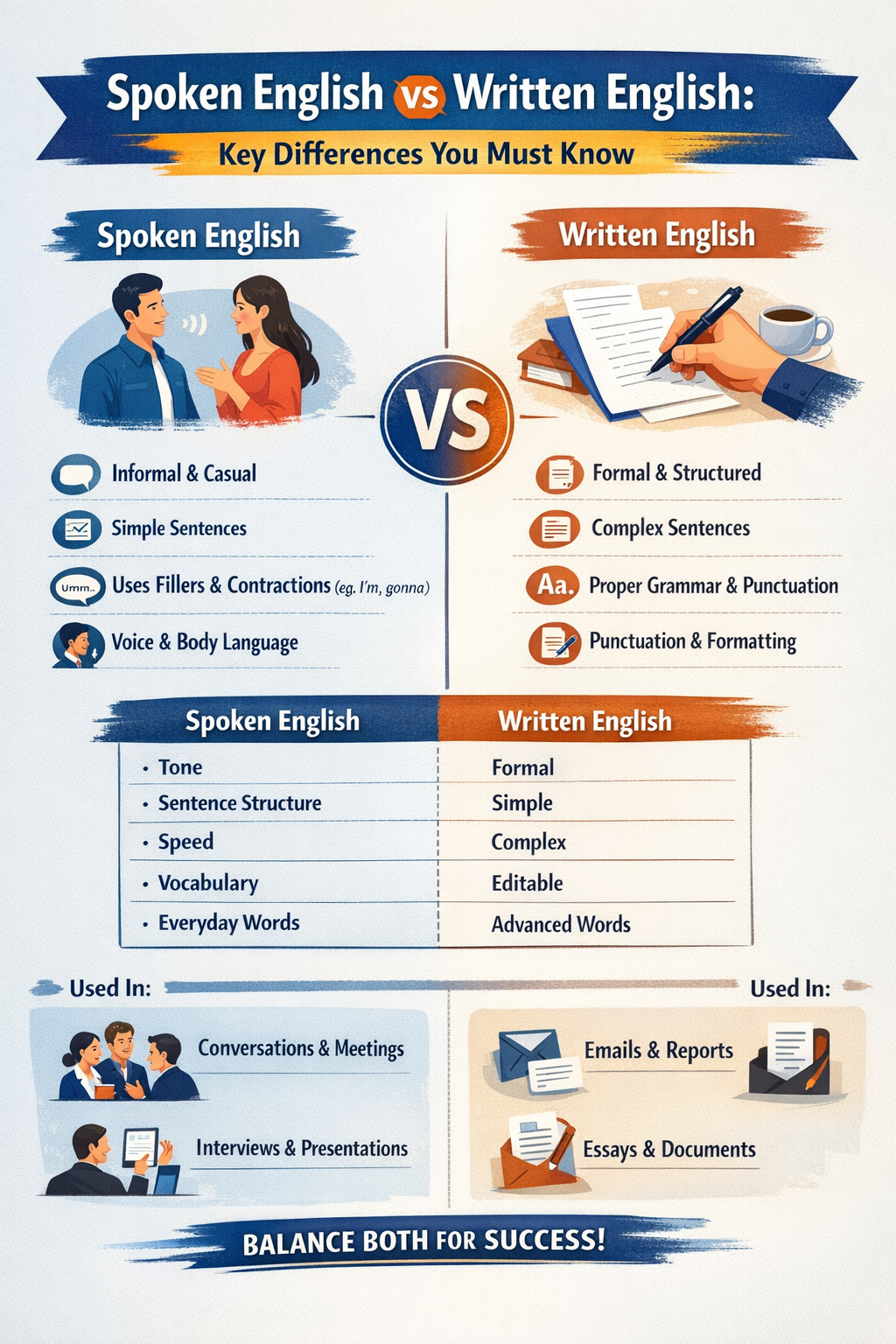
Key Characteristics of spoken English:
- Informal tone: Spoken English is generally
relaxed and conversational. - Short sentences: People often speak in fragments
rather than full sentences. - Use of pauses, fillers, and
contractions: Words
like um, uh, you know, I’m, don’t, can’t are common. - Body language and pronunciation
matter: Facial
expressions, gestures, tone, and stress play an important role.
Example:
“I’ll call you later,
okay?”
What is
written English?
Definition and Purpose:
Written English refers to English used in text form. Its main
purpose is to communicate information clearly, accurately, and permanently.
Where Written English
Is Used:
Written English is used
in:
- Emails and official letters
- Reports and documents
- Exams and assignments
- Blogs, articles, and books
- Notices and instructions
Key Characteristics of
Written English:
- Formal or structured tone: Depending on the context, written
English follows a proper structure. - Grammatically accurate sentences: Grammar rules must be followed
strictly. - Proper punctuation and spelling: Errors can change meaning or
create confusion. - No use of fillers or body language: Everything must be expressed
through words alone.
Example:
“I will contact you
later today.”
Major Differences between Spoken and Written
English:
Below is a comparison
table highlighting the major differences:
Aspect | Spoken English | Written English |
Tone | Informal, | Formal or structured |
Sentence Structure | Simple, short, | Complete and complex |
Grammar Accuracy | Flexible | Strict |
Vocabulary | Everyday, casual | Precise, advanced |
Speed & | Immediate, cannot | Editable before final |
Support | Voice, tone, gestures | Punctuation, |
This table clearly
shows why spoken and written English should not be treated the same.
Examples: Spoken English vs Written English:
Spoken English Example:
“Hey, I’m running late
today. Traffic’s really bad.”
Written English
Example:
“I will be arriving
late today due to heavy traffic.”
Explanation of
Differences:
In spoken English:
- The tone is casual.
- Contractions like I’m are
used. - The sentence is short and informal.
In written English:
- The tone is professional.
- Full forms are preferred.
- The sentence is structured and
formal.
Common Mistakes Learners
Make:
Many English learners
make avoidable mistakes because they do not separate spoken and written styles.
Writing the Way They
Speak:
Using casual language,
short forms, and fillers in emails or exams makes writing look unprofessional.
Speaking Too Formally:
Some learners speak
like a textbook, which sounds unnatural and stiff in conversations.
Overusing Grammar Rules
While Speaking:
Thinking too much about
grammar while speaking reduces fluency and confidence.
Fear of Making Mistakes:
Fear stops learners
from speaking freely, which slows improvement.
When to Use Spoken English vs
Written English:
Use Spoken English
When:
- Attending interviews
- Giving presentations
- Participating in meetings
- Having workplace discussions
- Social conversations
Use Written English
When:
- Writing emails and reports
- Preparing official documents
- Appearing for exams
- Writing blogs, articles, or
applications
Knowing when to use
each form helps you communicate more effectively.
How to Improve both Spoken and
Written English:
Tips to Improve Spoken
English:
- Practice speaking daily, even for
10–15 minutes - Speak in front of a mirror
- Record yourself and listen
- Focus on fluency, not perfection
Tips to Improve Written
English:
- Read books, blogs, and newspapers
- Practice writing short paragraphs
daily - Learn basic grammar rules
- Review and edit your writing
Listening to Native
Speakers:
Watching English
movies, podcasts, and interviews helps improve pronunciation, vocabulary, and
sentence flow.
Join Structured English
Speaking Courses:
A guided course helps
learners practice both spoken and written English with expert feedback and
real-life situations.
Why
Spoken English Skills Are More Important Today:
In today’s competitive
world, spoken English plays a crucial role.
Job Interviews:
Good spoken English
creates a strong first impression.
Workplace Communication:
Clear speaking improves
teamwork, leadership, and professionalism.
Public Speaking and
Confidence:
Strong spoken English
boosts confidence and personality development.
Global Opportunities:
Spoken English helps in
international careers, networking, and global collaboration.
While written English
is essential, spoken English often determines real-world success.
Conclusion:
Spoken English and
written English are equally important but serve different purposes. Spoken
English focuses on communication, fluency, and confidence, while written
English emphasizes accuracy, structure, and clarity.
To become a strong
English communicator, you must balance both skills. Practice speaking without
fear, write with attention to grammar, and understand when to use each form.
With regular practice,
the right guidance, and consistent effort, you can master both spoken and
written English and use them confidently in every situation.