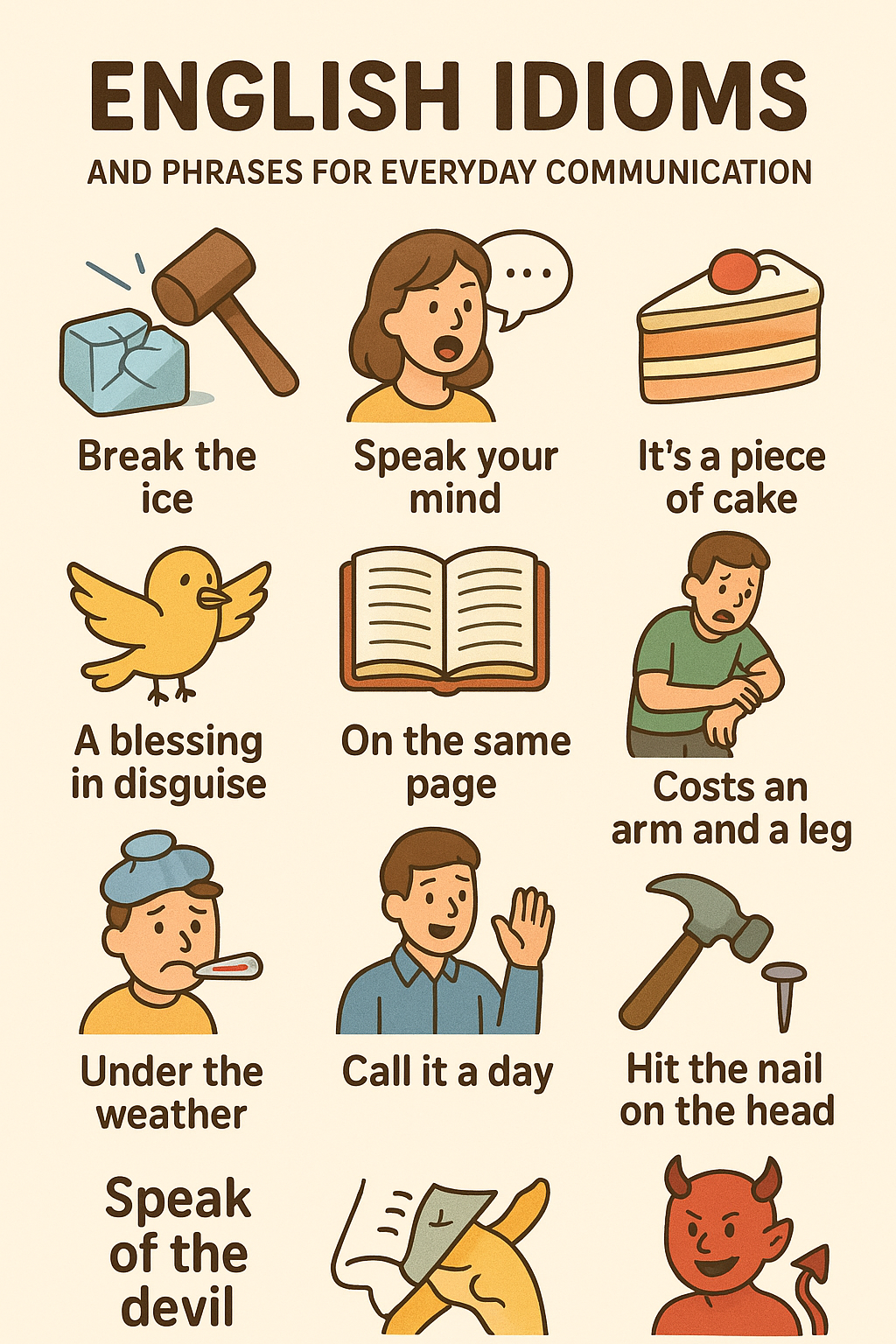
Introduction
English is one of the most widely spoken languages in the world, and learning it effectively requires more than just understanding grammar rules. To speak English fluently and confidently, learners must become familiar with English idioms and everyday phrases. These expressions are commonly used by native speakers in daily conversations, making them essential for real-life communication.
Many English learners struggle because idioms do not mean exactly what the words say. Phrases, on the other hand, are easier to understand but still very important for polite and natural conversations. Knowing when and how to use idioms and phrases can significantly improve your English skills.
What Are Idioms and Phrases?
An idiom is a fixed expression whose meaning is different from its literal meaning. Idioms are often cultural and cannot be translated word for word.
Example:
- “Kick the bucket” – means to die, not to kick a real bucket.
A phrase is a group of words that expresses a clear and direct meaning.
Example:
- “How are you?” – a simple greeting.
Why Idioms Are Important in Everyday English
Native English speakers use idioms naturally in conversations, movies, workplaces, and social media. If learners do not understand idioms, they may feel confused or lost during conversations. Learning idioms helps you understand spoken English better and express yourself more clearly.
Purpose of This Article
This article aims to help English learners understand the meaning, usage, and importance of idioms and phrases. It also provides practical examples and learning tips so learners can use them confidently in daily life.
Difference Between Idioms and Phrases
Understanding the difference between idioms and phrases is essential for correct usage.
What Is an Idiom?
Idioms are expressions with meanings that are not predictable from the words themselves. They often reflect cultural habits and everyday experiences.
Examples:
- “Once in a blue moon” – something that happens very rarely
- “Bite the bullet” – face a difficult situation bravely
What Is a Phrase?
A phrase is a combination of words that works together to convey a straightforward meaning. Phrases are commonly used in both formal and informal communication.
Examples:
- “I would like some water.”
- “Please help me.”
Simple Comparison Examples
Expression
Type
Meaning
Bite the bullet
Idiom
Face difficulty
Excuse me
Phrase
Polite request
Under the weather
Idiom
Feeling sick
I understand
Phrase
Showing clarity
Common English Idioms Used in Daily Life
Idioms are often connected to daily activities and emotions.
Idioms Related to Time
- In the nick of time – just before it is too late She arrived in the nick of time.
- Time flies – time passes very quickly Time flies when you are having fun.
- Behind schedule – late The project is behind schedule.
Idioms Related to Feelings and Emotions
- On cloud nine – extremely happy
- Down in the dumps – very sad
- Lose your temper – get angry
These idioms help express emotions more effectively.
Idioms Related to Work and Success
- Pull your socks up – improve your performance
- Get the ball rolling – start something
- Think outside the box – be creative
Everyday English Phrases for Daily Conversations
Phrases are essential for smooth and polite communication.
Polite English Phrases
- Thank you very much
- Could you please help me?
- I’m sorry
- May I come in?
Polite phrases show respect and professionalism.
Informal English Phrases
- What’s going on?
- Catch you later
- Take care
- No problem
These phrases are commonly used in friendly conversations.
Phrases for Agreement and Disagreement
- I completely agree
- That makes sense
- I don’t think so
- I respectfully disagree
How to Use Idioms and Phrases Correctly
Using idioms and phrases correctly is important for clear communication.
Choose the Right Situation
Idioms are usually informal. Avoid using them in official documents or academic writing unless appropriate.
Do Not Overuse Idioms
Using too many idioms can confuse listeners. Balance is key.
Common Errors to Avoid
- Translating idioms directly
- Using the wrong idiom for a situation
- Changing words inside an idiom
Effective Tips to Learn and Remember Idioms
Learn Through Context
Learning idioms in sentences or stories makes them easier to remember.
Practice Regularly
Use new idioms in short conversations or writing exercises.
Learn from Real-Life English
Movies, TV shows, podcasts, and songs are excellent sources of everyday idioms and phrases.
Benefits of Learning Idioms and Phrases
Speak English Naturally
Idioms help you sound fluent and confident.
Understand Native Speakers Better
You can easily follow conversations and media content.
Improve Overall Fluency
Using idioms and phrases improves expression and communication skills.
Conclusion
Key Takeaways
This article explained the meaning and usage of English idioms and phrases, their differences, common examples, and learning tips.
Practice Makes Perfect
Regular practice and exposure are essential for mastering idioms.
Final Advice
Learn idioms gradually, use them wisely, and enjoy the journey of learning English. With time and consistency, everyday English communication will become easier and more enjoyable.